

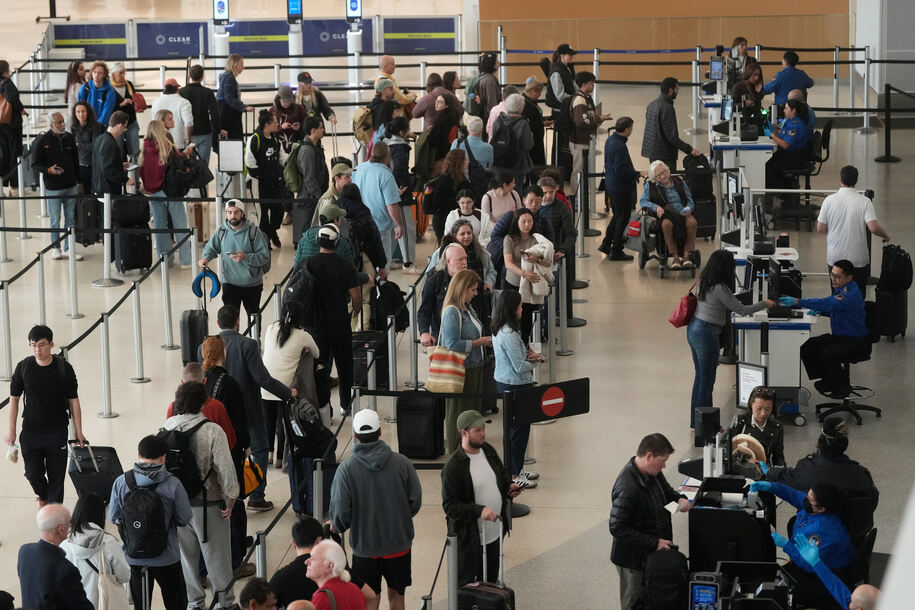
Thought flying during a government shutdown couldn’t get any worse? Think again.
The Federal Aviation Administration is preparing to cut flight capacity by up to 10% at 40 of the nation’s busiest airports—a move that could ground thousands of flights per day.
A display shows several flight delays at Newark Liberty International Airport on May 5.
The Trump administration announced the plan Wednesday, stating that it’s intended to ease the strain on unpaid air traffic controllers as the GOP’s shutdown enters its second month.
Transportation Secretary Sean Duffy said the new restrictions will take effect Friday morning, though sources told ABC News that they could start as early as Thursday.
And now, the airports and cities set to be hit the hardest are coming into focus.
The complete list of affected airports includes:
- Anchorage International
-
Hartsfield-Jackson Atlanta International
-
Boston Logan International
-
Baltimore/Washington International
-
Charlotte Douglas International
-
Cincinnati/Northern Kentucky International
-
Dallas Love
-
Ronald Reagan Washington National
-
Denver International
-
Dallas/Fort Worth International
-
Detroit Metropolitan Wayne County
-
Newark Liberty International
-
Fort Lauderdale/Hollywood International
-
Honolulu International
-
Houston Hobby
-
Washington Dulles International
-
George Bush Houston Intercontinental
-
Indianapolis International
-
New York John F Kennedy International
-
Las Vegas McCarran International
-
Los Angeles International
-
New York LaGuardia
-
Orlando International
-
Chicago Midway
-
Memphis International
-
Miami International
-
Minneapolis/St Paul International
-
Oakland International
-
Ontario International
-
Chicago O’Hare International
-
Portland International
-
Philadelphia International
-
Phoenix Sky Harbor International
-
San Diego International
-
Louisville International
-
Seattle/Tacoma International
-
San Francisco International
-
Salt Lake City International
-
Teterboro
-
Tampa International
The impacts extend from coast to coast, affecting the nation’s largest air travel hubs and signaling major disruptions ahead. It’s still unclear whether the list is final. The FAA hasn’t issued a public order outlining the details of its restrictions, and a spokesperson declined to respond to Daily Kos’ request for comment, citing a lapse in funding that halted routine media responses.
“As Secretary Duffy has said, there have been increased staffing shortages across the system. When that happens, the FAA slows traffic into some airports to ensure safe operations,” a spokesperson said.
Transportation Secretary Sean Duffy
But in a separate comment to Politico, another FAA official said, “We haven’t put anything out. Nothing is official.”
“I’m not aware in my 35-year history in the aviation market where we’ve had a situation where we’re taking these kinds of measures,” FAA Administrator Bryan Bedford said Wednesday. “Then again, we’re in new territory in terms of government shutdowns.”
Bedford’s remark came just a day after President Donald Trump pressed Senate Republicans to scrap the filibuster—a move he argued would break the stalemate. It laid bare what’s been obvious for weeks: The shutdown—and the havoc it’s wreaking—is the result of political choices, not circumstance.
According to The Washington Post, Bedford insisted that air travel is safe but that internal data and pilot reports show growing fatigue among air traffic controllers.
“We are starting to see some evidence that fatigue is building in the system in ways that we feel we need to work towards relieving some of that pressure,” he said.
Duffy was more blunt.
“There’ll be frustration. But in the end, our sole role is to make sure that we keep this airspace as safe as possible,” he said.
Related | Air travel will be ‘really rough,’ warns guy in charge of that
The reductions will begin at around 4% on Friday and ramp up to 10% in the coming days, mostly affecting flights between 6 AM and 10 PM—the busiest hours of the day. International routes will be exempt.
Bedford said that the decision was driven by safety data and concerns about fatigue, not politics.
“This is not based on light airline travel locations,” he said. “This is about where the pressure is and how to really deviate the pressure.”
The move follows Duffy’s warning earlier this week that parts of U.S. airspace could be forced to shut down entirely if the impasse continues.
“If you bring us to a week from today, Democrats, you will see mass chaos,” he said Tuesday, blaming Congress for the lack of a deal.
But airlines are now scrambling to adjust.
United Airlines said that long-haul international and hub-to-hub routes won’t be affected, and that customers will be eligible for refunds even on nonrefundable tickets. American Airlines said that it’s awaiting guidance from the FAA but expects that the “vast majority” of passengers won’t see major disruptions. Southwest Airlines also said that the “vast majority” of its customers won’t be affected but joined others in urging Congress to end the impasse.
A United Airlines flight lands in Newark, New Jersey, on Nov. 6.
Both Bedford and Duffy stressed that the move is a proactive measure, not a reaction to an existing safety issue.
“We’re not going to wait for a safety problem to truly manifest itself when the early indicators are telling us we can take action today,” Bedford said.
Still, with air traffic controllers and Transportation Security Administration officers among the nearly 700,000 federal employees working without pay, the pressure is mounting.
What’s worse, White House press secretary Karoline Leavitt confirmed Wednesday that Trump is aware of the FAA restrictions but hasn’t signaled any plans to change course.
It’s unclear how long the plan will remain in place or whether it will impact Thanksgiving travel, one of the busiest times of the year. Last year, more than 3 million passengers were screened by TSA agents on the Sunday after Thanksgiving. This year, air traffic controllers and TSA agents will have been working without pay for more than eight weeks, raising the risk of more delays and employees calling out of work.
Flying is about to get even worse and more hectic—and right ahead of the holidays, with no end in sight for the GOP’s shutdown.
