

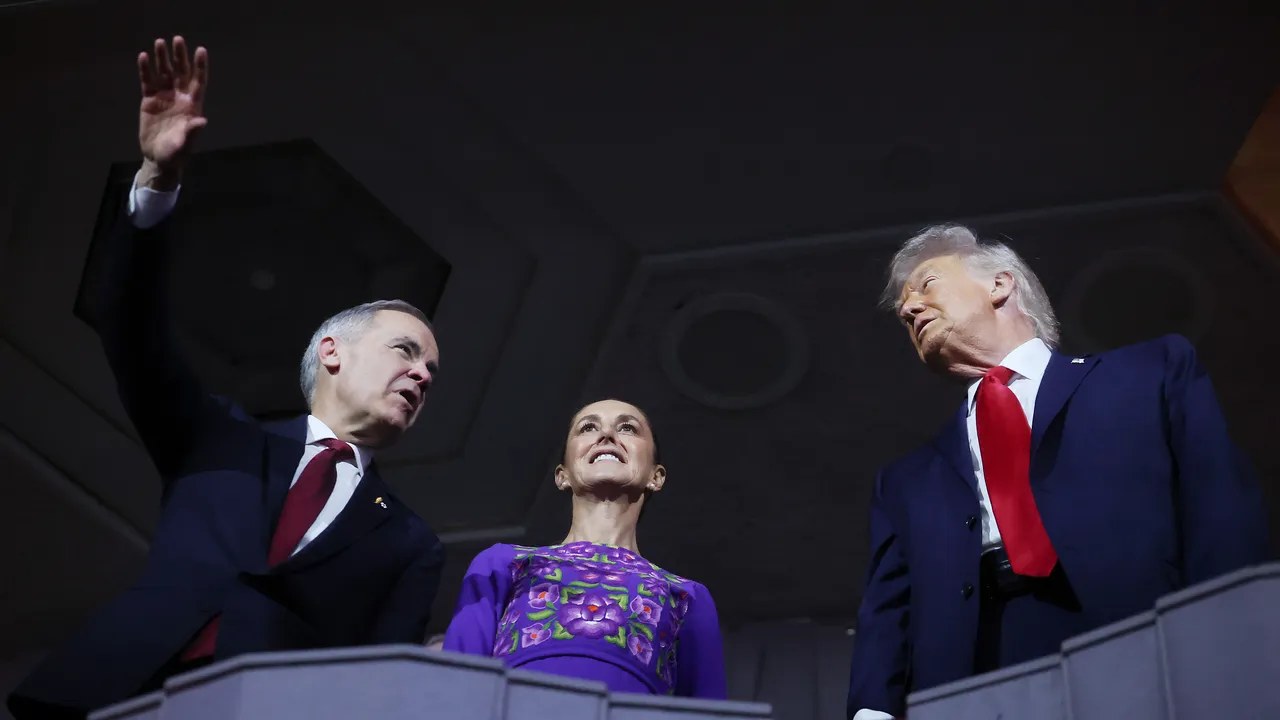
The negotiations that remade the North American Free Trade Agreement were, as one participant put it, a series of “near-death” experiences. For more than a year, starting in 2017, envoys from the United States, Canada, and Mexico met to determine the future of a trade alliance worth trillions of dollars. They clashed over everything from labor laws to the minutiae of duty-free imports, while repeatedly deflecting President Donald Trump’s threats to withdraw from the agreement. In the fall of 2018, they were finally prepared to sign what came to be known as the United States-Mexico-Canada Agreement. First, though, they needed to decide how long the accord should last.
NAFTA was what is called a “forever deal”—as with all of America’s major trade agreements, its terms were permanently fixed. This frustrated Trump’s trade czar, Robert Lighthizer, who believed that NAFTA had resulted in thousands of job losses and a ballooning trade deficit. Lighthizer wanted the U.S.M.C.A. to have an escape hatch: a review mechanism, or perhaps a fixed term. So he proposed that the agreement expire after four years.
In his book, “No Trade Is Free,” Lighthizer described his offer as “an aggressive opening bid.” Mexican and Canadian officials thought that it was insane: no business would expose its investments to a deal that could end so quickly. Even prominent Republicans expressed opposition. But Lighthizer found an ally in Jared Kushner, Trump’s key adviser on Mexico. Kushner had come to see trade negotiations as a game of mutual bluffing; the key to success, in his view, was getting your counterparts to “believe you are going to jump off a cliff.”
On August 25, 2018, Kushner invited Mexico’s foreign minister, Luis Videgaray, to his home in the upscale Washington, D.C., neighborhood of Kalorama. As he recalled in his own memoir, “Breaking History,” negotiators were scheduled to meet the next morning, and both sides were short on time: the Americans were eager to send the agreement to Congress before the midterm elections, and the Mexicans needed to reach a deal before a new President came into office.
Kushner made a proposal that he had cleared with Lighthizer. The agreement would remain in place for sixteen years, but, after six years, the countries would convene for a review. “If the parties agreed to an extension,” Kushner suggested, “the term of the agreement would reset for another sixteen years.” If they disagreed, “a ten-year termination clock would start to tick.” Videgaray left after midnight, having agreed to consult with the Mexican President, Enrique Peña Nieto.
In the morning, everyone gathered in Lighthizer’s office, across from the White House. “Let me share a proposal,” Kushner began—a theatrical gesture, since Trump and Peña Nieto had already been briefed on the plan. By the meeting’s end, negotiators had agreed to include a review mechanism, ending more than a year of gruelling talks. Soon, Trump stood in the Rose Garden, hailing the U.S.M.C.A. as “the most modern, up-to-date, and balanced trade agreement in the history of our country.”
For Mexican officials, one of the keys to accepting the deal was that the review would be triggered after six years rather than four: they predicted that Trump would serve two consecutive terms and leave office before the deadline came. In the meantime, they reasoned, the treaty would shield their nation’s economy from a hostile Administration. They turned out to be wrong. Trump returned to the White House four years later than expected, and the review of the U.S.M.C.A. is scheduled for next July, just seven months away. In Trump’s second term, his protectionist agenda has been even more aggressive and erratic than before. Most indications suggest that what will take place between now and the summer is less a review of America’s crucial trade relationships than a wholesale renegotiation.
In the years since the U.S.M.C.A was signed, Mexico and Canada have become America’s top trading partners. Millions of jobs depend on this economic alliance, which exceeds $1.8 trillion in trade. Officials are already shuttling between their various capitals for conversations about what the parties might get from it.
As the talks got under way, I sat down with Ildefonso Guajardo Villareal, a former secretary of the economy who led Mexico’s negotiations of the U.S.M.C.A. during his term. A short, dapper man of sixty-eight, Guajardo has been involved in every major trade accord that Mexico has signed since NAFTA. He built a reputation as a fearsome negotiator, once praised by Kushner for his ability to spin “technical issues into unsolvable deal-breakers.” Now he seemed pleased to be out of the fight. “I’ve got a trip coming up to Palm Beach,” he told me, in an airy cafeteria in Mexico City.
