

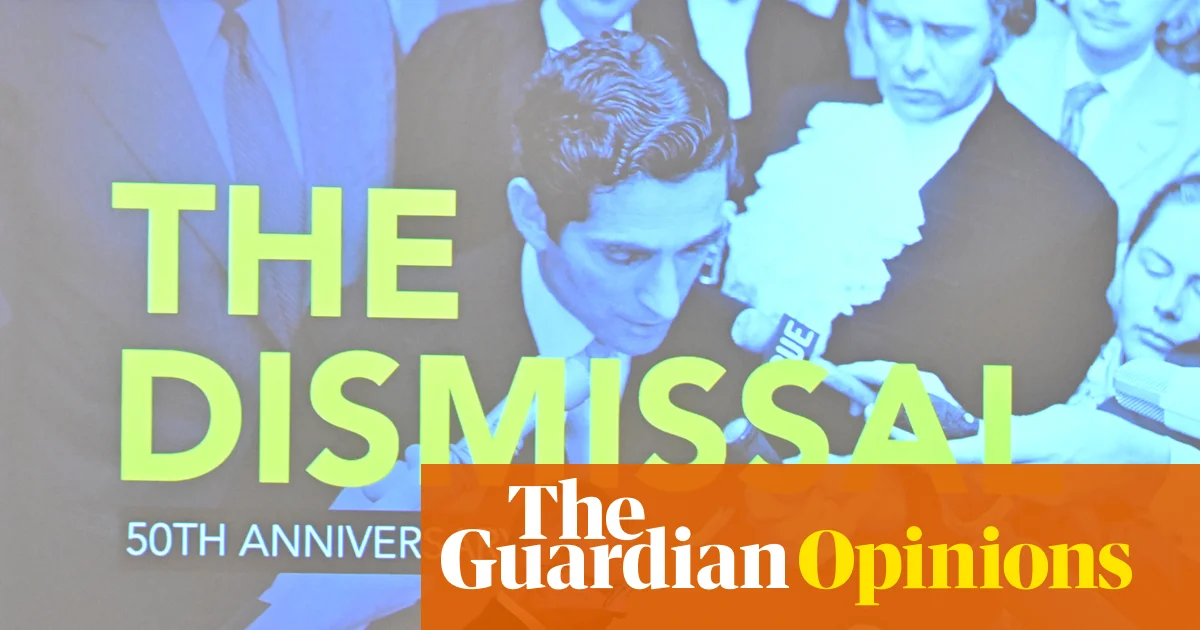
I’m too young to have been an eyewitness to the dismissal, but the memory of Dad coming home from Trades Hall pissed off and two parts shot and telling nine-year-old me to watch the telly because “this is important” was my introduction to politics.
In the lead-up to Tuesday’s 50th anniversary of our bloodless coup, I’ve been immersing myself in footage from that day, reflecting on what the great man would have made of the current government that carries his flame.
Whitlam’s removal after less than three years in office by the crown (amid suspicion of deeper US involvement which persists to this day) has shaped Labor in two contradictory ways: the resilience of his ambition and the danger inherent in pursuing such grandeur.
It would be unfair to say the Hawke-Keating government that followed eight years later lacked vision; their economic reforms were bold albeit aligned to the dominant force of neoliberal globalisation, tempered by a self-moderation born of the perceived overreach of the Whitlam project.
After the Rudd-Gillard-Rudd governments imploded with Whitlamesque drama, it’s tempting to see the Albanese government as an inheritor of the Hawke-Keating mantle. Indeed, this year’s election cast Labor as the party of stability in a time of global chaos.
But there are also echoes of Whitlam that reverberate deep in this government’s DNA, anchored by a prime minister who served his apprenticeship to Tom Uren, another larger-than-life figure who survived the Thai-Burma railway to become a key minister under Gough.
The Medicare card that was Albo’s constant companion through the election campaign has a living through-line to Whitlam, who created the universal health system that is so central to our national identity and the envy of much of the world.
The majority women in the Albanese government may stand in stark contrast to paucity of women in Whitlam’s (there wasn’t a single elected woman until 1974), but his recognition via equal pay and no-fault divorce, modelled through his partnership with the formidable Margaret, are the genesis of that cultural shift.
I’ve been thinking about Whitlam as I observe the current government’s struggle to navigate what could be the most consequential technological challenge since the 1970s: the rapid diffusion of artificial intelligence.
The latest Guardian Essential Report reinforces that this change is happening fast, with particularly younger Australians integrating AI into their work, their broader lives and even their relationships.
How this technology may (or may not) be regulated is currently an open question, with industry and tech boosters pushing for a hands-off approach, while unions, advocates and the broader public seek a more rules-based framework.
Given his career predated the Commodore 64, I’m not expecting Gough to give much guidance when it comes to the actual design of AI policy, but I do think the broader approach to such a big challenge could be informed by some Whitlamite values.
We can start with Gough’s assertion of Australia’s independence embedded in his recognition of China and scepticism of US imperialism (how he would view Aukus is another hypothetical which we don’t have space to pursue here).
In echoes of that cold war environment, US tech companies are driving the current acceleration doctrine, framing it as a race with China for which any regulatory restraint is an unnecessary handicap.
But much like the post-Vietnam environment, this is creating a false binary. Indeed, there are elements of the China approach in terms of scale and control of the AI models that are more sustainable and conducive to global cooperation.
Whitlam would also have come at the issue as a humanist rather than simply an economist. He would have eschewed the industry’s dubious modelling on productivity and he would have balanced that by a critical analysis of its impact on our national identity.
As a leader of the cultural renaissance, Gough would have chafed against AI’s theft of material to train its models to repurpose and replicate the work of artists, musicians and writers.
While the Albanese government has rejected the industry’s push to override copyright law to mine creative work, there are still unanswered questions on the ongoing damage of these crimes that need to be reconciled.
Finally, Whitlam would see Australia not as a taker of other nations’ technology but as a shaper – to quote his government’s 1974 white paper – “guided along paths coincident with the needs, aspirations and attitudes of an informed and expectant society”.
Just as he imagined energy self-sufficiency, I suspect Whitlam would champion indigenous AI models that serve purposes other than the maximisation of shares price built on the erasure of jobs and culture.
I’m not pretending that history has all the answers to the technological tsunami we face (and anyone who does is probably using Chat GPT), but I do know that to get the right answers we need to make sure we ask the right questions.
Fifty years on, Gough offers a way to frame these questions around his assertion of an independent nation, confident of its place in the world, determined to project its unique voice in the service of Australians.
Peter Lewis is the executive director of Essential, a progressive strategic communications and research company that undertook research for Labor in the last election and conducts qualitative research for Guardian Australia. He is the host of Per Capita’s Burning Platforms podcast
