

The Dutch vote is under way
Jakub Krupa
Voting is under way in a knife-edge parliamentary election in the Netherlands that polls suggest could again be won by the far-right Freedom party (PVV) of Geert Wilders, although there is little chance of it being part of the next government.
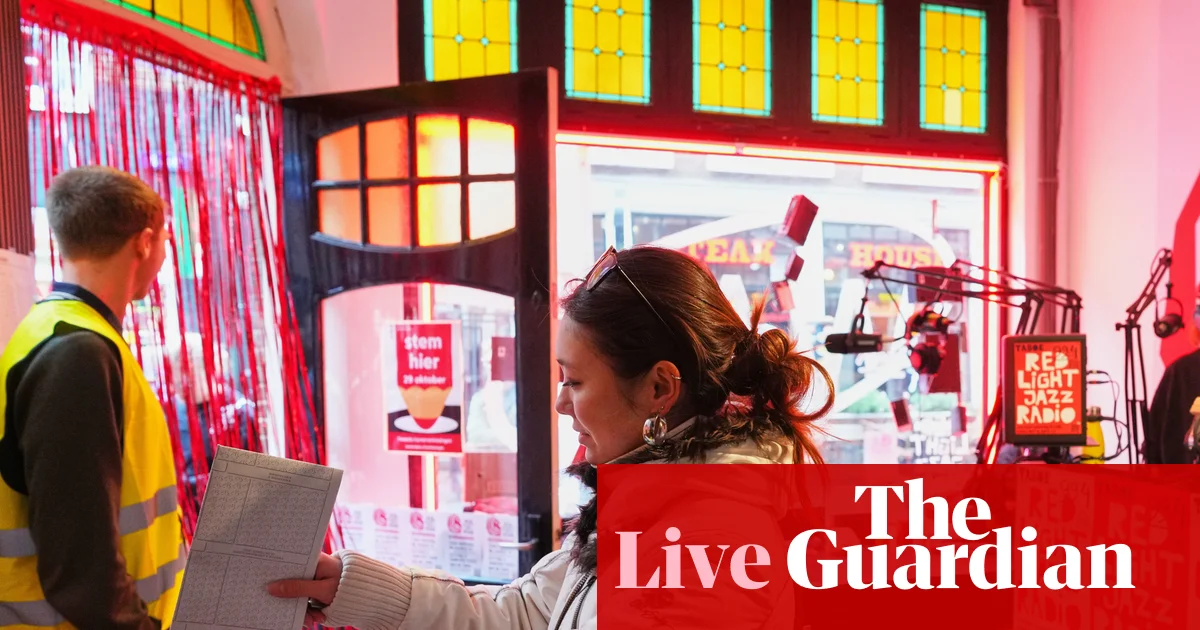
A person casts a vote at the cafe De Boterwaag decorated for Halloween, during the Dutch parliamentary election, in The Hague, Netherlands. Photograph: Yves Herman/Reuters
Final polling averages suggest Wilders’ party could win between 24 and 28 seats in the 150-seat parliament, well down on the 37 it captured in the 2023 elections. Even if it does finish first, all major parties have ruled out going into government with the anti-immigration firebrand.
We will be following closely the polling day in the Netherlands, with the Guardian’s Senay Boztas on the ground in Amsterdam, and will bring you the exit poll later tonight, as well as first reactions to the vote.
It’s Wednesday, 29 October 2025, it’s Jakub Krupa here, and this is Europe Live.
Share
Key events
Show key events only
Please turn on JavaScript to use this feature
Migration dominated electoral campaign with hardened rhetoric even from moderate parties
Jon Henley and Senay Boztas in Amsterdam
Migration has once again dominated the campaign, with many moderate parties hardening their rhetoric. Demonstrations have turned violent, including protests outside asylum-seeker hostels and rioting in The Hague.
A police car is set on fire during a protest against the current asylum policy on the Malieveld, in the Hague, the Netherlands in September. Photograph: Josh Walet/EPA
But even if Wilders, who argues that the Netherlands should refuse all asylum requests and use the army to guard its borders if necessary, does finish first, which is not certain – the PVV could lose up to a third of its current 37 seats – he is likely to be shut out of government.
The outgoing PVV-dominated government is seen by voters as one of the most ineffective in recent Dutch history, failing to deliver on its key promise of introducing Europe’s toughest immigration regime and tackle a dire national housing shortage.
The parties forecast to make the biggest gains – the centre-right Christian Democrats (CDA), which polls show may surge to 22 seats from five, and liberal-progressive D66, on track for 23 from nine – are those that have called loudest for a return to “responsible” government.
ShareJakub Krupa
The Anne Frank House is not the only unusual place where voters can cast their votes today.
The Dutch Vogue has a list of 11 special locations, including a children’s zoo in Amsterdam, the marine museum in Rotterdam, the miniature park in The Hague.
And yes, of course you can vote at a windmill …
Voters arrive at a polling station in the Kerkhovense Molen, a windmill in Oisterwijk, the Netherlands. Photograph: Rob Engelaar/EPA
… or, more precisely, inside their shop.
Voters in the Kerkhovense Mill in Oisterwijk, the Netherlands. Photograph: Hollandse Hoogte/ShutterstockShare
‘Fight against fascism begins with queue,’ voters at Anne Frank House say
Senay Boztas
in Amsterdam
“The fight against fascism begins with a queue,” said voters at the Anne Frank House polling booth in Amsterdam.
A queue snaked around the corner – not just to visit the museum where the Jewish diarist hit from the Nazi occupiers, but to vote in the current Dutch election (the get free entry to the museum afterwards!).
“I’m voting here against fascism,” said one voter, drily.
Voters standing in line to vote at the Anne Frank House museum, where the young diarist hid from the Nazi occupiers during the second world war. Photograph: Senay Boztas/The Guardian
Some said they did not dare to hope for too much change.
“I think it’s very important to vote,” said a women who gave her name as Désirée. “There is a lot that has gone wrong in recent years… but as things look now, the biggest party [then] is still the biggest party, one that has given very little in the past and undermines the rule of law.”
Mark de Bruin, 54, a lifelong Amsterdammer, was standing in the queue to vote and visit the museum for the first time.
“The last few years have been a total mess – to my great sorrow,” he said.
“If I see the current party leaders, there’s far more expertise there than we’ve had recently in government. I think [the PVV] will be smaller than in previous elections, because a lot of people see that they simply can’t govern. But it will certainly remain a factor in the opposition – although I’d rather that they were on the bench for two years. They will torpedo everything that comes along.”
Annemar Renzema, 24, from Friesland and a student in Amsterdam, said it was very important to vote, although she did not want to think too much about the result.
“Thinking about it makes me feel a bit unsettled,” she said. “We’ll see. I’m not happy [with the recent direction of politics] and that’s why I think it’s so important to make my voice heard.
“I’m 24 and I want to have a chance to buy a house; I’m a student and for me it’s important that the interest on student loans goes down. And more than that, it’s about women’s rights and social rights. I just hope that things will go a little better with us as human beings, and with each other.”
ShareSenay Boztas
in Amsterdam
The voting paper is as big as a bath towel – I’m amazed more people don’t get it wrong.
People in a polling booth at the polling station in Amstenrade Castle. Photograph: Hollandse Hoogte/ShutterstockPeople cast their votes for the House of Representatives elections at the Kunstmuseum. Photograph: Hollandse Hoogte/ShutterstockShareJakub Krupa
Speaking of “blank” votes and protests, you will be pleased to know that the electoral authority has provided a very detailed handbook on what will count as a “blanco,” and what will make the vote valid or invalid.
19,655 voters cast “blanco” votes in 2023 (0.19%), just below 22,822 (0.22%) who casted invalid votes.
So, if you want to make sure the vote is counted as a blank, it literally has to be, well, blank. If you write anything on it, even if it’s ‘I want this to be a blank vote,’ it moves it to the invalid category.
Guidance from the Dutch Electoral Commission on casting the votes in the 2025 parliamentary election. Photograph: Dutch Electoral Commission
You can, however, draw a smiley face without invalidating the ballot, but you just need to make sure there isn’t anything there that identifies you personally (so don’t sign it!).
Guidance from the Dutch Electoral Commission on casting the votes in the 2025 parliamentary election. Photograph: Dutch Electoral Commission
This and all other – some very amusing – scenarios are covered here.
Share
Updated at 10.36 EDT
Senay Boztas
in Amsterdam
There was an interesting interview with a Dutch taxi driver on NPO Radio 1 earlier, who characterised his job as “modern slavery,” working all hours to make ends meet, and has totally lost faith in democracy.
He will vote ‘blanco’ – an empty ballot as a sign of protest.
“They never asked us if we wanted a global economy. It’s a moving train and it doesn’t stop… Sinterklaas [St Nicholas] doesn’t exist but nor does democracy,” he said.
People vote during the Dutch parliamentary election in The Hague, Netherlands. Photograph: Piroschka Van De Wouw/ReutersShare
Lunchtime turnout marginally lower than in 2023
Early turnout estimates by Ipsos-I&O are so far marginally lower than in previous years, suggesting 27% of the electorate voted by 1.45pm local time.
It was 28% in 2023, and 33% in 2017. 2021 was a slightly different story, as the polls were open for three days, during the Covid pandemic.
We will be keeping an eye on that headline turnout figure later – it was 77.7% in 2023.
ShareSenay Boztas
in Amsterdam
Dutch broadcaster NOS ran a story earlier today telling people “best chances of dry voting are in the morning.”
Why is it relevant? PVV voters, for example, don’t always bother to vote and have little faith in democracy in general.
People walk past a banner leading them to the nearest polling station during general elections in Maastricht, Netherlands. Photograph: Ermindo Armino/AP
Bart Koenen, senior researcher at Verian, working on political polling thinks a higher turnout could benefit the PVV. But, he added:
“There are a lot of PVV voters who, in reality, when it’s bad weather on Wednesday, look outside and say: ‘Oh no, I’m not going to vote.’”
For what it’s worth, it’s now early afternoon, and the skies are darkening a bit …
Share
So what could the new government look like?
Jon Henley
Given the highly fragmented state of Dutch politics, what coalitions are actually possible is just as important as who finishes first (or in this case, more likely, second, since no major party will govern with Wilders, who insists he wants to lead a minority government).
Just look at the size of the polling card! Photograph: Piroschka Van De Wouw/Reuters
After the election, MPs first appoint an informateur, who seeks out possible alliances. Once a viable coalition has been found, a formateur, usually the head of the largest potential partner, begins negotiating the formal coalition agreement. It can take months.
Multiple options look plausible, most involving a mix of parties from the centre-left and moderate right. The most likely, according to the CoalitionChecker website, include CDA and GL/PvdA, plus D66 and one or more smaller parties potentially including JA21.
Share
Key players and main issues in the Dutch snap poll
Jon Henley
If you fancy a quick reminder of who are the key players and what’s at stake in the Dutch election, we have got this helpful explainer for you, by our Europe correspondent Jon Henley.
Dutch far-right Party for Freedom (PVV) leader Geert Wilders speaks to journalists earlier this month. Photograph: Olivier Matthys/EPA
The early legislative elections were triggered by the collapse in June of the 11-month-old government after the far-right firebrand Geert Wilders pulled his Freedom party (PVV) out of an already fractious and highly ineffectual ruling coalition.
The PVV had finished a shock first in the last election in late 2023 and after more than six months of talks formed a fragile four-party rightwing coalition with the populist Farmer-Citizen Movement (BBB), centrist New Social Contract (NSC) and liberal-conservative VVD.
Wilders’ partners, however, considered him too toxic for the job of prime minister, which went to a former intelligence chief, Dick Schoof. Wilders, an anti-immigration polemicist who has lived under police protection for two decades, resorted to sniping from the sidelines.
He pulled the plug on 3 June after the partners refused to adopt a radical 10-point anti-immigration plan that included enlisting the army to patrol the borders, turning back all asylum seekers, closing most refugee hostels and sending home all Syrian refugees.
While support for the PVV has dipped, polls suggest the far-right, anti-Islam party is again likely to win the most seats in parliament. However, the main Dutch political formations have all ruled out entering into a formal coalition with Wilders.
At least 16 parties are forecast to enter parliament but none to win more than about 20% of the vote.
As ever, the next Dutch government, generally an influential player on the EU and world stage, will emerge only after coalition negotiations that could last months.
There are 150 MPs in the Dutch parliament, meaning a government needs 76 seats to form a majority. No single party ever manages this, and the Netherlands has been governed by coalitions for more than a century.
Share
The Dutch vote is under way
Jakub Krupa
Voting is under way in a knife-edge parliamentary election in the Netherlands that polls suggest could again be won by the far-right Freedom party (PVV) of Geert Wilders, although there is little chance of it being part of the next government.
A person casts a vote at the cafe De Boterwaag decorated for Halloween, during the Dutch parliamentary election, in The Hague, Netherlands. Photograph: Yves Herman/Reuters
Final polling averages suggest Wilders’ party could win between 24 and 28 seats in the 150-seat parliament, well down on the 37 it captured in the 2023 elections. Even if it does finish first, all major parties have ruled out going into government with the anti-immigration firebrand.
We will be following closely the polling day in the Netherlands, with the Guardian’s Senay Boztas on the ground in Amsterdam, and will bring you the exit poll later tonight, as well as first reactions to the vote.
It’s Wednesday, 29 October 2025, it’s Jakub Krupa here, and this is Europe Live.
Share
