

This article is an on-site version of our FirstFT newsletter. Subscribers can sign up to our Asia, Europe/Africa or Americas edition to get the newsletter delivered every weekday morning. Explore all of our newsletters here
Good morning. In today’s newsletter we’ll be covering:
-
The US’s Ukraine-Russia peace plan
-
Vanguard’s warning to Wall Street
-
Saudi obstruction at COP30
-
And the dark truth behind supermarket tuna
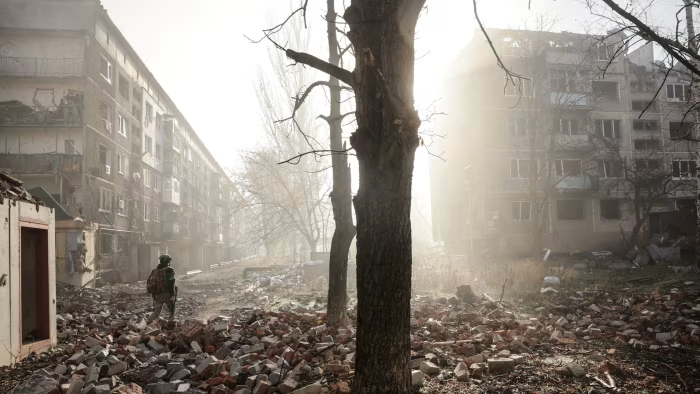
The US is urging Ukraine to accept a peace deal that would ban any future expansion of Nato, create a US-Russia investment vehicle using frozen Russian assets and force Kyiv to cede land currently under its control.
What we know: The 28-point plan, drafted by Russian and American officials, gives just one line on security guarantees for Ukraine, which has been a key demand of Ukrainian President Volodymyr Zelenskyy.
The deal would limit the size of Ukraine’s armed forces to 600,000 personnel — down from 900,000 currently — and turn the Donetsk region into a demilitarised zone formally considered part of Russia.
Moreover, the plan would allow Moscow back into the G8 group of nations, ending the country’s years of international isolation following the forced annexation of Crimea in 2014 and its full-scale invasion of Ukraine in 2022. You can read the full terms here.
Ukrainian officials said the White House had exerted intense pressure on them to accept the deal, which the US expected to be signed “before Thanksgiving” next Thursday, they added. A senior US official described the plan as a “working document” that could still change. European capitals are rushing to co-ordinate a response.
Here’s what else we’re keeping tabs on today and over the weekend:
-
Oval Office face-off: US President Donald Trump will play host to New York City mayor-elect Zohran Mamdani today.
-
Economic data: S&P Global flash purchasing managers’ index data for Eurozone, France, Germany, UK and US. US October state employment data.
-
COP30 climate summit: The conference in Brazil is scheduled to end today, although participating countries remain strongly divided on the route forward.
How well did you keep up with the news this week? Take our news quiz.
Five more top stories
1. Trump agreed to attend Davos in January after organisers gave assurances that overtly “woke” topics — including female empowerment and diversity, the green transition, climate change and international development finance — would not feature prominently on the agenda, people familiar with the matter said.
2. The US will not ‘punish’ Taiwan’s best-in-class semiconductor industry with high tariffs, a Taiwanese minister has said. Instead, Taipei will support the development of the US chip industry under the terms of a trade deal the island nation is seeking to finalise, he added.
3. Wall Street is underpricing robust artificial intelligence-driven growth and anticipates too many interest rate cuts from the US Federal Reserve as a result, Vanguard has warned.
4. UN secretary-general António Guterres suggested Saudi Arabia was leading moves to obstruct key outcomes at COP30, according to people present at meetings with EU negotiators. Saudi blocking, Guterres alluded to in other bilateral meetings, could lead this year’s talks to fail.
5. President Cyril Ramaphosa claimed the US had “a change of mind” over its boycott of South Africa’s G20 summit, after the Trump administration said it would send a diplomat to the closing session. Washington justified the boycott on the false claim that white Afrikaners were being “slaughtered” in South Africa, and said the official “will attend the handover ceremony as a formality” but would not participate in discussions.
Visual investigation
© FT composite
Migrant crews from Indonesia, the Philippines and Africa form the backbone of the tuna industry. Many endure brutal conditions at sea. In this stunning visual investigation, workers describe violations in two Western Pacific fisheries that supply major retailers. Read more on the dark truth behind supermarket tuna.
We’re also reading . . .
-
The UAE’s next attraction: An upcoming mega resort is fuelling an investment boom in a corner of the United Arab Emirates. (Just don’t call it a casino.)
-
AI fears: European and Asian stocks slumped this morning after yesterday’s US equity sell-off.
-
Power move: Japan has approved the restart of the world’s largest nuclear reactor to address rising energy costs, more than a decade after it was closed in the wake of the Fukushima disaster.
-
Fall from grace: Former US Treasury secretary Lawrence Summers’ reputation lies in tatters after the US Congress released his email correspondence with the late sex offender Jeffrey Epstein.
Map of the day
The Trump administration has moved to designate Venezuela’s “Cartel of the Suns” — a crime syndicate allegedly led by President Nicolás Maduro — as a foreign terrorist organisation. US officials say the group is responsible for trafficking narcotics across the globe. Read FT Latin America editor Michael Stott’s explainer on the group.
Take a break from the news . . .
Chief foreign affairs commentator Gideon Rachman picks a range of political tomes for the Friday instalment of the FT’s best books of the year series. Click here to see his must-read titles.
