

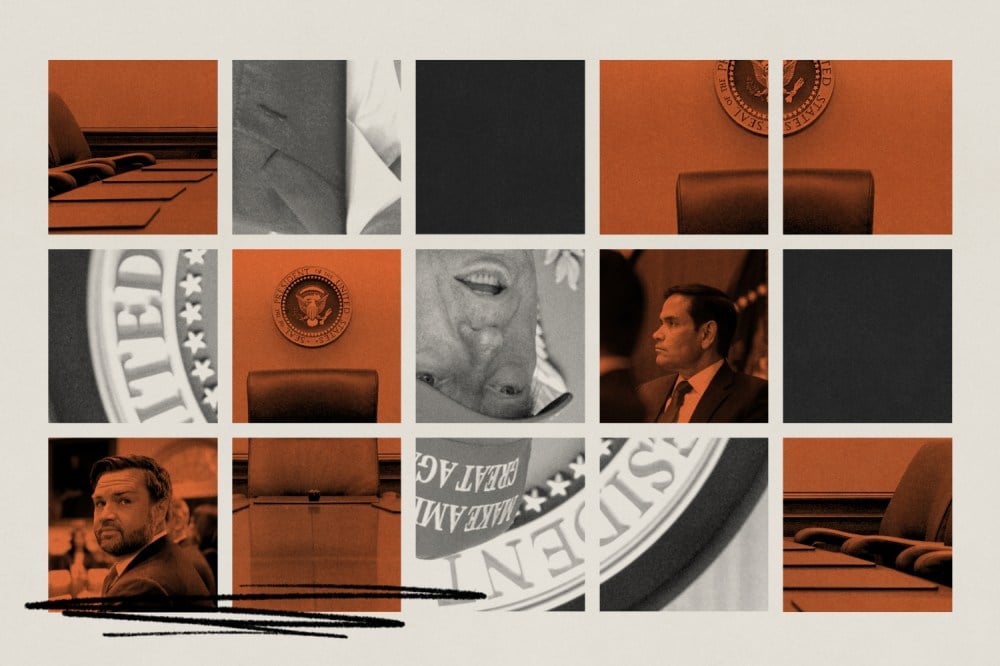
The past few years have created something of an existential crisis for the U.S. foreign-policy community. A series of big blunders—the invasions of Iraq and Afghanistan, regime change in Libya—have led many Americans to question the expertise of U.S. foreign-policy practitioners. Some have argued that President Donald Trump’s two election victories in 2016 and 2024 were populist vindications of the notion that presidents do not need to listen to experts as much as their guts.
But most international relations scholars were skeptical of the policy miscues listed above—and said so in public. In one 2004 survey of U.S. academics, just 15 percent reported backing Washington’s move to go to war in Iraq the year prior—a level of support much lower than among the general public. It was policy practitioners who too often ignored scholars’ warnings.
The past few years have created something of an existential crisis for the U.S. foreign-policy community. A series of big blunders—the invasions of Iraq and Afghanistan, regime change in Libya—have led many Americans to question the expertise of U.S. foreign-policy practitioners. Some have argued that President Donald Trump’s two election victories in 2016 and 2024 were populist vindications of the notion that presidents do not need to listen to experts as much as their guts.
Inside the Situation Room: The Theory and Practice of Crisis Decision-Making, ed. Hillary Rodham Clinton and Keren Yarhi-Milo, Oxford University Press, 512 pp., .99, September 2025
Inside the Situation Room: The Theory and Practice of Crisis Decision-Making, ed. Hillary Rodham Clinton and Keren Yarhi-Milo, Oxford University Press, 512 pp., $29.99, September 2025
But most international relations scholars were skeptical of the policy miscues listed above—and said so in public. In one 2004 survey of U.S. academics, just 15 percent reported backing Washington’s move to go to war in Iraq the year prior—a level of support much lower than among the general public. It was policy practitioners who too often ignored scholars’ warnings.
The fact that scholars have failed to move the U.S. policymaking needle highlights how desperately both communities must bridge the gap between them. Inside the Situation Room: The Theory and Practice of Crisis Decision-Making, edited by Keren Yarhi-Milo, the dean of Columbia University’s School of International and Public Affairs (SIPA), and former Secretary of State-turned-SIPA professor Hillary Rodham Clinton, is the latest attempt to get international relations scholars and policymakers to talk to each other.
In their introduction, Clinton and Yarhi-Milo promise that readers will better understand two key areas: “first, how the findings from the literature on crisis decision-making in international relations can help advance our understanding of recent successes and failures in U.S. foreign policy; and second, how the experiences of practitioners who have been involved in crisis situations can support or challenge theories in academic scholarship about how leaders think.”
Clinton and Yarhi-Milo assembled their contributors with care. The academic side includes chapters by some of the brightest minds in international relations—including Rose McDermott on the role of emotions, Elizabeth Saunders and Jessica Weeks on public opinion, and Austin Carson on covert action. All those chapters are accessible summaries of the academic state of knowledge for those readers who need a refresher on essential literature.
On the policymaker side, luminaries such as British politician Catherine Ashton and U.S. diplomat Dennis Ross contribute chapters about their foreign-policy experiences. The practitioner roster is bipartisan, with Democratic stalwarts such as Clinton and former Defense Secretary Leon Panetta contributing alongside Ambassador John J. Sullivan and National Security Advisor Robert O’Brien, who offer perspectives from their service in the first Trump administration.
A group of government officials gather closely around a conference table in a small briefing room.
U.S. President Barack Obama, Vice President Joe Biden, Secretary of State Hillary Clinton, and members of the national security team receive an update on the mission against Osama bin Laden in the White House Situation Room in Washington on May 1, 2011.Pete Souza/The White House via Getty Images
These policy practitioners’ recounting of their national security greatest hits—negotiations for the Iran nuclear deal, planning for the Osama bin Laden raid, the killing of Islamic State leader Abu Bakr al-Baghdadi, and the attempted deterrence of Russia’s invasion of Ukraine—mostly make for engaging and thoughtful reads. There are also some spicy details; for example, it seems clear from his contribution that O’Brien is no fan of former Defense Secretary Mark Esper.
Inside the Situation Room is a noble effort at bridging the academic-policymaker gap, and the editors have recruited an excellent set of contributors. Unfortunately, the resulting book also highlights the absurdity of conducting this exercise right now—and the challenges of doing it for the future.
Reading through the book’s chapters, it was difficult not to conclude that the gap between scholars and practitioners still exists. As someone who has edited more than one volume in my day, I know how difficult it can be to get authors to incorporate insights from other chapters. In this instance, however, the lack of engagement is a tell in and of itself.
For example, Carson’s chapter on covert action is useful, but it does not really engage with either Panetta’s chapter on the hunt for bin Laden or O’Brien’s chapter on the killing of Baghdadi. Similarly, neither Panetta nor O’Brien engage with Carson’s chapter. The same is true when examining Saunders and Weeks’ scholarly chapter the role of public opinion and former Deputy Secretary of State Victoria Nuland’s practitioner chapter on the same topic. While all these sections are worth reading, the participating authors seem to be talking past each other.
This problem is exacerbated by the contradictions contained within the practitioner chapters. For example, both Panetta and O’Brien acknowledge that they excluded the White House chief of staff when planning their covert operations targeting bin Laden and Baghdadi, respectively. But this contradicts Nuland’s suggestion in her chapter that political advisors should be included in policy deliberations. Unfortunately, none of the more academic chapters wrestle with this conundrum.
A group of senior government and military officials sit around a large conference table, the presidential seal of is visible on the wall behind them.
In a handout image, U.S. President Donald Trump, Vice President Mike Pence, and other advisors monitor updates on the killing of Islamic State leader Abu Bakr al-Baghdadi in the White House Situation Room on Oct. 26, 2019.Shealah Craighead/The White House via Getty Images
A specter is haunting this book—that of Robert Jervis, a legendary scholar and former SIPA professor who passed away nearly four years ago. Clinton and Yarhi-Milo acknowledge Jervis as the inspiration for Inside the Situation Room. Jervis was the rare scholar whom practitioners took seriously; he was the person the CIA called on to assess prominent intelligence failures, such as its failure to foresee the 1979 Iranian Revolution. Through both his scholarship and his personal network, Jervis was able to influence how policymakers framed their foreign-policy decisions.
Ironically, while many of the scholarly ideas contained in Inside the Situation Room have value, their progenitors lack Jervis’s formidable reputation. At the moment, he has no successor.
There is another unspoken bias in the topics Clinton and Yarhi-Milo chose for this edited volume: a bias for action. Inside the Situation Room primarily covers proactive policies by the United States that shaped the global environment, such as covert action or high-stakes negotiations.
To be sure, acts of coercion, covert action, backchannel diplomacy, and high-level summitry are crucial components of foreign policy. All too often, however, foreign-policy crises are exercises in rapid reaction rather than preemption—instances in which another actor in international relations precipitates a situation and U.S. officials have no choice but to react in real time.
It would have been interesting for Clinton and Yarhi-Milo to include chapters on the crisis response to the 2012 attack on the U.S. consulate in Benghazi, Libya, for example, or the follow-up to Hamas’ Oct. 7, 2023, attacks on Israel. By their sins of omission, the editors fail to acknowledge that a large fraction of U.S. foreign policy amounts to damage control.
This article is featured in the FP Weekend newsletter, a curation of our best book reviews, deep dives, and other reads that take a step back from the drumbeat of the news. Get the lineup directly every Saturday.
This article is featured in the FP Weekend newsletter, a curation of our best book reviews, deep dives, and other reads that take a step back from the drumbeat of the news. Get the lineup directly every Saturday.
Sign Up
By submitting your email, you agree to the Privacy Policy and Terms of Use and to receive email correspondence from us. You may opt out at any time.
Enter your email
Sign Up
Loading…
Unfortunately, reading Inside the Situation Room during the second Trump administration is also a cruel exercise in absurdity. For example, Carson’s advice about the need for secrecy with respect for covert action is sound—it’s just too bad that he failed to mention the stupidity of using Signal to communicate operational military details. Nuland’s remarks about the need for the executive branch to notify members of Congress during any military action is grimly amusing given the current administration’s delays in briefing the legislative branch on its airstrikes on alleged drug boats in the Caribbean.
The chapter by Jennifer Klein, Rebecca Turkington, Melanne Verveer, and Rachel Vogelstein emphasizing the necessity of including women in crisis decision-making is well taken, but to this administration it will sound like an exercise in DEI and therefore be ignored. Reid Pauly and Jessica Chen Weiss’ chapter on coercion is chock full of sharp advice for practitioners, serving as a pointed reminder that the Trump administration’s lack of constancy renders it incapable of coercing its way out of a paper bag.
All the chapters stress the need for the sober analysis of actionable intelligence—which may come as a surprise to an administration determined to politicize it. Watching the Trump administration bumble its way through various foreign-policy crises makes it painful to read advice that, in more competent hands, might be put to good use.
Inside the Situation Room will not bridge the gap between scholars and policymakers during the second Trump administration. But aspiring policymakers should keep it on hand for when—or if—they get a chance to pick up the foreign-policy pieces come January 2029.
