

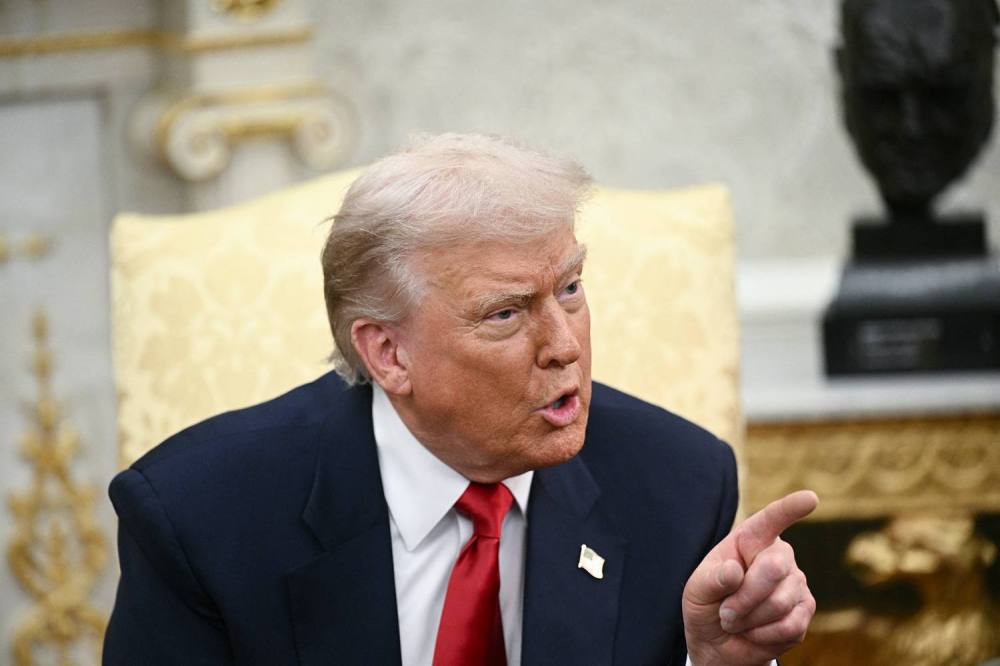
U.S. President Donald Trump has a long and well-documented history of launching incendiary rhetorical attacks against the press and his political opponents. But rights groups warn that the president’s anti-free speech crusade reached an alarming and dangerous new level this week, raising grave concerns about the potentially rippling consequences for reporters and freedom of expression more generally.
Since last Friday alone, U.S. President Donald Trump called a female reporter “piggy,” lambasted another reporter for questions that she asked during his meeting with Saudi Crown Prince Mohammed bin Salman, and appeared to endorse the idea that congressional Democrats should be executed over public statements they made encouraging U.S. troops to uphold their oath to the Constitution and refuse any unlawful orders.
U.S. President Donald Trump has a long and well-documented history of launching incendiary rhetorical attacks against the press and his political opponents. But rights groups warn that the president’s anti-free speech crusade reached an alarming and dangerous new level this week, raising grave concerns about the potentially rippling consequences for reporters and freedom of expression more generally.
Since last Friday alone, U.S. President Donald Trump called a female reporter “piggy,” lambasted another reporter for questions that she asked during his meeting with Saudi Crown Prince Mohammed bin Salman, and appeared to endorse the idea that congressional Democrats should be executed over public statements they made encouraging U.S. troops to uphold their oath to the Constitution and refuse any unlawful orders.
“President Donald Trump’s comments this week marked a new low for an administration that has routinely shown contempt for the truth or facts. Berating and demeaning journalists for doing their job—asking questions—is the action of a playground bully not a head of state. It is not ‘frankness,’ as Karoline Leavitt argued, it is behavior meant to intimidate, humiliate and demean,” Jodie Ginsberg, the CEO of the Committee to Protect Journalists, told Foreign Policy.
“Smearing journalists creates an environment in which others feel free to harass and attack them and makes all reporters less safe,” Ginsberg said. “News organizations and politicians on all sides of the political spectrum should be denouncing such actions loudly.”
During Trump’s meeting with Mohammed bin Salman at the White House on Tuesday, the U.S. president called ABC News’s Mary Bruce a “terrible reporter” and “insubordinate” for asking the Saudi leader a legitimate question about the brutal murder of Washington Post journalist Jamal Khashoggi. While taking issue with other questions that Bruce asked, Trump also threatened ABC’s broadcast license in addition to lobbing insults at her.
A declassified U.S. intelligence assessment released under the Biden administration concluded that Mohammed bin Salman had approved the operation that led to Khashoggi’s killing and dismemberment at the Saudi consulate in Istanbul in October 2018.
Though Khashoggi once had close ties with the Saudi royal family, he eventually went into self-imposed exile after he began to publicly criticize the crown prince’s policies, including his approach to the war in Yemen. Khashoggi’s killing sparked outcry around the world and was seen as an egregious assault on freedom of the press. Along these lines, Bruce asked Mohammed bin Salman, who was visiting Washington for the first time since 2018, why Americans should trust him.
Trump, who has previously bragged about shielding the crown prince from retribution over Khashoggi’s killing, jumped in to answer the question and once again stood by the Saudi leader. Contradicting the U.S. intelligence finding on the matter, Trump said Mohammed bin Salman “knew nothing” about Khashoggi’s killing. Trump went on to denigrate Khashoggi, calling him “somebody that was extremely controversial” and saying that a “lot of people didn’t like” him, before brushing off his killing by saying, “Things happen.”
While the insults that Trump has hurled toward journalists in recent days are part of a pattern of behavior that should not be ignored, Ginsberg said that the president’s “assertion that Prince Mohammed had nothing to do with the murder of reporter Jamal Khashoggi—directly contradicting his own intelligence service findings— is even more chilling.”
“It shows contempt for the facts, not just those who seek to uncover and report them,” Ginsberg added.
Similarly, the National Press Club said in a statement that it was “deeply troubled” by Trump’s remarks on Khashoggi’s murder while emphasizing that for reporters around the globe, statements from powerful leaders such as the president “that appear to minimize or excuse the killing of a journalist have real-world consequences” and can “embolden those who wish to silence reporters.”
In another attack on freedom of expression, Trump this week appeared to endorse violence against a group of congressional Democrats who released a video urging members of the U.S. military and intelligence community to disobey unlawful orders.
“This administration is pitting our uniformed military and intelligence community professionals against American citizens,” the lawmakers said in the video, which came at a time when Trump’s immigration crackdown and deployment of U.S. troops in major cities face legal challenges and public pushback.
Trump, who railed against the video in posts on Truth Social, said it was “seditious behavior, punishable by DEATH!” The president, who in recent months has accused the left of inciting political violence in the United States following the assassination of Charlie Kirk, also reshared posts from Truth Social users suggesting that these Democrats should be hanged.
Though the White House denied that Trump was calling for lawmakers to be executed, and the president said on Friday that he was not “threatening death,” his comments have raised serious alarm.
“The President of the United States just called for Democratic members of Congress to be executed,” Democratic Sen. Chris Murphy wrote on X. “If you’re a person of influence in this country and you haven’t picked a side, maybe now would be the time to pick a fucking side.”
Meanwhile, congressional Republicans have been fairly muted in their reaction to Trump’s attacks on Democrats this week. House Speaker Mike Johnson defended Trump, stating that he was responding to “wildly inappropriate” behavior from Democrats. Sen. Rand Paul of Kentucky was more critical, stating that he doesn’t think it’s “a good idea to talk about jailing your political opponents or hanging them or whatever else.” Paul said that political disagreements should be worked out “in a political way.”
“That kind of rhetoric isn’t good and it stirs up people among us who may not be stable who may think well ‘traitors,’ what do we do with traitors? It’s the death penalty. Maybe I’ll just take matters into my own hands, which is not something we should be encouraging,” Paul said.
Advocacy groups have also spoken out. Steady State, an organization of former U.S. national security professionals, excoriated Trump and said that the message sent by the Democratic lawmakers was “not radical” but rather a clear and calm reflection on the limits of presidential authority and the “obligations of all who swear an oath to the Constitution.”
The group noted that it is long-standing U.S. military doctrine that troops must refuse to obey unlawful orders—a principle that was established in the Nuremberg trials of Nazi leaders after World War II.
“Accusing elected Members of Congress of ‘treason’ or ‘insurrection’ for restating binding military law, misinforms the public, endangers the professional ethics of the armed forces, signals that lawful restraint is now treated as partisan, and creates incentives for abuse of the chain of command. The United States has long relied on a military that is apolitical, professional, and governed by law. Undermining those norms risks real and lasting damage,” Steady State wrote.
The White House did not immediately respond to a request for comment.
