

Unlock the Editor’s Digest for free
Roula Khalaf, Editor of the FT, selects her favourite stories in this weekly newsletter.
The writer is co-founder and chief economist of Gavekal
There is nothing mysterious about the Office for Budget Responsibility’s predictions of a UK productivity slump revealed this week and its expected consequences for the Budget. The roots of the problem are clear.
Britain enjoyed the fastest growth of GDP per head, the broadest measure of productivity and living standards, among the Group of Seven major advanced economies between 1992 and 2016 and it outpaced the US and other G7 economies even more emphatically from 1992 to 2008. Since 2016, however, Britain’s per capita GDP growth has slumped, still marginally above Germany’s but well below all other countries in the group, including Italy, France and Japan.
Why this sudden collapse? Until this question is convincingly answered there can be little hope of restoring Britain’s economic prospects or rebuilding the fiscal basis for a properly functioning welfare state.
The great financial crisis in 2008 and the Brexit referendum in 2016 are obvious causes of Britain’s economic decline, but blaming these irreversible events is an unproductive distraction. More useful is to ask why the financial crisis harmed Britain so much more than other countries and why Brexit magnified this damage to the extent it did.
Unfortunately, three of the most plausible explanations are almost unmentionable in Britain’s present political debate, which focuses instead on irrelevant panaceas such as railway and airport investment that have little or no bearing on productivity growth. US productivity is far higher than Britain’s, despite the appalling state of US infrastructure.
The first politically incorrect explanation for the enduring damage to Britain from the financial crisis and Brexit is simply that global finance and pan-European services are the economic activities in which the country has the clearest comparative advantage. These two sectors were the main growth engines of the productivity golden age that followed the creation of the EU single market in 1993.
In today’s Britain, by contrast, global finance has become a pejorative term and bankers are still labelled “greedy”, fomenting opposition to any expansion of finance. The politics of European integration has become almost equally controversial since the Brexit referendum, disadvantaging other major sectors where Britain had a clear comparative edge: pan-European business services, culture, education and scientific research.
A second political transformation has magnified and entrenched the damage to UK productivity from Brexit and the 2008 crisis: a cross-party agreement to finance the expansion of the welfare state by taxing “the rich”, while reducing the contribution from “ordinary working people”. This fiscal transformation happened mainly under the Conservatives, perhaps with the subliminal intention of ultimately bankrupting the welfare state.
The result has been a paradox at the heart of Britain’s budgetary problems: while the share of total taxation in GDP is now at its highest level since the 1940s, the rate of income tax and national insurance paid by “ordinary working people” earning average earnings is the lowest in postwar history, according to Tax Policy Associates. As a result, the top 1 per cent of UK taxpayers accounted for 29 per cent of income tax receipts in 2023-24, compared with 11 per cent in 1978-79, according to Institute for Fiscal Studies data.
This shift in tax burdens may or may not be socially desirable, but it obviously discourages the expansion of industries that pay very high salaries: not just international finance and business services, but also technology, pharmaceuticals, media and other high-productivity sectors.
The third neglected explanation for Britain’s productivity problem is the most important in the present budgetary context: a necessary condition for strong productivity is decent economic growth. If demand is crushed by overzealous efforts to control borrowing by raising taxes in a weakening economy, productivity growth becomes impossible — and public finances just lurch from crisis to crisis.
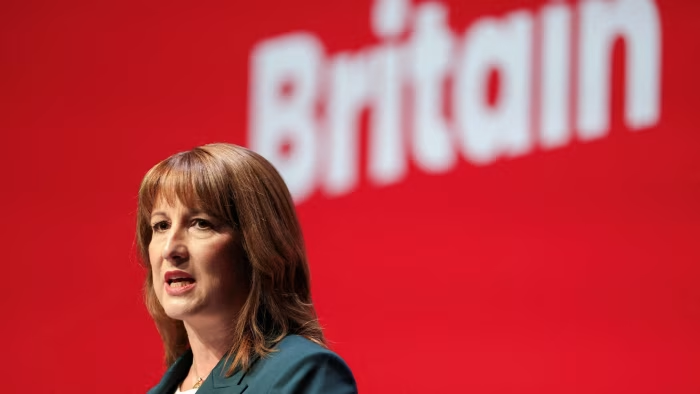
All of which suggests a conclusion for this month’s Budget. Chancellor Rachel Reeves is doomed if her fiscal rules crush economic growth in the short-term and damage productivity in the long-term. The alternative is to encourage short-term growth and the expansion of high-productivity sectors by avoiding immediate tax rises and instead legislating now for an increase in the standard rate of income tax from 2028 or 2029, the only revenue source large and reliable enough to maintain the confidence of bond investors.
The key to restoring both fiscal sustainability and productivity growth is to expand Britain’s most competitive businesses instead of relentlessly taxing their owners and employees, while recognising that a universal welfare state can only be financed in the long run by taxes on “ordinary working people”.
