

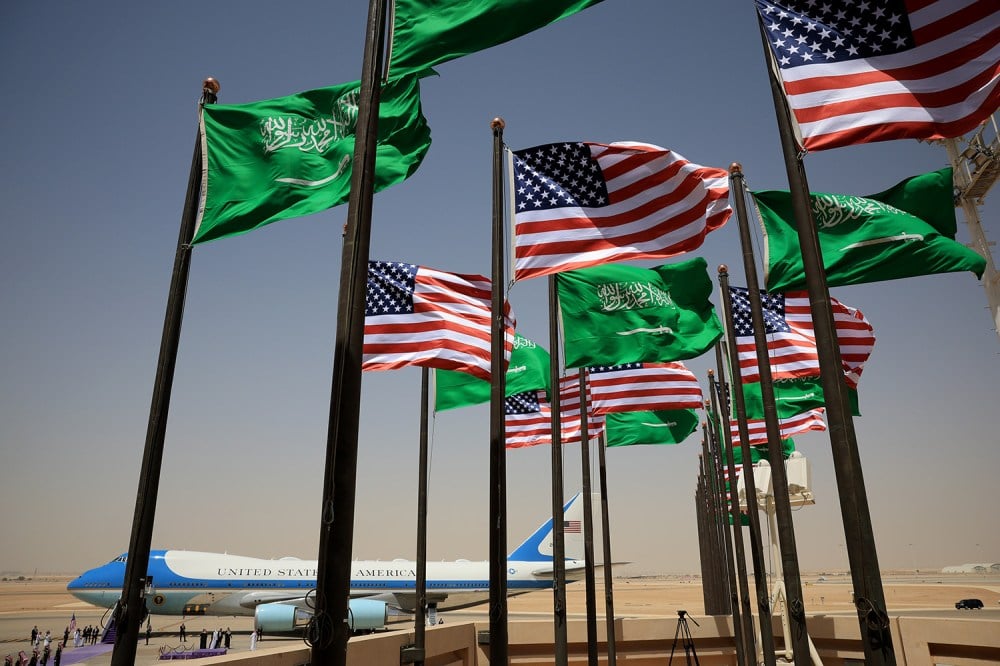
The rehabilitation of Saudi Arabia’s Mohammed bin Salman from global pariah to global patron is one of the most extraordinary political feats of our time. This week, the crown prince will triumphantly return to Washington after nearly a decade of banishment. He is expected to dole out $600 billion in promised investments in U.S. companies and, as part of this exchange, obtain a long-desired security guarantee from the United States. This may well be a great deal for the corporations that stand to benefit from the lavish shopping spree, but it remains a raw and risky deal for the American people, who will be stuck with the bill.
In the aftermath of the 2018 murder of DAWN founder Jamal Khashoggi by Saudi operatives, Mohammed bin Salman faced global sanctions and isolation. Corporate executives pulled out of Riyadh investment conferences, official state visits were suspended, and megadeals with the Saudi government were canceled. The Trump administration sanctioned 17 of those involved in the murder in November 2018.
The rehabilitation of Saudi Arabia’s Mohammed bin Salman from global pariah to global patron is one of the most extraordinary political feats of our time. This week, the crown prince will triumphantly return to Washington after nearly a decade of banishment. He is expected to dole out $600 billion in promised investments in U.S. companies and, as part of this exchange, obtain a long-desired security guarantee from the United States. This may well be a great deal for the corporations that stand to benefit from the lavish shopping spree, but it remains a raw and risky deal for the American people, who will be stuck with the bill.
In the aftermath of the 2018 murder of DAWN founder Jamal Khashoggi by Saudi operatives, Mohammed bin Salman faced global sanctions and isolation. Corporate executives pulled out of Riyadh investment conferences, official state visits were suspended, and megadeals with the Saudi government were canceled. The Trump administration sanctioned 17 of those involved in the murder in November 2018.
So far had the country’s reputation sunk that former U.S. President Joe Biden campaigned on promises to end weapons sales to the “pariah” kingdom with “very little social redeeming value.” In February 2021, the Biden administration’s Office of the Director of National Intelligence made public its investigation, concluding that Mohammed bin Salman had, indeed, ordered Khashoggi’s murder. It simultaneously announced a new sanctions regime, the so-called Khashoggi Ban, to punish acts of extraterritorial repression and designated 76 of the crown prince’s agents for their role in the murder, prohibiting them from traveling to the United States—though it deliberately avoided sanctioning Mohammed bin Salman himself. The administration promised, once again and at long last, to pivot to Asia, withdraw from heavy engagement in the Middle East, and end the catastrophic military entanglements there, from Iraq to Afghanistan and Yemen.
Yet within two years, the Biden team returned to business as usual, unwilling to risk losing Saudi Arabia as its most valuable arms client or U.S. hegemonic influence in the Gulf. It also had a taste of Saudi leverage, with deeply unpopular hikes in gas prices ahead of the 2022 U.S. midterm elections. In July 2022, Biden returned to Saudi Arabia, with the notorious fist bump seen around the world, to mend relations with Mohammed bin Salman, begging him to increase Saudi oil output and promising to water down the U.S. weapons ban to include only “offensive” weapons.
By the time U.S. President Donald Trump returned to power, the crown prince’s rehabilitation was already fairly complete. In contrast to Biden, Trump has been explicit and forthright about the transactional nature of the relationship, built on commercial alignment: U.S. military protection in return for Saudi capital commitments.
Much has changed for the better in Saudi Arabia, but many of the country’s worst aspects remain the same. The government has ushered in unprecedented social liberalization and largely ended enforced gender segregation, resurrecting Mohammed bin Salman’s title as a “reformer.” The government has abolished most of the facets of the “guardianship” system that reduced women to perpetual minors, requiring them to obtain a male guardian’s permission for the most basic life decisions, such as getting a job, opening a bank account, or renting an apartment. Saudi youth can now go to concerts, restaurants, and shopping malls unhindered by religious police. It’s also undertaken many overdue reforms for migrant workers in the country, allowing them to change jobs after completing their contracts and to leave the country without their employer’s permission.
What hasn’t changed is the country’s government: an absolute dictatorship under a single, completely unaccountable leader. Saudis cannot participate in any sort of democratic process to choose or change their representatives. They cannot protest or criticize Mohammed bin Salman or the government for policy failures, unless they want to be charged with terrorism and face decades in jail. There’s no codified criminal law in the country, so coming before a judge is a dice roll: The law is whatever the judge says it is, and so is the punishment, as 322 executions in 2025 to date—the majority of them of foreign nationals—attest. There is most certainly no accountability, not for Khashoggi’s killing, the ongoing detentions of activists, or the devastation of Yemen.
Critical to Saudi Arabia’s global rehabilitation, however, are not the rave concerts and art galleries that Saudis can now enjoy but the strategic deployment of Saudi capital. The country’s Public Investment Fund, with more than a trillion dollars in assets, has poured hundreds of billions of dollars into an extremely diverse pool of U.S. financial, entertainment, sports, gaming, agriculture, oil, gas, water, and technology sectors—from acquiring LIV Golf and artificial intelligence defense start-ups to eye-watering, lucrative deals with the Metropolitan Opera, women’s tennis, and even America’s raunchiest, most irreverent comedians. While many have described these extravagant purchases as exercises in reputation-washing, they are more accurately seen as levers of influence and control in the U.S. economy that will make it extremely difficult to see U.S. businesses walk away from Saudi Arabia again. What started as employment and business deals with recently resigned government officials, now including deals with family members of Trump himself, have made it much harder for the U.S. government to distance itself from the kingdom as well.
What Saudi Arabia’s deployment of capital has also brought within reach is the long-sought golden prize of a U.S. security guarantee—and a bonus of F-35 fighter jets, to date reserved only for Israel in the Middle East. Riyadh will not land a treaty-backed guarantee, thanks to the Israeli government’s blowing up any possibility of an Abraham Accord with the kingdom—the earlier price tag for such a solid commitment. But it’s widely expected that it will obtain a security commitment at least equal to Qatar’s, with a promise from Trump to commit U.S. troops to defend the country should it come under attack. Israel’s bombardment of Qatar means Saudi Arabia now likely has more interest in deterring an Israeli attack than an Iranian one, increasing the cost burden to the United States of any Israeli belligerence. The trade will also include Saudi promises to exclude China from major weapons projects in the country and to purchase U.S. weapons for the foreseeable future.
The U.S. beneficiaries of such a deal would no doubt include the businesses profiting from Saudi lucre, but the costs—military, diplomatic, and moral—would be borne by the American public, including the U.S. soldiers who would be expected to risk their lives to save the Saudi royal family. This is not strategy, nor has the Trump administration offered any security justification for expanding, not shrinking, U.S. military commitments in the Middle East, despite his promises for an America First foreign policy.
Supporters of a security pact argue that Mohammed bin Salman has matured—that the era of the reckless war in Yemen, the Qatar blockade, and the Ritz-Carlton detentions is behind him. But a system without accountability does not evolve simply because its ruler grows older. A formal defense commitment would tie U.S. strategic decisions to the judgment of a single leader who is unbound by legal, electoral, or institutional restraints and has shown himself to be impulsive, reckless, and brutal.
That is not a stabilizing arrangement. It is an invitation to be drawn into future conflicts Washington neither chooses nor controls, indeed, encouraging a sense of Saudi impunity. The core risk is structural: Saudi Arabia would gain protection, and the United States would gain obligation. The American people deserve a critical examination of the nature of this proposed pact. It does not advance U.S. security interests. It does not promote regional de-escalation. And it does not encourage reform inside the kingdom. What it does is further normalize a U.S. political economy in which state power defends capital rather than citizens and foreign policy becomes a tool for private advantage, subsidized by the American public.
