

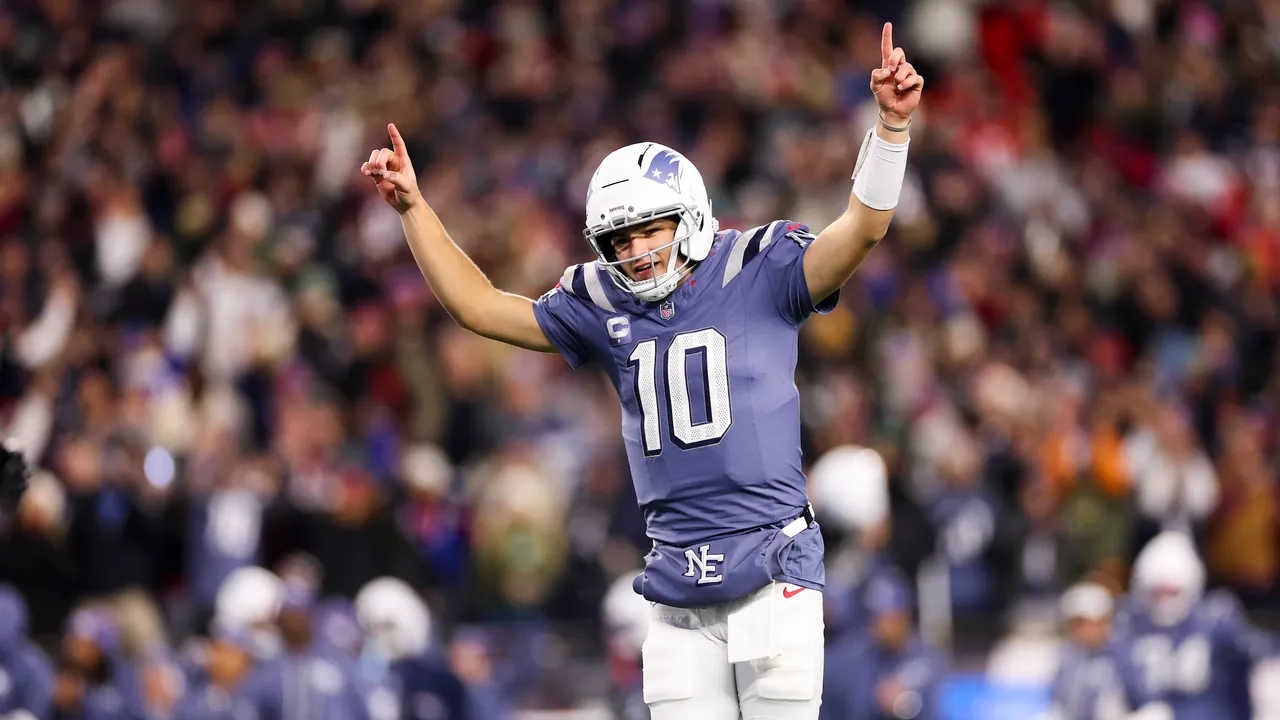
But there were signs during that win against the Dolphins that this year might be different. Maye completed nineteen out of twenty-three passes, for two hundred and thirty yards, throwing for two touchdowns and rushing for another. The game’s real highlight, though, came at the end, when the running back Antonio Gibson returned a kick ninety yards for a score—and Vrabel chased him along the sideline in excitement. When was the last time anyone in New England looked like they were having fun?
Since the loss to the Steelers, the Patriots have won eight straight. They’re atop the A.F.C. East, with a good chance to secure a first-round bye in the playoffs. On Thursday, at home, they avoided an embarrassing loss to one of those New York teams, the Jets—a trap game if ever there was one. What stood out most was what now seems unremarkable: the quarterback playing up to increasingly lofty expectations, serenaded by chants of “M.V.P.!” Maye threw fewer of the spectacular deep throws that he has become known for, but that was a sign of growth: he seemed content to take the yardage that was given to him; nothing was forced. He completed his first eleven pass attempts of the night, and even after cooling off didn’t turn the ball over once. Again and again, he showed how well he can move, dodging pressure and sliding through danger to find open receivers, whether it meant making difficult throws over the middle while on the run or taking the quick out.
But about those deep throws! Nothing has brought life back to Foxborough like the rocketing spirals Maye has been launching downfield. Last season, New England ranked thirty-first in explosive-pass rate, or how often a play gains at least twenty yards. They were thirtieth in that metric the season prior. Now Maye is considered one of the best in the league at long throws, Diggs is having a resurgence, and the team has developed a few of its other receivers into deep-ball threats. There is no doubt that the culture in New England has changed. Vrabel has a tradition of greeting each player on the way to the locker room after games, and the coaches are quick to praise the players. (This was not Belichick’s forte.) The players, for their part, deflect the praise; they speak about one another with delight and awe. The team seems to have found that elusive balance of confidence and calm, accountability and community, which characterizes many excellent teams. There appears to be a willingness to take big risks on the basis of trust.
Where does that trust come from? Sports narratives inevitably have a teleological dimension. Once the ending is known, everything that leads up to it seems to be instruments of that end. In a well-sourced account of the Patriots’ renaissance in the Substack Go Long last month, the football journalist Tyler Dunne noted that, shortly after Vrabel became head coach, he discovered trash in the sauna and dirty washcloths littering the floor of the locker room. He immediately instructed the players to treat their workplace, and the people who cleaned it, with respect. The players understood that the point wasn’t simply civility. It was winning. “If you want to win, you do the small things,” the running back Antonio Gibson said. Dunne’s story was full of details like that. In Dunne’s telling, Josh McDaniels isn’t an asshole; he’s the perfect coach for a hungry and talented young quarterback. Vrabel’s smashmouth style isn’t old-school brutality but necessary toughness. The cultural shift is oriented around the team’s newfound success.
Maybe so. Vrabel is right: respect really does begin at home. Different personalities mesh differently, and what doesn’t work in one situation might be just the thing in another. Maye seems to be thriving under the guidance of McDaniels, whose mastery of the Patriots’ offense has never been in doubt. “It’s fun to be in the headset with him,” Maye said recently, of McDaniels.
It’s also undeniable that the Patriots have had an unusually easy schedule, and perhaps they look great because they’re playing weak opponents. Through eleven games, the teams they have beaten have a combined record of 30–54, and the Patriots have the easiest remaining schedule in the N.F.L. In fact, one measure pegs the Patriots’ schedule as the third-easiest in the N.F.L. since 1978. Clearing the sauna of debris might not have been instrumental, after all. And if a few things had gone in another direction, if a few loose balls thrown by Maye on Thursday night had been intercepted, or if Antonio Brown hadn’t outrun the Dolphins and the Patriots had begun the season 0–3, some stories—such as the one about how Vrabel emerged from a preseason brawl between the Patriots and the Washington Commanders with a bloody face—might sound a little different. Maye has been having a fantastic season. He might really win M.V.P., but he’s been sacked more than any other quarterback (among qualified starters) except one, and over all the Patriots offense has been middling. Take away a few of those thrilling plays, and we might be telling a different story.
But what’s true of negative-feedback loops is also true of positive ones. Encouragement becomes courage. Luck starts to seem like fate. For years, the Patriots couldn’t catch a break. Then came Brady—the hundred-and-ninety-ninth pick in the draft—and the team’s fortunes changed entirely. Losers become winners, until the cycle repeats itself. ♦
