

In September 2025, tens of thousands of young protesters poured into the streets of Kathmandu and stormed Nepal’s Parliament. They were furious about entrenched corruption and opposed recent attempts to clamp down on free speech and dissent through a social media blackout. Although the authorities killed numerous demonstrators, the uprising forced the resignation of Nepalese Prime Minister K. P. Sharma Oli and the installation of an interim government. Nepal, however, is only the latest example of a broader trend in South Asia. In 2024, a youth-led uprising ended the 15-year rule of Sheikh Hasina as prime minister of Bangladesh. Sri Lanka witnessed repeated waves of mass demonstrations, most dramatically in 2022, resulting in the ouster of a corrupt government. And in the Maldives, discontent over corruption, democratic backsliding, and polarizing foreign entanglements have led to similar protests demanding political change.
The uprisings across the region stem from domestic grievances, but that isn’t the whole story. For years, India has embraced the notion that it is the world’s largest democracy. It has championed liberal values and accepted the role—bestowed by the United States—of the Indo-Pacific’s democratic linchpin. Yet when it comes to dealings in its own neighborhood, India has often behaved in decidedly illiberal ways, propping up autocratic regimes and meddling in the affairs of other sovereign countries. New Delhi has treated democratic ideals and human rights as expendable whenever its own strategic interests are at stake.
The United States, wary of alienating its key Indo-Pacific partner, rarely challenges India on how it manages its backyard. In 1979, U.S. President Jimmy Carter announced that the United States would defer to India in most matters to do with South Asia. Every U.S. administration since has echoed that policy of deference. New Delhi has propped up neighboring governments by bankrolling them, lobbying the West on their behalf, or deploying its security forces. In return, Washington has often stayed silent about any indiscretions it sees, retreating from the promotion of democracy when such an effort might clash with India’s preferences.
As a result, smaller countries in South Asia view India as a regional hegemon, empowered to manipulate domestic politics with U.S. approval. This fuels resentment toward India and mistrust of the United States, catalysts for the kind of violent popular overthrow that has marked the subcontinent in recent years. Tellingly, the protesters in Nepal’s September uprising angrily confronted Indian TV crews, associating them with the country’s political crisis. This resentment not only threatens India but also creates fertile ground for the spread of Chinese influence. As South Asian publics have pushed back against governments closely aligned with New Delhi, Beijing has asserted itself, courting new regimes with loans and military hardware and stressing respect for their sovereignty.
South Asia’s slide toward China has real consequences for Washington. As disillusioned governments draw closer to Beijing, the United States risks losing both influence and credibility in the region. This moment of flux calls for a reassessment of the U.S. relationship with New Delhi and the pursuit of a more balanced approach to South Asia—one that engages smaller neighbors as independent partners, not simply as appendages of India.
“INDIA OUT!”
Nowhere has the contradiction between India’s ostensible democratic principles and its support for autocrats been more glaring than in Bangladesh. For over a decade, India backed Hasina and her party, the Awami League, even as her rule grew more autocratic and as she retained power through controversial elections in 2014, 2018, and 2024. New Delhi’s support enabled Hasina to undermine democratic institutions, politicize the judiciary and Election Commission, and enforce repressive laws such as the Digital Security Act, which limited free speech online and allowed arbitrary arrests and detentions of opponents of the regime.
Hasina’s government helped India meet critical security objectives—notably, dismantling networks of anti-Indian insurgents that operated out of Bangladesh—and in return, India bolstered Bangladesh’s authoritarian security apparatus. New Delhi provided diplomatic protection to the Rapid Action Battalion (RAB), an elite Bangladeshi counterterrorism force that targeted opposition politicians, activists, and journalists. According to a 2023 report from Human Rights Watch, millions of Bangladeshis faced political persecution during Hasina’s tenure, including arrests, prosecution, and violence. Indian officials frequently defended the actions of her government, insisting that it was a pillar of regional stability and a bulwark against terrorism. But New Delhi remained notably silent on the subject of domestic repression.
Public resentment toward India surged in response. In early 2024, the India Out movement flared, with widespread protests, boycotts of Indian-made goods, and powerful social media campaigns. The Bangladeshi government’s brutal suppression of a student-led uprising in mid-2024, which according to the UN resulted in as many as 1,400 deaths, intensified public outrage. These demonstrations snowballed into mass protests that encouraged the country’s military to abandon Hasina and toppled her government, forcing her to flee. Her exile in India exacerbated tensions with the interim government in Bangladesh, which has since held New Delhi at arm’s length.
The United States rarely challenges India on how it manages its backyard.
Before Hasina’s ouster, the United States didn’t do much to check the course of democratic backsliding in Bangladesh. It deferred, as it often has, to India’s priorities. U.S. officials expressed concerns about irregularities in the 2014 and 2018 Bangladeshi elections but took little concrete action, yielding to India in its backing of Hasina. The Biden administration was the most assertive, imposing sanctions on the RAB in 2021 and, in 2023, implementing visa restrictions on Bangladeshi officials and political figures it deemed responsible for undermining elections. Still, the U.S. administration tempered its public criticism and held back broader penalties. Wary of straining ties with India, it acknowledged that Bangladesh’s 2024 elections were “not free or fair,” but avoided any stronger reproach.
Bangladeshi civil society welcomed rhetorical support for its democracy but was demoralized by Washington’s reluctance to act decisively. After Hasina’s government fell, China swiftly moved in. In October 2024, Chinese warships visited Chittagong—the first foreign naval vessels to do so after the establishment of the interim Bangladeshi government—signaling a major geopolitical shift. Significant diplomatic and military visits followed, as well as Chinese support for Bangladesh’s involvement in naval exercises with Pakistan (a longtime Indian rival), Chinese defense technology transfers, and Chinese investment in infrastructure and economic zones. By mid-2025, the two countries had opened discussions on defense and free trade, and Bangladesh joined China and Pakistan for a trilateral summit in June after restoring diplomatic ties with the latter. This was a decisive turn away from Hasina’s India-first posture and toward closer alignment with Beijing. The interim government turned to China and Pakistan to rebalance Bangladesh’s options and secure tangible gains in defense cooperation and economic assistance. China’s expanding role in Bangladesh is thus not merely opportunistic—it is the outcome of Washington’s habitual deference to New Delhi. By failing to challenge India’s support for an autocratic regime, the United States inadvertently opened the door for China.
UNSETTLED ISLANDS
A similar process unfolded in the Maldives, an archipelago country where domestic discontent over Indian influence led to a change in government and, subsequently, greater Chinese involvement. The outcome offered further evidence that prioritizing short-term stability over democratic values and accountable governance can invite long-term reversals, a trend that Washington and New Delhi would do well to reckon with.
After Abdulla Yameen became president of the Maldives in 2013, India treated him as an important ally, prioritizing military and surveillance cooperation with the government in Malé even as Yameen became more authoritarian. By 2016, New Delhi had deepened its defense ties with Yameen’s government, hosting him with high honors and signing agreements that made India the Maldives’ primary security partner. Meanwhile, Yameen dismantled democratic institutions, jailing opposition leaders (including former President Mohamed Nasheed), manipulating the judiciary, and declaring states of emergency in 2015 and 2018 that allowed him to concentrate his power and silence dissent. In 2016, as the Commonwealth moved to censure the Maldives, New Delhi provided diplomatic cover by making the case for engagement over sanctions and supporting the Maldives’ preemptive withdrawal from the organization. For many Maldivians, this was tantamount to India tacitly approving of repression.
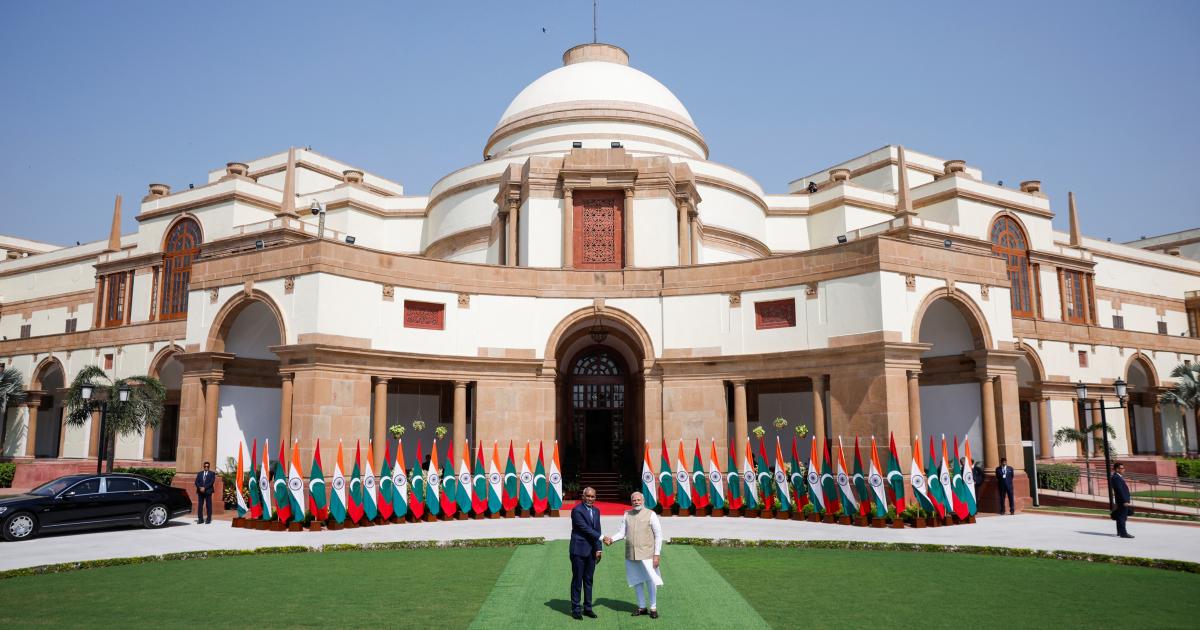
But in 2018, Yameen was voted out of power. The Maldives’ own India Out campaign—paradoxically led by Yameen after his electoral defeat to the pro-Indian politician Ibrahim Mohamed Solih—gained traction, casting India as a neo-imperial power. By 2022, nationalist rhetoric from Yameen and his Progressive Party coalition intensified into a demand for the expulsion of the Indian troops stationed in the country. The movement helped propel Mohamed Muizzu, an opposition candidate from the anti-Indian People’s National Congress, to a surprise victory in the 2023 presidential election. Framing his win as a reclamation of sovereignty, Muizzu expelled Indian troops and canceled defense agreements with New Delhi, abruptly ending decades of security cooperation between the two countries. A visit by Indian Prime Minister Narendra Modi to Malé in July 2025 (his first since Muizzu took office) eased tensions somewhat, with the two leaders launching trade talks and opening a $565 million credit line for the Maldives in a shift toward a renewed economic partnership. But trust between New Delhi and Malé remains thin, with the partnership yet to return to its former strength.
South Asian democracies are battlegrounds for great-power rivalry.
Despite the Maldives sitting along key sea lanes, the United States has long treated the country as a footnote in its Indo-Pacific strategy. Washington delegated diplomatic responsibility for the Maldives to India, issuing no sanctions in response to democratic backsliding and refraining from penalizing Yameen as he undermined democratic institutions. As the anti-India movement in the Maldives gained momentum, China exploited the United States’ absence, rapidly expanding its regional footprint by easing the tremendous debt the island country owed China. In January 2024, Muizzu visited Beijing and signed agreements spanning infrastructure, trade, fisheries, and digital connectivity.
In response, the Biden administration’s secretary of state, Antony Blinken, attempted diplomatic damage control, hosting Maldivian Foreign Minister Moosa Zameer in Washington in June 2024 and extending offers of U.S. security and naval cooperation. Still, the gesture paled in comparison with what China offered: military assistance in the form of grants, hardware, and training, as well as a free trade agreement that included major infrastructure projects. The perception of Western indifference had hardened among Maldivians, who saw the U.S. overtures as reactions to Chinese regional influence rather than genuine efforts to support autonomy, democracy, and human rights in their country. Without convincing support for political transparency, democratic institutions, and a free civil society, U.S. attempts to engage the Maldives appeared to be mere geopolitical scheming.
ACCOUNTING, NOT ACCOUNTABILITY
The arc of discontent evident in Bangladesh and the Maldives, where Indian meddling has produced Chinese gains, is also visible in Sri Lanka. India emerged as a critical ally for Sri Lanka in the wake of the latter’s civil war, which ended in 2009 with the defeat of the insurgent Tamil Tigers. As in Bangladesh and the Maldives, however, this support came at the expense of human rights and accountability. At a special session of the UN Human Rights Council that year, India voted in favor of a resolution praising Sri Lanka’s victory and seeking to block Western calls for an investigation into alleged war crimes.
New Delhi continued to deflect international pressure from Sri Lanka in the years that followed, shielding Sri Lankan President Mahinda Rajapaksa from meaningful global scrutiny and allowing him to consolidate power while dismissing Tamil grievances as Western propaganda. Meetings between Modi and Rajapaksa in subsequent years focused on security and counterterrorism strategy, sidestepping human rights issues. New Delhi’s calculated leniency sent a clear signal: if the Sri Lankan government stayed aligned with India on regional security, India would not press it on past atrocities or its persecution of minorities.
By 2022, however, Sri Lanka faced economic collapse. Mismanagement by President Gotabaya Rajapaksa, Mahinda Rajapaksa’s brother who was elected in 2019, triggered mass protests. New Delhi, in response, provided nearly $4 billion in condition-free assistance through credit lines, currency swaps, and emergency aid. India became Sri Lanka’s de facto lender of last resort without requiring the Sri Lankan government to address concerns about the human rights abuses, militarization, or corruption that fueled the country’s political crisis. But the bailout merely delayed the inevitable. Protesters stormed the palace in July 2022, forcing Gotabaya Rajapaksa to flee. Much of the Sri Lankan public saw India as complicit in preserving a failing regime, and protesters spray-painted “India Out” on the walls of the presidential palace. Rajapaksa’s successor, Ranil Wickremesinghe, turned to China for support. Beijing responded with alacrity, granting a two-year moratorium on debt repayments and, with the approval of the Sri Lankan government, advancing a $4.5 billion oil refinery project in Hambantota, one of the largest foreign investments in Sri Lanka’s history. Once operational, the refinery will anchor a Chinese logistics hub just 180 miles from India’s coast.
As the chaos unfolded, the United States expressed concern about Sri Lanka’s democratic backsliding but largely followed India’s lead. While Washington supported UN efforts to investigate wartime human rights abuses and provided humanitarian aid to Sri Lanka during the economic crisis in 2022, it did not press for the establishment of governance benchmarks or anti-corruption safeguards from the Sri Lankan government, either through Indian cooperation or otherwise. U.S. officials praised India’s financial lending but stayed quiet about the lack of accountability. Many Sri Lankans, especially the young protesters, viewed both New Delhi and Washington as responsible for the persistence of a corrupt old regime.
NIXING NEW DELHI
Like its South Asian peers, Nepal has watched for decades as India prioritized its regional influence over promoting local democracy, a policy that has exacerbated political upheavals in a country that has seen 14 different governments in the last 17 years. Although much of the country’s instability is rooted in its internal fractiousness and troubled transition from monarchy to republican democracy, many Nepalis believe India’s meddling has deepened their endemic political crisis.
New Delhi, for instance, imposed a blockade from late 2015 to early 2016 to punish Kathmandu for a constitutional change that affected Indian communities on the Nepali side of the border. At the time, the blockades crippled transportation routes and hospital services and prompted international warnings about a humanitarian crisis in the country, which was reeling from a devastating earthquake. Tensions between India and Nepal worsened. In 2020, the emergence of the #BackOffIndia social media campaign reflected a growing impatience among young Nepalis with New Delhi’s overbearing influence and supposed sympathies for the royalist camp within Nepali politics. In 2025, protesters were not just rejecting oligarchic rot, but also reaffirming their long-standing frustration over India’s role in sustaining it.
Washington has long seen Nepal as merely part of India’s backyard, and therefore limits its involvement to aid projects and disaster relief while avoiding deeper diplomatic initiatives that might irk New Delhi. The only serious U.S. engagement with the country is the $500 million Millennium Challenge Corporation compact, which has funded major electricity transmission lines and road upgrades. To many Nepalis, however, the compact looked like a plan hatched in New Delhi to cement both Indian and U.S. authority in South Asia. Opponents of the agreement rallied outside the Parliament building in February 2022 and burned both American and Indian flags in protest.
These strained relations, and Nepal’s domestic instability, opened the door for China to expand its influence in the country. In 2017, Nepal joined the Belt and Road Initiative (BRI), China’s vast infrastructure investment program. It has since hosted a number of slow-moving Chinese-backed projects: the Kathmandu-Kerung railway, oil and gas exploration in the Dailekh district, and the cross-border economic corridor known as the Trans-Himalayan Multi-Dimensional Connectivity Network, which forms part of the BRI. Chinese trade with Nepal is growing quickly, and Beijing touts the no-strings loans it has extended to Kathmandu. Even before he was forced from office, Oli began to hew closer to China, breaking protocol in 2024 by visiting Beijing before New Delhi to revive dormant rail talks and security coordination. Thus far, the interim government has signaled that it will maintain this China-friendly orientation while cautiously advancing domestic calls for accountability and autonomy.
GOOD FENCES, GOOD NEIGHBORS
Across South Asia, the pattern is clear: India prioritizes its narrow strategic interests over upholding democratic and liberal values. Washington, wary of straining its ties with New Delhi, turns a blind eye. Local populations view the dynamic as emblematic of U.S.-sponsored Indian hegemony, and the grievances pave the way for greater Chinese investment and influence. These are not isolated outcomes, but structural ones. South Asian democracies are battlegrounds for great-power rivalry. The more India interferes with democratic processes or props up unpopular strongmen, the wider the opening becomes for China. And as long as Washington continues to adopt a regional policy that defers to—and unthinkingly endorses—Indian preferences, it risks ceding South Asia to Beijing.
The remedy is not for Washington to micromanage India’s neighborhood policy but to forge a shared democratic baseline for cooperation. If the world’s two largest democracies cannot reconcile their geopolitical strategies with the democratic values they claim to share, China will continue to make strategic gains amid the wreckage that Indian and U.S. policies produce.
This is a prime moment for Washington to reassess its approach to South Asia. The U.S.-Indian partnership has been shaken in Trump’s second term, with Washington slapping high tariffs on New Delhi ostensibly because of the latter’s purchases of oil from Moscow. As U.S. officials determine what kind of partnership they want with India, they should change the way they look at the broader region. It is not simply India’s backyard, but a series of independent partners home to hundreds of millions of people. Listening to local voices, setting clear standards for transparency and human rights, and responding firmly to breaches of those standards—including by India—will be key to making deals in South Asia that can last. If Washington does not want to see Chinese influence expand irrevocably in the region, it must stop deferring to India. Instead, it should take seriously the democratic aspirations of all South Asian states and remember that their citizens will not countenance repression and bad governance—especially when it is sponsored by the world’s largest democracy.
Loading…
