

This article is an on-site version of our Trade Secrets newsletter. Premium subscribers can sign up here to get the newsletter delivered every Monday. Standard subscribers can upgrade to Premium here, or explore all FT newsletters
Hello from Washington, where I’m standing in for Alan Beattie today. This week we look ahead to what is shaping up to be a blockbuster trade case in the US Supreme Court, and a brief peek at where the US now stands on Mexico City and Ottawa — a tale of two cities.
Get in touch. Email me at aime.williams@ft.com
Heading for a reckoning
It’s been a dramatic year for US trade policy to date.
We began with big swashbuckling tariff threats against Canada, Mexico and China over their roles in the manufacturing of the deadly opioid fentanyl.
Then we graduated to the “reciprocal tariffs” of April, followed by a global stock market rout and suspension of the tariffs. Then we had several months of hasty dealmaking, and finally the new round of reciprocal tariffs in August.
As we enter the final months of the year, the grand finale will be kicked off by this week’s Supreme Court hearing on whether the US president is legally allowed to use emergency powers — under the International Emergency Economic Powers Act — to impose his duties.
The stakes are high. Trump himself has said he plans to attend the hearing at the US’s highest court on Wednesday. White House officials have not yet officially confirmed his attendance, but it would be an unprecedented move.
In a nutshell, the US government argues that Trump has wide authority to make his own decisions in the foreign policy space. Moreover, revoking the tariffs would be economically calamitous for the US, they argue, given the $4tn deficit reduction being pegged to the extra duties over the next decade.
The main arguments against the Trump administration are that the statute he has used does not list tariffs as an available tool, that the trade deficit is not an emergency and therefore can’t be addressed using emergency powers. The US constitution gives revenue-raising powers to Congress.
But chatter has also turned to what happens if Trump loses the case. Here there is an interesting split between trade lawyers, who fret about the legal basis of Trump’s recent spray of deals should IEEPA be removed from the scene, and diplomats, who are not really fretting at all (not more than usual, in any case).
The diplomats of DC, perhaps more used to actually dealing with Trump officials than trade lawyers, have just assumed that the administration will impose the tariffs by other means.
While US officials have said little publicly about their preparations should they lose the case, they have told multiple diplomats to sit tight on those trade deals — even though many of the tariffs have been applied using the law that is being challenged in court.
But the administration already has alternative means in train. It has Section 232 probes and Section 301 probes ongoing, both of which allow the US to hit foreign trading partners with tariffs.
Section 232 has been used in Trump’s second term already to impose duties of 50 per cent on steel and aluminium and of 25 per cent on autos and their parts, among other things.
Many trade lawyers also think the administration could use Section 122 of the Trade Act of 1974 to apply tariffs of 15 per cent for up to 150 days to address balance of payments deficits, using the time window to set off more Section 301 and 232 investigations.
Under Trump 2.0, the commerce department has been running “inclusion” processes for the 232s, meaning ever-expanding lists of the products that can be hit.
None of these tools has the immediacy of IEEPA — they are all more procedural, and take time. In the early days of the administration, some US trade officials including Jamieson Greer were advocating for this more legally sound approach. They may be about to be proven right.
A tale of two neighbours
Still technically members of the US’s largest trade deal, Mexico and Canada now face diverging fates. At least as far as political rhetoric goes.
To recap: after being the early victims of Trump’s tariff enthusiasm, the US’s neighbours managed to escape from the reciprocal tariff showdown better than any other US trading partners. Things were going well.
After threatening high tariffs on all trade, the US auto lobby — which has supply chains strung across the continent — managed to persuade the US president that his 2020 United States-Mexico-Canada Agreement should hold up.
At present, all trade with both Mexico and Canada that complies with the terms of the deal avoids the reciprocal tariffs. And that is most trade.
It was here where the US neighbours’ fates began to part, albeit just around the edges.
Mexico was threatened (in the letters — remember the letters?) with 25 per cent duties on the non-USMCA goods, but those duties were suspended for 90 days. Mexican leader Claudia Sheinbaum said that deadline was November 1.
Canada, meanwhile, was given the higher tariff of 35 per cent for non-USMCA goods, with no suspension.
Both sides face 50 per cent tariffs on steel and aluminium, which is a particular bugbear for the Canadians.
This week, Sheinbaum said her trade talks with the US were going well, and that things should be wrapped up in a few weeks. A US official told the FT they were “confident” in a resolution before the tariffs reapplied.
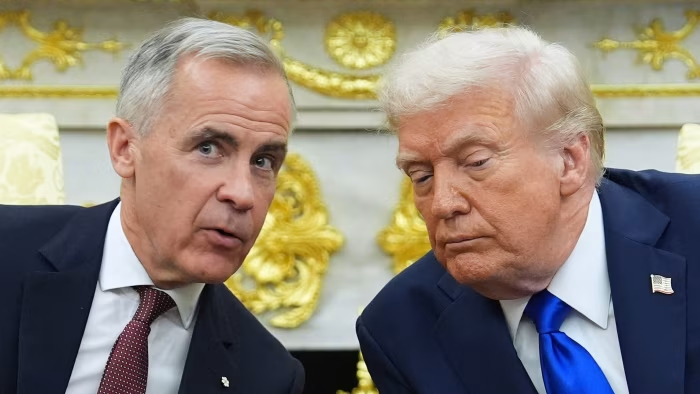
Pan the camera over to Mark Carney, Canada’s relatively new prime minister and the former governor of the Bank of England, who was recently told his trade talks would be “TERMINATED” when Trump disliked an advert — aired by the province of Ontario — that was rude about tariffs.
On top of that, the US tariff on Canada was bumped up by an additional 10 per cent (although this has not actually been enacted by the US — there has been no legal change made to Canada’s tariff rate at the time of writing).
On Friday, Trump insisted he would not be restarting the trade talks with Canada, even though Carney had “apologised for what they did” when the two men spoke in Asia.
This is despite Carney publicly dropping the country’s irksome digital services tax — a trade irritant for the US — and schlepping down to Washington with most of his cabinet in tow this month.
This leaves the US’s two largest trading partners — both signatories of USMCA — on weirdly separate tracks.
It’s unclear if any of this really matters, given the bigger issue of the USMCA review that is already under way. But given Trump’s personal dealmaking style — the vibes may be important.
Charted waters
Analysts feared the worst when Trump imposed “reciprocal tariffs” on south-east Asia’s trade-dependent economies. But evidence from Vietnam suggests that exports to the US, especially in high value-added sectors, have remained strong.
Trade links
Tej Parikh examines the economic benefits of Donald Trump’s second term.
Opec+, the oil producers’ group, has responded to fears of an oil glut by pausing its plans to increase production next year.
Britain’s small businesses are struggling to take advantage of the UK government’s new trade deals, with a majority reporting flat or declining exports in the third quarter of this year, a survey by the UK’s largest business lobby group has found.
Trade Secrets is edited by Georgina Quach today
Recommended newsletters for you
The AI Shift — John Burn-Murdoch and Sarah O’Connor dive into how AI is transforming the world of work. Sign up here
FT Swamp Notes — Expert insight on the intersection of money and power in US politics. Sign up here
