

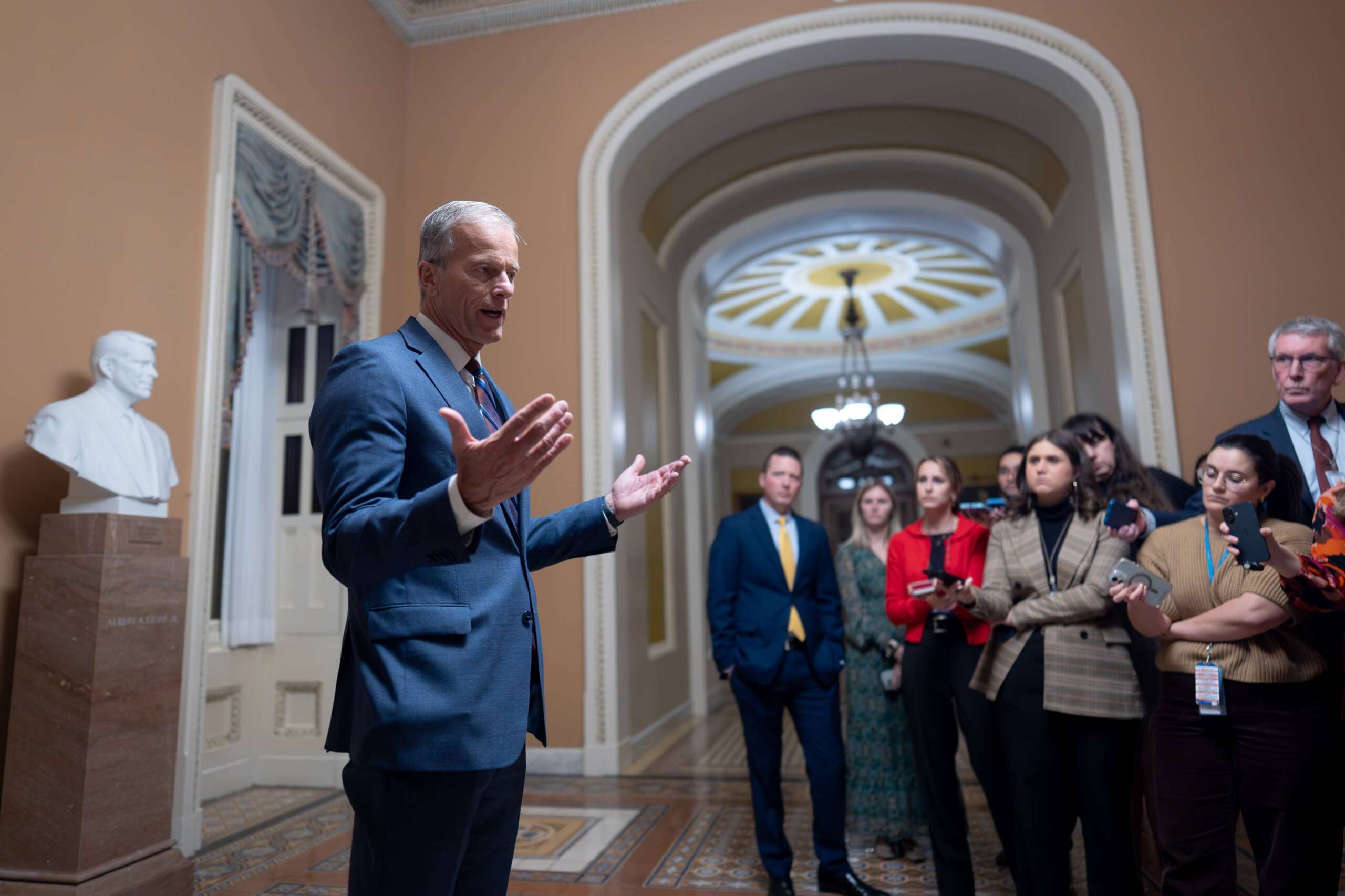
Terry Gerton Let’s talk about the current state of shutdown negotiations in the Senate. You’re sitting up there, what are you hearing?
Maeve Sheehy Yeah, we are officially well into the longest shutdown ever. There’s some growing frustration on both sides as we see kind of travel delays, people missing their SNAP benefits. So a lot of problems are starting to pile up, but we’re still seeing each side be pretty dug into its respective point of view. There are bipartisan conversations right now going on in the Senate. I just spoke with House Appropriations Chairman Tom Cole, and he was speaking a little bit about the negotiations that are happening with a continuing resolution and a minibus. But really what we see happening here is a lot of going around in circles. They keep landing on the same issues that we’ve had since the very beginning, like with Affordable Care Act tax credits. So it’s kind of a question mark right now where we’ll be able to get out of this, but it does seem like there’s intense pressure on both sides to reach an agreement.
]]>
Terry Gerton Well, there was some optimism at the beginning of last week that faded by the end of the week. There was perhaps hope that they could move that minibus with the three agreed-upon appropriations bills, MILCON, VA, USDA, and Leg Branch. What’s going to happen there?
Maeve Sheehy Yeah, we saw a lot of confidence, especially on Monday, with that three-bill minibus. After Tuesday’s elections, Democrats did better than a lot of people were expecting, and that kind of, you could say, inspired them to dig in a little bit more. They see that as a, that the American people are kind of on their side with this. And so things have derailed a little bit. Although I will say for the first 35 days of the shutdown, there were barely any bipartisan negotiations in the House or Senate. And now we’re actually seeing senators sit in rooms together and and talk about a way out. So, that is kind of a step forward to ending the shutdown, even though there isn’t any sort of agreement yet.
Terry Gerton Well, certainly in other pressure points, the FAA’s reduction of domestic air travel, the reduction in SNAP benefits, and coming up on another military pay cycle, all of those were expected to be pressure points. Are you seeing that anybody is feeling the need to respond to those?
Maeve Sheehy Yeah, and especially with the flight delays, you hear a lot about this because in the 2018-2019 shutdown, that was kind of a big forcing mechanism for lawmakers to make a deal. And we actually did see the FAA have to cut hundreds of flights already at airports across the country. So what you’re going to see is people having delayed flights, people having canceled flights, and that’s obviously a pretty big disruption. Lawmakers are taking note of that. It’s making things much more urgent, especially with the holidays coming up, being the busiest travel time of the year. With SNAP benefits, I would say that there’s been a lot of discussion about this, but there is that kind of legal fight going on between the Trump administration and judges over how many benefits and whether they can immediately put out full benefits. So there’s been a lot of questions around that, but there definitely is a lot of stress from the perspective of the 42 million Americans who received these food stamps and didn’t get them at the beginning of the month.
Terry Gerton Right. And I guess the other point that we had expected to maybe move hearts and minds was the healthcare premiums increase. I mean, the feds are now in Open Season, other folks are looking at the ACA premium benefits. That doesn’t seem to be having the effect people expected either.
Maeve Sheehy Yeah, Democrats for a long time had said that November 1st was a huge day in this whole experience because that’s the day that people would begin open enrollment, see that their premiums were going up. And while that did happen to a degree, it’s not really having any sort of shutdown-ending effect. We’re hearing Senate Democrats really calling for an ACA subsidy extension, and Senate Majority Leader John Thune has said that he would put that on the floor for an up or down vote. But the big problem here, or the big hang up, is that Speaker Mike Johnson in the House won’t promise to put that on the House floor for a vote. So, getting a bill through the Senate is all well and good, but it doesn’t really have any impact unless you can guarantee that it will also go through the House. And that’s why we’re seeing these negotiations repeatedly come up against this same obstacle.
Terry Gerton Well, you mentioned that folks are at least meeting in in the same room to have some conversations. Do you have a sense of what the non negotiables are from each side?
]]>
Maeve Sheehy It seems to me that, well, from the House perspective, I’ll start with that ’cause I’m a House reporter. Speaker Johnson does not want to negotiate at all because he believes that the House has done its job and that Democrats are kind of holding the government ransom. In the Senate, it seems like Democrats are intent on having some sort of healthcare takeaway. They also want to make sure that federal workers who have been furloughed over the past month will get their back pay. That is guaranteed under law, under 2019 law. And until this shutdown, it’s been pretty understood that federal workers who are furloughed will get back pay. But there’s been some questioning about the legality of that, and the Trump administration has suggested that perhaps they won’t get the back pay, which would be a really big deal, obviously, for a lot of federal workers.
Terry Gerton I’m speaking with Maeve Sheehy. She’s a congressional reporter with Bloomberg Government. Well, Maeve, to that exact point about back pay for federal workers, Ron Johnson has a bill to pay excepted federal workers and military service members during the shutdown. Is that getting traction?
Maeve Sheehy It’s one of those things that sounds like it would, but actually hasn’t. Basically, Democrats have said — most Democrats have said, it’s gotten some bipartisan votes — but that they don’t want to kind of except very narrow parts of the workforce and allow them to get paid because that could leave vulnerable other people not to get paid. Because Ron Johnson’s bill would pay some federal workers, but not every single federal worker. And I think that that’s kind of the big sticking point and that’s what’s stopping it from getting more traction than it has.
Terry Gerton That’s an interesting take on it. Let’s change topics just a little bit. What else is going on with the legislative agenda? We know that the NDAA might be moving to conference soon. What else are you hearing?
Maeve Sheehy Yeah, in the House there’s really not much happening at all because they’ve been out of session for almost fifty days at this point. It’s been a really, really long time, and there haven’t been committee meetings, there haven’t been sort of the bipartisan meetings that there usually would be. So that’s obviously hampering things over here. In the Senate, they’ve been able to do a little bit more. And also, as you mentioned earlier, there are discussions about appropriations. So even if Congress does pass a clean continuing resolution to keep the government funded or to fund the government again, there are still those appropriations bills that are really important in the eyes of lawmakers to get done.
Terry Gerton So really until we get the shutdown sorted, not a whole lot else happening in those back rooms on the Hill.
Maeve Sheehy Yeah, we’ve been hearing a lot less about pretty much every single policy area ever since the government shutdown happened, just because it’s become the number one issue.
Terry Gerton Well, there was one other tidbit of information last week. Nancy Pelosi announced she’s not going to run for re-election. How did that play out?
Maeve Sheehy Yeah, it wasn’t necessarily a surprising decision because Pelosi had sort of hinted that maybe this would be her last term. She’s been on the Hill for so long, this is her, I believe, twenty-first or twentieth term in office. So she’s one of the longest serving members. I think the real question that this raises for me and that I’ve heard on the Hill as well is, will some of these other longest serving members, like Congressman Steny Hoyer, who served in leadership with Pelosi, like, will they also kind of take this as their time to leave? And the Democratic Party has had this whole question of generational change, of passing the torch, ever since President Biden stepped down. There were all of these questions about committee leaders in the House. So it’s really interesting to look at who is in leadership positions in the House and how long some of them have been there.
]]>
Terry Gerton That generational change question continues to come up, so we’ll see whether she’s opened up the door for others.
Maeve Sheehy That’s the big question.
Copyright
© 2025 Federal News Network. All rights reserved. This website is not intended for users located within the European Economic Area.
