

Reeves says she has to face world ‘as it is’ as she refuses to say she’ll stick to manifesto pledges on tax
Reeves is now taking questions.
Beth Rigby from Sky News goes first.
Q: Will you stick to your manifesto promise not to raise the taxes that working people pay? And, if you won’t, doesn’t that make a mockery of the trust people put in you at the election?
Reeves replied:
I will set out the individual policies of the budget until the 26th of November. That’s not what today is about. Today is about setting the context up for that budget.
And your viewers can see the challenges that we face, the challenges that are on a global nature. And they can also see the challenges in the long-term performance of our economy. And the Office for Budget Responsibility will set all that out. They’ve done the review of the supply side of the economy that looks at the past, but they use the past to predict the future.
As chancellor, I have to face the world as it is, not the world that I want it to be.
And when challenges come our way, the only question is the how to respond to them, not whether to respond, or not.
And as I respond on the budget 26 November, my focus will be on getting NHS waiting lists down, getting the cost of living down and also getting the national debt down.
Share
Updated at 03.41 EST
Key events
Show key events only
Please turn on JavaScript to use this feature
Reeves suggests voters will see doing ‘right thing’ as more important than sticking to manifesto pledges
Pippa Crerar from the Guardian asked Reeves why she was saying she fixed the foundations of the economy last year when now she is having to come back for more revenue.
In response, Reeves suggested she was referring to the way she changed the fiscal rules last year, which allowed much more investment.
She also said she was determined “to beat those forecasts” on productivity. But she said she had deal with the OBR forecasts; if she just ignored them, then interest rates and inflation would go up.
Crerar also asked how important she thought it was for politicians to keep their promises.
And Reeves replied:
I think it is important that people are honest.
As I said, everyone can see that this year has thrown many more challenges.
It would be possible to cut capital spending, to change the fiscal rules, to make the numbers superficially add up all. But I’m not convinced that would the right thing for our country.
I have to respond to the world as it is rather than the world I might want [it] to be.
I believe, in the end, the public will respond better to doing the right thing than just doing the expedient thing.
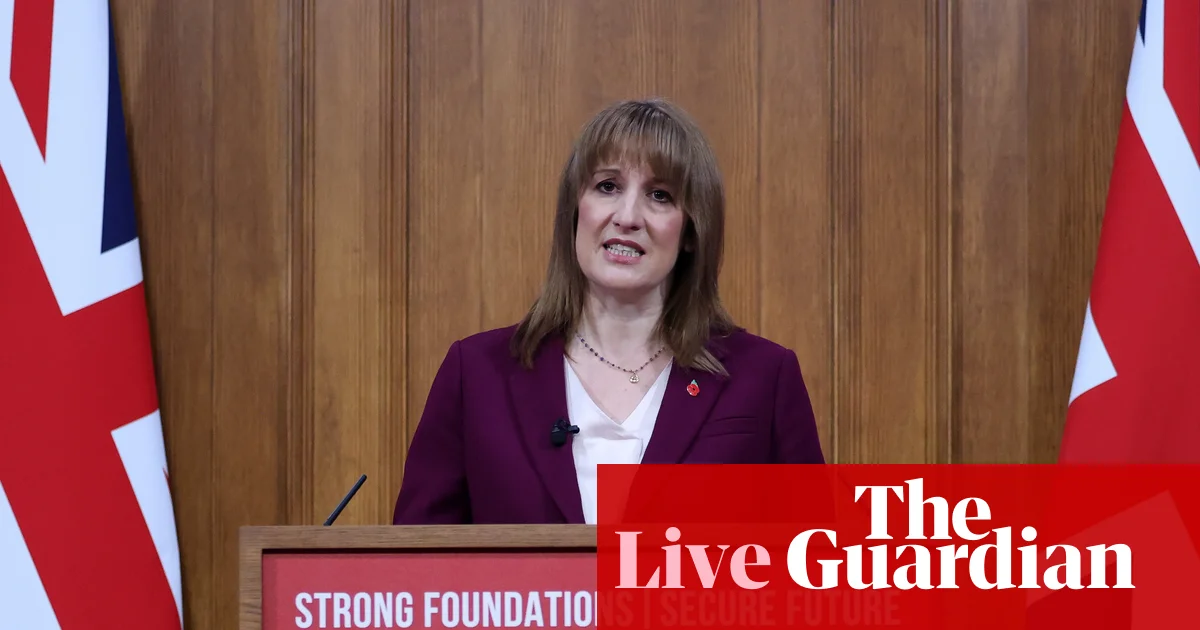
Rachel Reeves speaking in the media briefing room at 9 Downing Street this morning. Photograph: Justin Tallis/PAShare
Reeves says she and Starmer will put national interest ahead of political expediency ‘every single time’
Reeves also told Riley-Smith that she and Keir Starmer would always put the national interest first.
If you ask me what comes first, the national interest or political expediency, it’s a national interest every single time with me. And that’s the same for Keir Starmer too.
Share
Reeves says UK still paying price for Liz Truss’s mini budget
During the Q&A Ben Riley-Smith from the Telegraph said that Reeves was saying she was going to do what was right but not popular.
Reeves joked “I’d like to do both.” But she said doing what was right came first.
Riley-Smith asked if she was willing to do that even if it meant losing the next election.
Reeves replied:
The problem of the last 14 years is that political expediency always came about the national interest. And that is why we are in the mess that we are in today.
Reeves also claimed the UK was still paying the price for Liz Truss’s mini budget.
Why are borrowing costs higher in England, in Italy or in France? The reason they are is because the damage done by that mini budget.
It might have been three years ago, but we’re still paying the price of that.
Share
The BBC’s Chris Mason also asked Rachel Reeves how she made such a mess of her home rental arrangements, claiming not to know that she needed a rental licence she had championed those rental schemes hereself.
In response, Reeves just said she had nothing to add to what was said last week in her exchange of letters with the PM.
Share
Q: [From Kitty Donaldson from the i] Hasn’t the PLP made things worse, because it is unfair to raise tax when you are not cutting welfare? And will you get rid of the two-child benefit cap?
Reeves said that it was unfair to blame the PLP (ie, the Labour MPs who voted against the proposed welfare cuts earlier this year) for the UK’s productivity problems. She said the productivity downgrade was “the most impactful thing” in the budget process.
She did not address the two-child benefit cap part of the question.
Share
Updated at 04.12 EST
Q: [From the FT’s George Parker] Will your budget make life harder for employers?
Reeves said people should not talk the perfomance of the economy down. She said the UK was the fastest growing economy in the G7 in the first half of the year.
She said she recognised the need not to discourage employment.
Share
Q: [From the BBC’s Chris Mason] What do you say to people who think you are about to break manifest promises?
On the budget, Reeves said that today she wanted to explain to people the context in which the budget decisions will be made. She said she would act in the national interest.
She said other parties had to set out their alternative plans. Reform UK is just offering “fantasy economics”, he said.
Share
Q: You must have known about this productivity problem at the time of the election. Shouldn’t you have been more honest with people then?
Reeves said at the last budget she did act to address a £22bn black hole in the accounts.
And she says chancellors had to use OBR forecasts. She respected the independence of the OBR, she said.
Share
Reeves says she’s being ‘honest’, and she won’t follow previous governments in ducking difficult choices
Robert Peston from ITV News went next.
Q: You have made the cases for raising taxes by billions. Is that what you will do?
Reeves repeated the point about not announcing the decisions today.
But she said she would not duck difficult choices.
As chancellor, I could do what previous governments have done, which is to sweep those challenges under the carpet, to cut capital spending, to make the numbers not up.
But then we’d be back here in a year, in five years’ time, with productivity still in its knees, growth under-performing … national debt continue to, to rise.
So I’m being honest with people.
At the election, I said that we would put the national interest first.
People can see that things are changing, that the global circumstances, are challenging, and I hope they will see at the budget on 26 November that the focus on getting the debt down or getting NHS waiting lists and getting the cost of living down, which continues to be people’s number one concern.
Share
Reeves says she has to face world ‘as it is’ as she refuses to say she’ll stick to manifesto pledges on tax
Reeves is now taking questions.
Beth Rigby from Sky News goes first.
Q: Will you stick to your manifesto promise not to raise the taxes that working people pay? And, if you won’t, doesn’t that make a mockery of the trust people put in you at the election?
Reeves replied:
I will set out the individual policies of the budget until the 26th of November. That’s not what today is about. Today is about setting the context up for that budget.
And your viewers can see the challenges that we face, the challenges that are on a global nature. And they can also see the challenges in the long-term performance of our economy. And the Office for Budget Responsibility will set all that out. They’ve done the review of the supply side of the economy that looks at the past, but they use the past to predict the future.
As chancellor, I have to face the world as it is, not the world that I want it to be.
And when challenges come our way, the only question is the how to respond to them, not whether to respond, or not.
And as I respond on the budget 26 November, my focus will be on getting NHS waiting lists down, getting the cost of living down and also getting the national debt down.
Share
Updated at 03.41 EST
Reeves rejects calls to ignore fiscal rules and raise borrowing
Reeves says some people are saying she should “sidestep” her fiscal rules.
But she rejects that, she says:
No accounting trick can change the basic fact that government debt is sold on financial markets. There are limits on the price the banks, hedge funds and pension funds are willing to pay for our debt, and we are competing constantly with other countries also selling debt.
The more that we try to sell, the more it will cost us.
It is important that everyone, the public and politicians understand that reality.
The less we spend on debt interest, the more we can spend on the priorities of working people, NHS, our schools, our national security, the public service essential to both a decent society and a stronger economy.
Share
Reeves says the choices in the budget will be focused on getting inflation falling, and allowing interest rates to be cut “to support economic growth and improve the cost of living”.
Share
Reeves says, at the last budget, she changed the fiscal rules to allow more investment and put more money into public services.
She says she is proud of those decisons.
But I know that real progress takes time.
Our growth was the fastest in the G7 in the first half of this year … And I know that there is more to do.
The first part of our planning reforms will add an additional £6.8bn to the size of our economy in the next five years.
But the next part of planning bill must complete its passage through parliament before it can make a difference.
Interest rates, which rose from 0.1% to 5.25% in the last parliament, have now been cut five times to 4%.
Share
Reeves says she is not interested in “relitigating old choices”.
Instead, “it’s about being honest with the people, about the consequences” of those decisions.
Share
Reeves says past governments have put ‘political convenience’ ahead of ‘economic imperative’
Reeves says previous government have failed to make the investment decisions Britain needed.
The truth is that previous governments have not adequately faced up to these challenges.
Too often, political convenience has been prioritised over economic imperative.
The decision to pursue a policy of austerity after the financial crisis – that’s a hammer blow to our economy, gutting our public services and severing the flows of investment that would have put our country on a path to recovery.
The years that followed were characterised by instability and indecision … Crucial capital investment continually sacrificed and hard decisions put off again and again.
And then a rushed and ill-conceived Brexit – the further disruption as businesses trying to trade were faced with extra costs and extra paperwork.
All this meant that when the pandemic arrived, our country was underprepared, public services weakened and our economy fragile.
We finished the pandemic with higher tax rates and higher debt, and our peers.
Share
Reeves says UK’s productivity is worse than previously assumed
Reeves says at the budget the OBR will set out the conclusions of its review into the supply side of the UK economy.
She says she won’t pre-empt their conclusions.
But it is already clear that the productivity performance the government inherited is worse than thought.
That has consequences for working people, for their jobs, for their wages, and it has consequences for the public finances, too, in lower tax receipts.
She says this is not a reflection on how hard people work. It is about the problems caused because “workers don’t have the tools that they need”, like “trains that run on time”.
Share
