

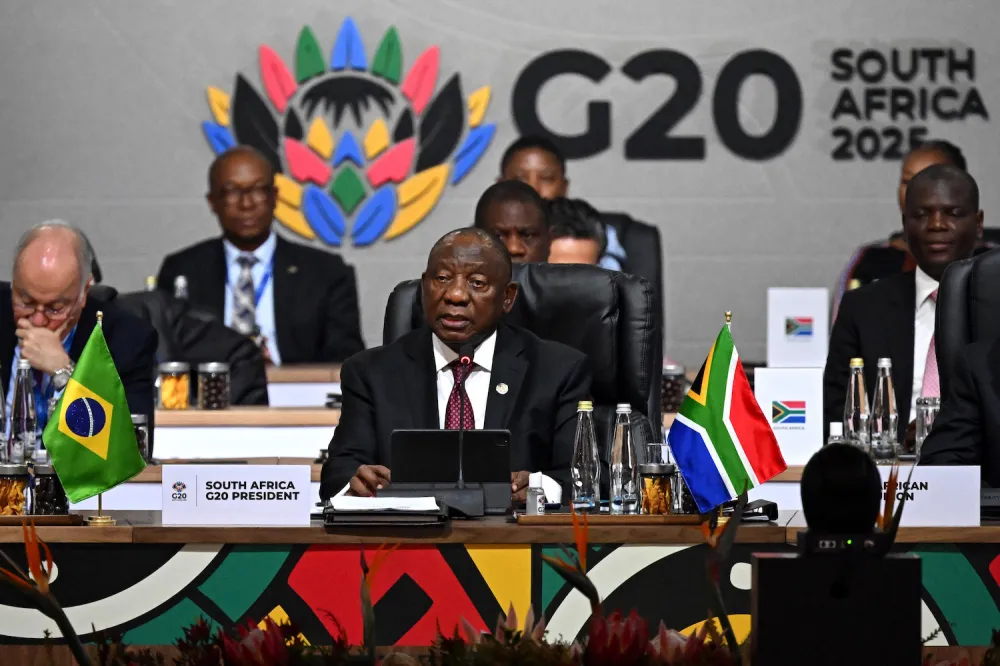
Welcome back to World Brief, where we’re looking at South Africa’s ambitions at the G-20 leaders’ summit, the U.S. terrorism designation of a Venezuelan cartel, and a new peace proposal for the Russia-Ukraine war.
Sign up to receive World Brief in your inbox every weekday.
Sign up to receive World Brief in your inbox every weekday.
Sign Up
By submitting your email, you agree to the Privacy Policy and Terms of Use and to receive email correspondence from us. You may opt out at any time.
Enter your email
Sign Up
Loading…
Marked Absent
South African President Cyril Ramaphosa championed multilateralism at this weekend’s G-20 leaders’ summit in Johannesburg. However, a notable absence from one of the bloc’s biggest powers—coupled with a series of broken traditions in response—resulted in what some experts are calling a symbolic diplomatic victory but a weak final declaration.
U.S. President Donald Trump boycotted the summit over unsubstantiated allegations of “white genocide” in South Africa, accusing Pretoria of discriminating against and even allowing the killing of white Afrikaners. U.S. Secretary of State Marco Rubio had also denounced this year’s G-20 theme of “Solidarity, Equality, Sustainability” for promoting what he referred to as “DEI” (diversity, equity, and inclusion) and climate change initiatives.
Rather than bowing to the constraints of Washington’s empty chair, Ramaphosa capitalized on the United States’ absence to focus on global cooperation and African interests.
“The G-20 should send a clear message that the world can move on with or without the U.S.,” South African Foreign Minister Ronald Lamola said. “We will mark them absent and continue with the business.”
Specifically, Ramaphosa broke with tradition by issuing the bloc’s 122-point final leaders’ declaration at the start of the summit rather than at its conclusion. The statement addressed several key concerns of all parties involved, such as Africa’s debt crisis, critical mineral access, and illicit financial flows. But it also highlighted several terms that U.S. officials had opposed ahead of the conference, including “just energy transitions,” “climate change,” and “gender equality.”
According to Ramaphosa, the declaration received unanimous support from all delegations present. Notably, that excluded the United States, but it also ignored the protests of Argentina, which was in attendance and sided with Washington’s demands; Buenos Aires has repeatedly backed Trump’s proposals after the White House granted Argentina with a whopping $40 billion bailout that was announced last month.
Still, experts warn that the declaration may have little effect, as the text is not binding, and the United States, with its massive economy, can still heavily influence the very institutions that the declaration addresses, such as the International Monetary Fund.
Much of the progress made during this weekend’s summit could also be reversed next year, when the United States hosts the gathering. The White House accused South Africa of weaponizing its time holding the bloc’s rotating presidency to undermine unanimous consensus and vowed to restore the conference’s “legitimacy” once the United States assumes the role, which is set to occur next week. Analysts expect Washington to narrow the G-20’s agenda next year to just the leaders’ summit and financial forum, scrapping other meetings on energy, health, and the environment.
But that didn’t stop South Africa from having the last laugh. Just two days before the summit, Trump asked to send a U.S. delegation to Johannesburg for the rotating presidency handover ceremony. However, Ramaphosa refused to present the gavel to a lower-ranking U.S. official and instead said that Washington’s representatives could come by the South African Foreign Ministry on Monday for the handover.
Today’s Most Read
The World This Week
Tuesday, Nov. 25: Leaders from the pro-Ukraine “coalition of the willing” group of countries meet virtually.
The two-day European Union-African Union summit concludes in Angola.
Thursday, Nov. 27: Kyrgyzstan hosts leaders from the Collective Security Treaty Organization.
St. Vincent and the Grenadines holds legislative elections.
Friday, Nov. 28: The International Criminal Court delivers a ruling in an appeals case brought by former Philippine President Rodrigo Duterte.
Sunday, Nov. 30: Honduras holds a general election.
Kyrgyzstan holds early parliamentary elections.
Monday, Dec. 1: St. Lucia holds a general election.
What We’re Following
Terrorism designation. The United States formally labeled Venezuela’s Cartel de los Soles as a foreign terrorist organization on Monday as part of the Trump administration’s efforts to exert pressure on Venezuelan President Nicolás Maduro. The White House claims that Cartel de los Soles conducts drug-trafficking operations in the United States and Europe alongside the Venezuelan Tren de Aragua gang, and it alleges that Maduro oversees the group personally.
However, experts say that Cartel de los Soles (or Cartel of the Suns) is not actually a cartel but rather a “system of widespread corruption” within the Venezuelan government and security forces. It is a term originally coined by Venezuelans to refer to government officials who engage in corruption; the name emerged in the 1990s, when Venezuelan military leaders, who wore sun insignias, were investigated for drug trafficking.
“Venezuela categorically, firmly, and absolutely rejects the new and ridiculous fabrication,” Venezuelan Foreign Minister Yván Gil wrote on Telegram, calling the group “nonexistent.” Gil asserted that the designation is a means to justify U.S. regime-change efforts in Caracas, which have included increased U.S. military deployments in the Caribbean and repeated U.S. attacks on Venezuelan boats that Washington claims are being used for drug trafficking. Washington is also reportedly preparing to launch a new phase of Venezuela-related operations in the coming days, according to reporting from Reuters on Saturday.
A new peace proposal. The United States and Ukraine drafted a new 19-point peace plan on Monday in an effort to end the Russia-Ukraine war, heavily amending the earlier 28-point proposal that Washington had secretly worked on with Moscow. According to Ukrainian First Deputy Foreign Minister Sergiy Kyslytsya, top U.S. and Ukrainian officials reached agreement on several issues after hours of negotiations. However, they placed holds on the most contentious topics—including potential territory swaps, U.S. security guarantees, and NATO involvement—for Trump and Ukrainian President Volodymyr Zelensky to discuss later.
Under the original 28-point text, Russia would have been granted de facto control of Ukraine’s Donbas region, and Kyiv would have been forced to limit the size and capabilities of its military. In exchange, the United States would have provided security guarantees to Ukraine and the rest of Europe. Such a deal would have dealt a heavy blow to Zelensky, who has repeatedly rejected making any territorial concessions.
“Very few things are left from the original version,” Kyslytsya told the Financial Times. According to German Foreign Minister Johann Wadephul, “All issues concerning Europe, including those concerning NATO, have been removed” from the original plan.
And on Monday, Zelensky demanded that Moscow fully pay for war reconstruction using frozen Russian assets. The new draft agreement will now be placed under further review as Trump seeks to advance talks with Russia’s delegation.
Hezbollah leader assassinated. An Israeli airstrike killed Hezbollah’s top military official, Ali Tabtabai, in Beirut on Sunday, despite Israel reaching a cease-fire deal with the Iranian-backed militant group last November. Israel’s attack crossed a “red line,” Hezbollah official Mahmoud Qamati said, adding that senior leadership would decide if and how the group would respond. According to the Lebanese Health Ministry, the strike killed at least five people and injured 28 others.
Israel claimed that Tabtabai “commanded most of Hezbollah’s units and worked hard to restore them to readiness for war with Israel,” with Israeli Prime Minister Benjamin Netanyahu saying he would not allow the group to rebuild its forces in southern Lebanon. Since the U.S.-brokered truce went into effect, Israel has pressured the Lebanese government to be more aggressive at confiscating unauthorized weapons in the country, including those held by Hezbollah.
Sunday’s strike was the first Israeli attack on Beirut’s southern suburbs in months. In response, Lebanese President Joseph Aoun urged foreign leaders to help halt Israel’s cease-fire violations. Both sides have accused each other of breaking the deal.
Odds and Ends
Readers with claustrophobia might want to skip this section. A Thai woman shocked mourners on Sunday, when the 65-year-old suddenly regained consciousness from within her own coffin. According to the woman’s brother, his sister had been bedridden for two years and had appeared to stop breathing in recent days. But during the four-hour funeral procession, he heard faint knocking from within the coffin. “I was a bit surprised, so I asked them to open the coffin, and everyone was startled,” he said. “I saw her opening her eyes slightly and knocking on the side of the coffin. She must have been knocking for quite some time.”
