

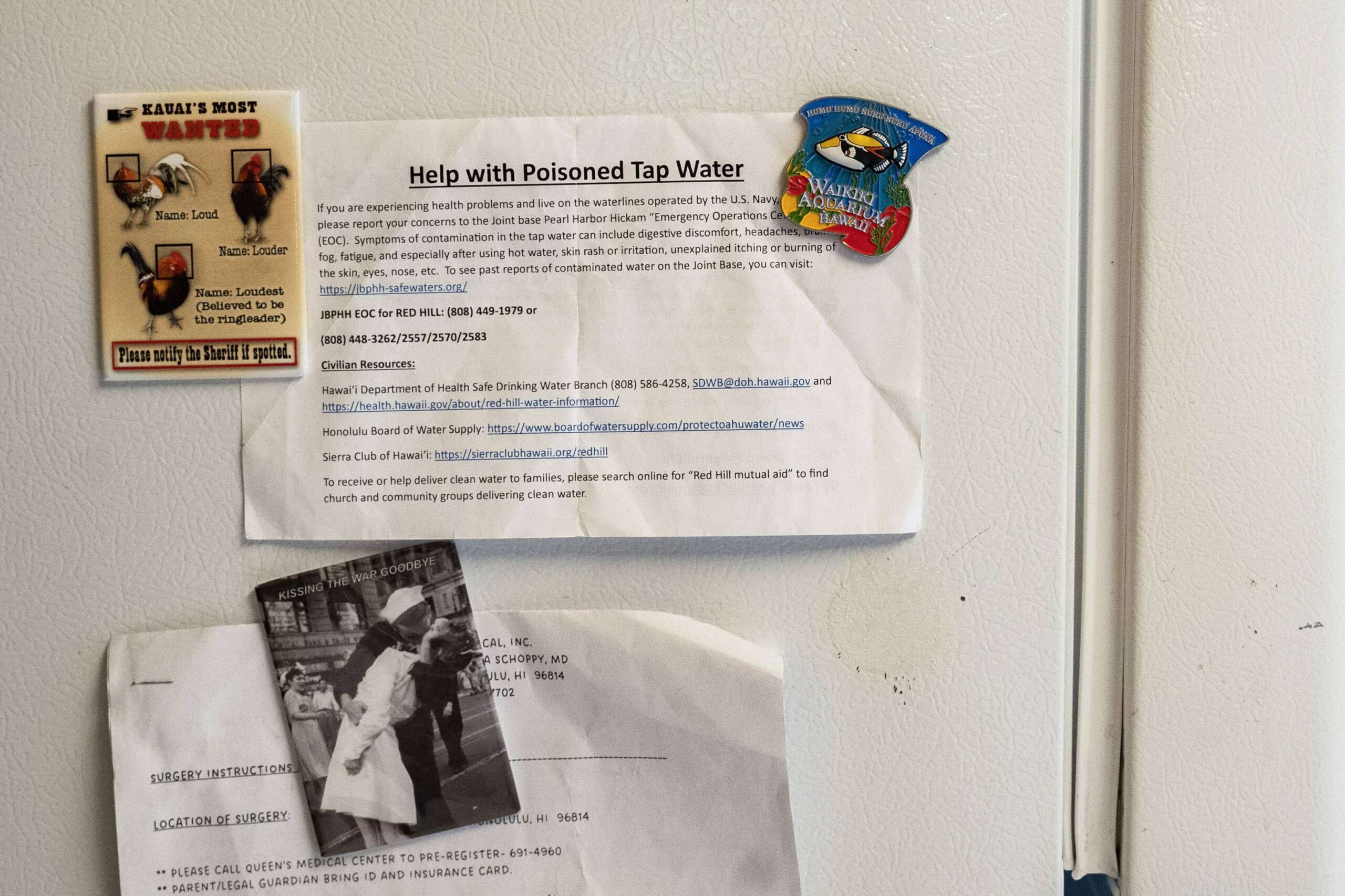
Nearly every service member living in privatized military housing has experienced at least one serious issue in their home — and an overwhelming number say their family’s health has been negatively impacted by their housing conditions. Nearly half said a medical provider had confirmed the connection, a new survey found.
The Change the Air Foundation recently conducted the Safe Military Housing Survey — one of the most comprehensive efforts yet to collect data the Defense Department has never been able to track accurately. The survey was designed to answer questions previous studies had overlooked and to provide Congress and the Pentagon with better data on what families across all branches and ranks are actually experiencing in military housing.
“We were hearing a lot of how many indoor air quality hazards and just housing hazards that these families were experiencing. But nobody was really ever asking, how is this affecting your physical health? How is this affecting your cognitive abilities? How is this affecting your mental and emotional health, and your and your personal finances? That’s a huge component of this survey,” Brandon Chappo, co-founder and director of public policy at the Change the Air Foundation, told Federal News Network.
Erica Thompson, a military spouse and the military families’ liaison for the Change the Air Foundation, lived in military housing for 10 months at Maxwell Air Force Base located in Montgomery, Alabama. Thompson said her family immediately noticed serious issues with the house, including a failing AC system they were told couldn’t be replaced. Once contractors opened the walls without any containment, the entire family — including their dog — began experiencing a cascade of medical issues. Her son started passing out in the house and the dog started having seizures; three of their children were later diagnosed with asthma and one was diagnosed with bilateral pediatric cataracts in both eyes.
]]>
“We saw a huge range of health implications across the board, throughout our whole family. And so I think using part of that, it was able to guide us through this questionnaire, some of those things that I wish offices knew. It was able to really give me insight into making some of these questions, because we would share our story with congressional offices, they would say, ‘How many more kids are there like yours?’ And I said, ‘I don’t know. There’s no data around that right now,’” Thompson told Federal News Network.
For decades, service members and their families living in privatized military housing have been exposed to hazardous conditions, including black mold, contaminated water, asbestos in ceilings and lead in walls. The survey found that mold, mildew or microbial growth were the most common issues, reported by 74% of respondents. More than half of respondents cited significant problems with temperature and humidity, pest infestations, water damage and HVAC failures.
“Mold and water damage can be extraordinarily hazardous to somebody’s health. That’s extremely dismaying,” Chappo said.
Overall, 76% of service members said their health has been negatively affected by housing conditions, and nearly half said a physician had confirmed their homes were making them sick.
The survey also revealed an alarming statistic — 47% of service members said their housing issues impacted their ability to perform their duties or maintain mission readiness. The problem was particularly prevalent among those stationed in Florida.
Three in five service members reported experiencing mental health challenges such as anxiety or depression, and roughly two in five service members said those issues affected their ability to attend work or training. One in six service members had to relocate — sometimes temporarily, sometimes permanently — often leaving behind personal items that had been damaged.
“That is absolutely stunning. And so, if anything, it underscores the importance of trying to get these issues dealt with. It’s the fact that not only are our service members’ health and wellness being affected, it’s mission readiness. This is a national security issue, and we need to start talking about it in that light, and start really framing it in that way,” Chappo said.
]]>
While anxiety, depression, mood changes, cognitive issues, insomnia, headaches, migraines, brain fog and skin, eye and respiratory irritation top the list of reported health problems, the survey found the health impacts to be far more extensive than that.
“This is extraordinary. These [medical conditions] weren’t just in the low percentages. We’re talking in the 20, 30, 40 percentages for some of these. Even those alone, being as high as they are, really should catch the attention of, hopefully, the country, and of course, those in Congress,” Chappo said.
The survey found that Florida, Hawaii and Texas experienced housing-related issues at far greater rates and saw significantly higher rates of both health impacts and readiness concerns. Nearly 60% of service members stationed in Florida said housing issues impacted their ability to perform their duties. Health impacts were also higher than average — 84% of Florida service members said their families’ health had been impacted by house-related issues, compared with 83% in Hawaii and North Carolina.
“I think it’s got to do with lots of these states are on federal land, and they don’t have to follow the state regulations for building and code, and so that’s something that needs to be looked at. But Florida, Hawaii and Texas were exponentially higher on those stats for both readiness and really across the board. And those have some really big commands in those states as well that need to have some attention drawn to it,” Thompson said.
Marines reported the highest rates across all branches, with 85% saying their families were affected.
“We were displaced multiple times, with one displacement over 30 days. Relocation to a new home was requested, but we were denied a new home. We ultimately moved into a hotel on our dime after getting rid of everything we owned,” an active Marine service member in North Carolina told the Change the Air Foundation.
Gaps in current dispute resolution process
Whenever a housing-related issue arises, service members are supposed to follow a three-step tenant resolution process that includes built-in escalation steps.
The first step is to file a service call. If the issue isn’t resolved to the service member’s satisfaction, it can be escalated to the Military Housing Office or the government housing office on base, along with the service member’s chain of command to help elevate the issues. Thompson said that’s where most families drop out of the process.
The survey found that nine in ten service members always reported the issues they were experiencing, but only 7% made it all the way through the tenant resolution process — and of those, 72% said it still did not resolve their problem.
]]>
One in 14 service members were denied the tenant resolution process altogether.
“I want people to try to understand this, nine of 10 service members reported issues as they should to the proper authorities. Nine of 10 had to report the same issue multiple times. 66% of those had their issues marked resolved without a satisfactory result and over 50% of those went unresolved entirely. We have a situation here where the families are asking, calling, screaming for help. They’re upholding their end of the bargain, and the other side isn’t, and it’s failing,” Chappo said.
“Only 7% of service members actually made it through the entire dispute resolution process. That shows us that it’s broken. It’s failing. It’s not working,” he added.
In addition, the survey highlights major gaps in seven-year housing histories, with only 43% of service members receiving one — and most of those were incomplete.
“You’re able to turn down a house if you recognize or see something you’re not comfortable with. But if their service calls aren’t accurate, or it’s not reporting accurately, I think that screams to a bigger issue of what is going on? What’s the further issue? It’s not only for the service members, but it’s for DoD accountability,” Thompson said.
Out-of-pocket cost of privatized housing
Roughly half of service members reported paying an average of $1,680 out of pocket for costs such as pest control, mold inspections, hotel stays and medical bills .
“If they’re paying for pest control out of pocket, that’s not something that’s reimbursable. Our dehumidifiers and air purifiers are not reimbursable. You just end up paying out of pocket to do what you can, to try and make what you have work. And then same with medical bills, if you’re seeking extra time or care outside of the military, that’s out of pocket as well,” Thompson said.
Nearly all military family housing in the United States — about 99% — is owned and managed by private companies. These projects are built around 50-year ground leases and legal agreements that private partners use to secure financing and guarantee predictable revenue over decades, which limited the Defense Department’s ability to cancel or renegotiate agreements when housing conditions declined, creating oversight challenges that have persisted for decades.
Thompson, along with other advocates, have been advocating for several amendments to be included in the 2026 defense policy bill, including the proposed Healthy at Home on Base Act, which would require the Defense Department to study mold and its health effects in both military housing and barracks. Another amendment would direct the department to adopt uniform mold remediation standards across all barracks and family housing.
“We’re hearing a lot of congressional offices are starting to read the report, and they’re already asking for meetings to discuss these a little more closely, and then, of course, talk about some of the fixes and solutions. We’re having some feedback and some conversations with folks at the Pentagon who are kind of taking a closer look at this as well, and trying to come up with long term fixes, as opposed to band aid fixes,” Chappo said.
Copyright
© 2025 Federal News Network. All rights reserved. This website is not intended for users located within the European Economic Area.
