

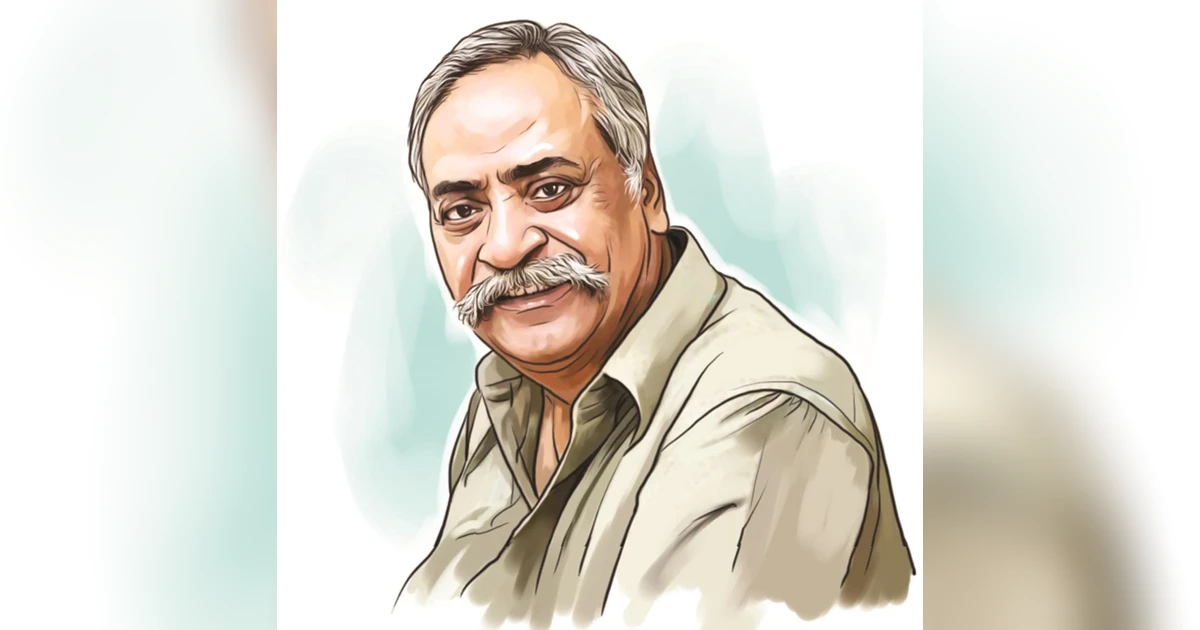
“Yeh Fevicol ka jod hai…” “Chal meri Luna.” “Kuch khaas hai hum sabhi mein.” “Har ghar kuch kehta hai…” Taglines that, one can safely argue, turned brands into household names. That was the creative genius of Piyush Pandey, the advertising legend who signed out on October 24, at 70.
Few people have left the kind of imprint on India’s advertising canvas as Piyush Pandey. An observer who seemed to know what made the country tick, a man who could find humour in life’s everyday struggles and spin magic from it, one who understood that to reach the masses you needed to communicate with them in their language and context – he was all of this and more.
Born in Jaipur in 1955, he joined Ogilvy at 27, and went on to rewrite the rules of what was until then an elite game – cerebral and English-centric. More than the head, he believed that ads needed to touch the heart if they were to hit the spot. Ad after ad proved him right, whether it was the brilliant Fevicol campaign, where his homeland, Rajasthan, featured more than once, or the “Hindustan ka dil dekho” (See the heart of India) ad for Madhya Pradesh tourism.
Through simple yet powerful stories, taglines, and jingles, he created a new idiom for Indian advertising, starting with his first advertisement for Sunlight Detergent. Along the way, he traced the journey of the country’s coming of age – from its pre-liberalisation past to its aspirational, upwardly mobile tomorrow.
Recognised as the “father of Indian advertising”, Pandey was awarded the Padma Shri award in 2016.
As news of his passing broke, tributes poured in.
“…He made a monumental contribution to the world of advertising and communications. I will fondly cherish our interactions over the years…,” wrote Prime Minister Narendra Modi on social media platform X. Pandey’s “Ab ki baar Modi sarkar” campaign ahead of the 2014 Lok Sabha elections, which ushered in Modi as PM, had instantly resonated with the masses.
Finance Minister Nirmala Sitharaman wrote on X: “…A titan and legend of Indian advertising, he transformed communication by bringing everyday idioms, earthy humour, and genuine warmth into it… His legacy will continue to inspire generations.”
“He brought vernacularism into advertising,” said Ad filmmaker Prahlad Kakkar. “He thought and wrote in Hindi.”
Pandey made a generation believe one could remain rooted in their culture and still create universally appealing work, added writer and adman Prasoon Joshi. Samit Sinha, founder and managing director of Alchemist Brand Consulting, said at a time when the advertising industry was steeped in classism and looked down on vernacular advertising as second-rate, Pandey almost single-handedly overturned that notion. Lloyd Mathias, who worked with Pandey while heading marketing for Motorola in 2005-2006, said that Pandey’s creativity was not born of an English ethic but deeply rooted in Indian thought.
His ads, such as Cadbury iconic film featuring a young woman dancing her way onto a cricket field with gay abandon, resonated through their warmth and celebration of uninhibited emotion. Deepak Iyer, executive vice president and president, AMEA, Mondelez International, described him as “more than a creative genius — a dear friend and inspiration,” whose authenticity, humour, and empathy created stories that became part of everyday life.
Pidilite Industries remembered him as a “cultural architect” whose wit and warmth shaped culture and made India smile, while Asian Paints CEO Amit Syngle credited him with the “Har ghar kuchh kehta hai” campaign that transformed how Indians viewed the concept of home. Rajdeepak Das of Publicis Groupe called him a legend who “put Indian advertising on the world map,” and whose vision touched everyone in the industry.
Pandey also led Motorola’s first non-US-focused campaign in India, featuring Abhishek Bachchan, which, as Mathias said, “spoke like family, not like advertising.” Shashank Lanjekar, who worked with Pandey at Ogilvy, said his razor-sharp focus and ability to discard distractions brought unmatched clarity to his work.
Beyond brands, Pandey’s campaigns — from the polio awareness drive to the national integration anthem Mile sur mera tumhara — reflected his social conscience. Manisha Kapoor, CEO and secretary general of the Advertising Standards Council of India, recalled, “He used to say, ‘I don’t want to make an advertisement I’m not comfortable watching with my family.’” For him, advertising was a strategic tool, not art for art’s sake, she added.
While industry veterans agree that his absence leaves an irreplaceable void, they believe his influence will endure. As Sinha summed up, “In the age of artificial intelligence, Piyush’s work is a timeless reminder that technology can never replace imagination.”
