

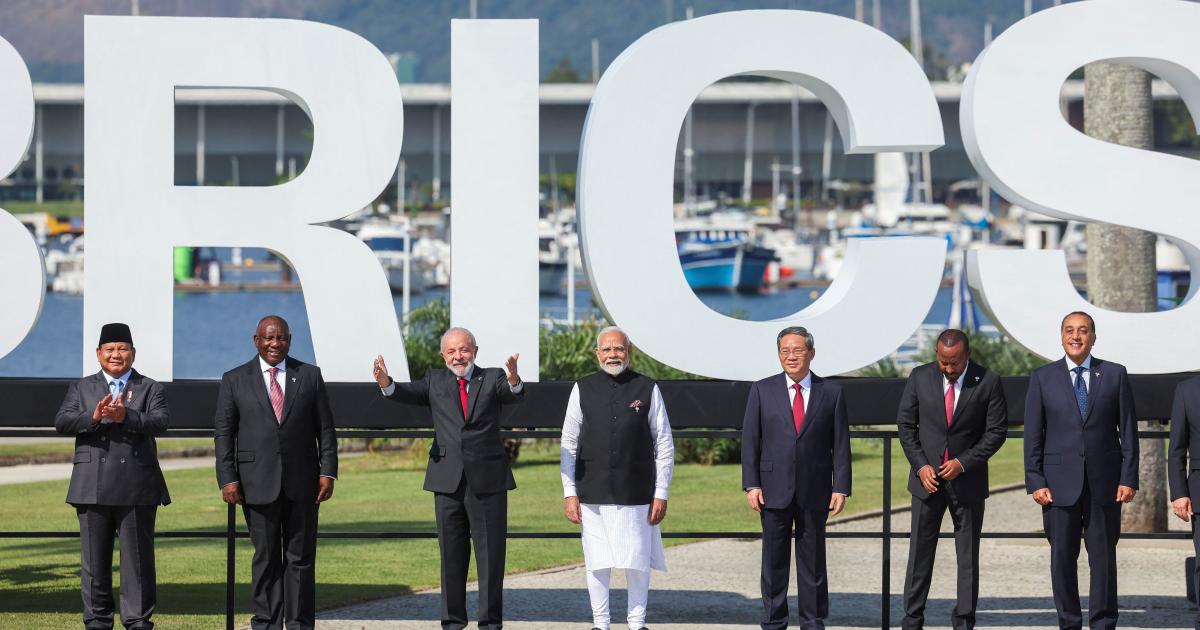
In the battle to shape the global order, the BRICS—a ten-country group, which is named for its first five members (Brazil, Russia, India, China, and South Africa)—has become increasingly important. The bloc represents roughly a third of global GDP and nearly half the world’s population. It exists to give countries that belong to the so-called global South more sway on the world stage.
That might make the BRICS seem like an inherently anti-Western group. It was, after all, founded in part by Beijing and Moscow. But for most of its 16-year history, the BRICS has not positioned itself in opposition to the United States and its allies. Several BRICS members have even been close U.S. partners. Washington has built a strong trade relationship with Brazil, for instance, and cooperates with India and Indonesia on matters of defense.
But much of that picture now appears to be changing. Over the past decade, China and Russia have ramped up their efforts to steer their fellow BRICS members toward a worldview contrary to Washington’s interests. China has become Brazil’s top trade partner and supports the country’s efforts to reduce its dependence on the U.S. dollar. Russia has been selling massive amounts of oil to India. And both China and Russia have courted South Africa as a partner in resisting what Russian President Vladimir Putin has described as the “colonialism” of the U.S.-led order. Meanwhile, the United States has strained its relations with friendly BRICS members. The U.S.-Indian relationship has not been this chilly since 1998, when the United States sanctioned it for testing nuclear weapons. In September, Deputy Secretary of State Chris Landau said that the U.S.-Brazilian relationship was at its “darkest point in two centuries.” And ties with South Africa are the most tenuous they’ve been since the end of apartheid in 1994.
The causes of the deterioration are different in each case, and some of Washington’s grievances against Brazil, India, and South Africa—global swing states that will help dictate which country leads the world—are legitimate. But in each instance, the Trump administration has made relations significantly worse than they should be, and for reasons hard to square with U.S. national interests. As a result, there is a new risk on the horizon: the emergence of the BRICS as a more active, anti-Western bloc that is increasingly dominated by China and Russia. Unless the United States changes policy in the short term, it will pay for this realignment in the long term.
THINGS FALL APART
Democrats and Republicans had, until this year, agreed that a better U.S.-Indian relationship was worth building. The benefits were obvious to policymakers regardless of their party affiliation. India, they realized, could help balance Chinese power in the Indo-Pacific. With the fastest-growing major economy, India also offered substantial economic dividends to American investors. It was the world’s largest democracy and poised to be the world’s most populous country—as it now is.
U.S.-Indian ties, frosty during the Cold War, began to thaw by the end of the Clinton administration and continued warming under every American president and Indian prime minister since. Bipartisan efforts to improve relations resulted in a series of major, concrete achievements. In 2008, the two countries finalized a watershed deal that ended India’s long-standing nuclear isolation by allowing civil nuclear trade with India even though New Delhi never signed the Nuclear Nonproliferation Treaty. In the years since, the two countries have done roughly $20 billion in arms sales. In 2016, the U.S. Congress made India a “major defense partner,” a designation that allows it to buy advanced U.S. military technologies. During his first term, U.S. President Donald Trump became close with Indian Prime Minister Narendra Modi. In 2017, Washington revived the Quad, a coalition focused on Indo-Pacific security made up of Australia, India, Japan, and the United States. The Biden administration built on this cooperation by launching a technology partnership that expanded defense industrial ties between the United States and India. After Trump began his second term, Modi was one of the first world leaders to visit the White House.
And then, at the drop of a hat, Trump upended the relationship. He antagonized New Delhi by repeatedly insisting that he had ended the May 2025 clash between India and Pakistan in Kashmir—a claim New Delhi rejects—and by hosting the Pakistani army chief of staff at the White House in June. According to The New York Times, Trump no longer plans to attend a summit for the Quad, which is scheduled to be held in New Delhi in November. Now, the entire conference may be canceled. He also slapped 50 percent tariffs on India, including a 25 percent hike as punishment for buying Russian oil, and threatened to tack on an extra ten percent tariff to any countries that align with the “anti-American policies” of the BRICS. India condemned the tariffs as “unfair, unjustified, and unreasonable” and has since deepened engagement with Russia and China. In August, New Delhi and Moscow agreed to expand bilateral trade ties. In September, Modi made his first visit to China in seven years to attend a meeting of the Shanghai Cooperation Organization, where he held hands with both Putin and Chinese leader Xi Jinping.
The United States has strained its relations with friendly BRICS members.
Bilateral relations with Brazil were never as close, ambitious, or transformative as those with India. But successive U.S. administrations also saw value in cooperation with Brasília. Trade and investment ties have steadily grown in recent decades, and the United States enjoys a trade surplus in goods—around $6.8 billion in 2024. The two countries have worked with each other on security and counternarcotics for decades and have struck multiple agreements that link their defense technology companies. During his first administration, Trump forged close personal ties with then President Jair Bolsonaro, and Washington designated Brazil a major non-NATO ally.
Then, as with India, Trump’s return to power set relations on a downward trajectory. The bulk of his anger appears rooted in Brazil’s decision to prosecute Bolsonaro for attempting a coup after his 2022 electoral loss, which seemed to remind Trump of his own judicial troubles after his supporters attacked the U.S. Capitol in January 2021. In July of this year, the Trump administration raised tariffs on Brazil to 50 percent, citing a “witch hunt” against Bolsonaro. He also used the Global Magnitsky Act, a law meant to punish foreign functionaries for human rights violations, to sanction Brazilian officials involved in Bolsonaro’s trial—including a supreme court justice and his spouse.
The roots of the United States’ problems with South Africa long predate Trump. Pretoria purports to be a champion of human rights but tends to condemn the injustices of the United States and its allies while ignoring those committed by China or Russia. For example, South Africa accused Israel of committing genocide in Gaza at the International Court of Justice. But when Russia invaded Ukraine, South Africa repeatedly abstained from United Nations votes on the war—rankling officials in Washington. And in 2023, the U.S. ambassador in Pretoria charged South Africa with letting a Russian ship subject to U.S. sanctions, the Lady R, pick up weapons at a South African naval base. In 2024, a bill was even introduced in the U.S. Congress to review the United States’s relationship with South Africa, signaling broad frustration with Pretoria among American policymakers.
Yet the U.S.–South African relationship has deteriorated further since Trump again became president. He accused South Africa of waging genocide against white farmers, a claim rejected by most observers, and created a priority refugee track for Afrikaners, even as he suspended the resettlement of refugees from elsewhere. In March, his administration expelled South Africa’s ambassador from the United States for claiming that Trump’s political movement is driven by a “white supremacist instinct.” In May, Trump played a video for South African President Cyril Ramaphosa that alleged violence against white farmers and handed him a stack of articles that he said described the “death, death, horrible death” of white South Africans. In August, Trump imposed a 30 percent tariff on the country.
A WALL OF BRICS
The United States does have legitimate grievances with Brazil, India, and South Africa. New Delhi has historically maintained a protectionist trade policy, with an average tariff rate of 12 percent, and it started buying Russian oil in large quantities after the invasion of Ukraine to take advantage of the discounted price caused by sanctions. Brazil maintains that both Russia and Ukraine share equal responsibility for the war, has made efforts to reduce its reliance on the U.S. dollar, criticizes Washington for sanctioning Venezuela, and openly seeks “a new geopolitics” that is less dominated by the United States. South African policymakers speak of liberation from an unjust, Western-imposed global order while maintaining close ties with Beijing, Moscow, and even Hamas.
But it is profoundly unwise for Washington to push these swing states away. China and Russia are actively competing with the United States for influence among them, so Brazil, India, and South Africa are caught between a relatively liberal bloc, led by the United States, and a revisionist axis made up of China, Iran, North Korea, and Russia. Washington is unlikely to ever fully win the swing states over to its side; instead, they prefer to maintain relationships with China, Russia, and the United States simultaneously. But if Washington continues to antagonize these countries, it could drive them away.
It is in the United States’ interests to see the BRICS divided between two factions: one that includes China and Russia, which oppose the United States, and the other composed of Brazil, India, and South Africa, which are not automatically at odds with Washington. When the BRICS is polarized, it is less likely to oppose the United States’ interests. But if the former faction takes hold, American power will suffer. The BRICS, for example, might lead a coordinated effort to de-dollarize trade and create alternative payment systems that erode the global dominance of the U.S. economic system, weakening a key pillar of American clout and the effectiveness of Washington’s sanctions. If the BRICS collectively invests more in alternative institutions, including its New Development Bank and Contingent Reserve Arrangement, existing U.S.- and European-led financial institutions, such as the International Monetary Fund, might lose their influence. China and Russia will also gain more opportunities to expand their spheres of influence in the global South, putting U.S. interests in these regions at greater risk.
When the BRICS is polarized, it is less likely to oppose U.S. interests.
Instead of alienating such global swing states, the United States should be working with them. It could team up with Brazil, for instance, to diversify its semiconductor supply chains and offset Chinese influence in Latin America. India remains a key player in the Indo-Pacific, and Washington should keep using the Quad to balance Chinese power. And if Washington signed a trade deal with Pretoria, American officials might entice South Africa to work with the United States on its diplomatic efforts across the African continent. All three countries have access to critical minerals that could help the United States diversify away from adversary suppliers.
Ironically, the Trump administration is, in some ways, unusually well positioned to rebuild these relationships. No American president in memory has been less constrained by existing policy or more willing to change tack. For instance, his administration went from warmly embracing India to denouncing it nearly overnight. And in the past few months, Trump cannot seem to decide whether Russia or Ukraine will prevail in their conflict, alternating where he applies pressure. U.S. foreign policy shifts quickly these days.
But even if the United States makes strides with Brazil, India, and South Africa, some damage will remain. The memory of U.S. capriciousness does not easily fade. India is a case in point: it took decades for Washington and New Delhi to overcome their mutual distrust from the Cold War, when India was close with the Soviet Union, and the United States had a partnership with Pakistan. Indian policymakers still remind American diplomats about U.S. support for Pakistan during the 1971 Indo-Pakistani war and the United States’ deployment of a naval task force to the Bay of Bengal. Even if the administration changes policy on a dime, no multi-aligned country will suddenly go all in with the United States.
But that is no excuse for not trying. If Washington fails to even mildly improve relations with Brazil, India, and South Africa, Beijing and Moscow will toast their good luck.
Loading…
