

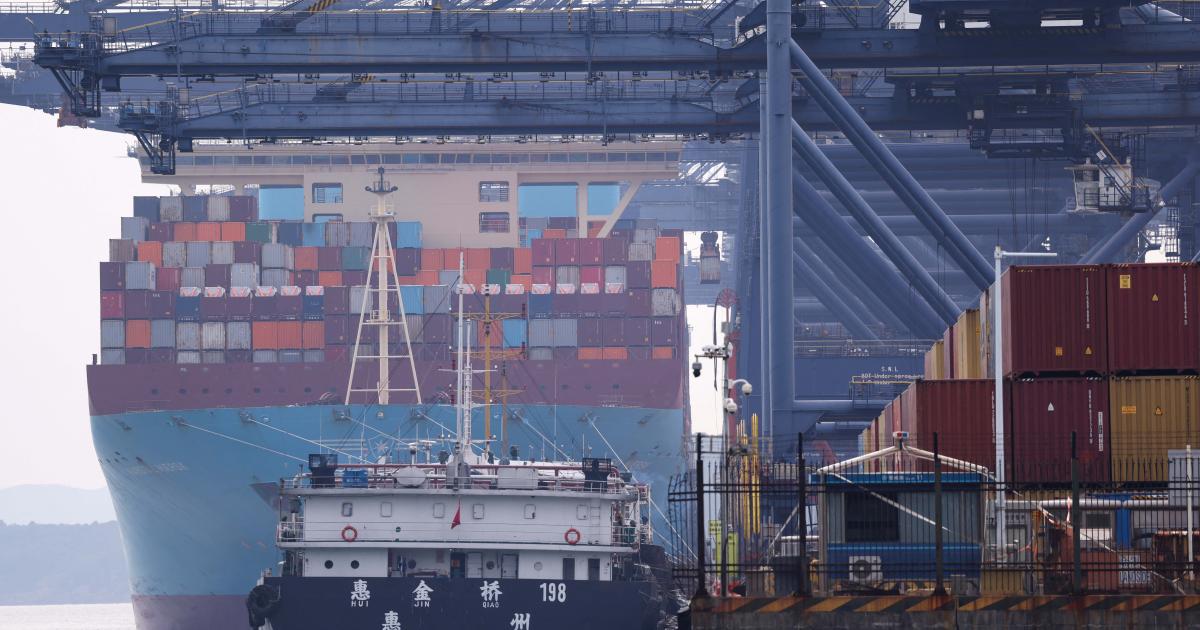
Debates over world trade often conflate two distinct issues. The first is how to expand the efficiencies that occur when international trade is broadly balanced and countries are able to benefit from trade by specializing in particular industries. As the British economist David Ricardo famously observed, when Portugal specialized in producing wine and the United Kingdom specialized in producing textiles, trade allowed them collectively to produce more than they otherwise would. The second issue is how to think about and allocate the costs of persistent trade surpluses—or when some countries export more than they import in order to resolve economic imbalances between domestic production and domestic demand.
Many economists are unable to distinguish between the two, mainly because mainstream models are largely based on assumptions that government intervention in trade is limited, and countries export primarily to maximize their imports. Their policy recommendations thus assume that countries export roughly as much, value-wise, as they import—even in cases where that clearly isn’t true. Instead, some large economies use growing exports not to pay for growing imports but rather to compensate for weak domestic demand. To do so, they manipulate their trade and capital accounts to keep their manufacturing cheap—such as by suppressing their currencies. They then export their cheaper wares, forcing the wider world to absorb their subsidized manufacturing while insulating their economies from the consequences of weak domestic purchasing power.
Persistent trade imbalances are thus the result of a world in which—to use the framing of the Harvard economist Dani Rodrik—countries have made different tradeoffs between global integration and economic sovereignty. Those choosing more of the former have to absorb the imbalances of those choosing more of the latter. Consider, for example, a government that runs surpluses by pursuing policies that effectively subsidize manufacturing at the expense of households. It might do so by suppressing the rate at which banks lend to manufacturers, by depreciating its currency, or by subsidizing transportation infrastructure. Unless its trade partners resist with countervailing policies, they will have to absorb this surplus either through higher domestic investment, higher consumption, higher unemployment, or some combination of the three. That is true no matter how powerful those partners might otherwise be. The United States, for example, has the biggest economy in the world. But because its market has been so open, its economy has been partly restructured by China—which heavily subsidizes its domestic manufacturers.
This doesn’t mean governments should close themselves off to international commerce; people benefit from trade. But to make sure that trade serves their national interests, the United States and its allies must create a system that reduces the ability of countries to offload the cost of their domestic policies. The best way they can do so is by establishing a new global customs union whose members agree to keep their trade relatively balanced and free, while putting up barriers against countries that refuse to balance exports with imports. Within such a union, a government could still choose to subsidize certain types of investment and manufacturing, but only if it can itself absorb the resulting costs. For trade to work, every state must maintain its economic sovereignty. Otherwise, countries will have too strong an incentive to export their economic problems through beggar-thy-neighbor policies.
DUMPING GROUND
Any country’s internal imbalances must always be consistent with its external imbalances, which in turn must always be consistent with the external imbalances of its trade partners. The result in today’s hyperglobalized world is a kind of transitive property: states that control their capital and trade accounts can export the costs of their domestic policies. Consider what happened, for example, when Germany chose to address domestic unemployment in the 1990s with the Hartz reforms of 2003–5. These reforms effectively restrained wage growth relative to productivity, reducing the share of German GDP held by German workers and sharply boosting business profits. The lower wage share limited domestic consumption while the higher business profits led to an expansion in manufacturing. The country’s trade surpluses surged.
These effects did not end at Germany’s borders. At the time, Berlin effectively managed the euro, thanks to its dominance at the European Central Bank, and used this power to limit monetary and interest-rate adjustments within the European Union. As a result, Germany’s EU partners were forced to import nearly all of Germany’s surpluses. As they ran the corresponding trade deficits, their economies had to adjust, sometimes with higher investment, including in real estate bubbles, and sometimes with higher unemployment or rising household or fiscal debt. But either way, the manufacturing share of GDP rose in Germany and fell elsewhere in the eurozone.
Germany’s behavior helps explain why so much of Europe struggled to recover after the 2008 financial crisis. Analysts like to blame the troubles of Greece, Portugal, and Spain on bad domestic decisions, especially excess fiscal spending, but in truth, the hardships they experienced were not only the product of decisions made in Athens, Lisbon, or Madrid. They were also the consequence of policies designed by Berlin to expand German manufacturing. Those policies were transmitted through Berlin’s trade and capital account to its European Union partners, causing them to lose manufacturing while being forced to make tradeoffs between higher unemployment and higher debt. Berlin, in other words, was able to use trade to accommodate its industrial policies in Germany, which in turn constrained and directed policy in much of the EU.
Policymakers must recognize that shared trade entails shared constraints.
A similar story unfolded between China and the United States around the same time. Between 2002 and 2010, as Beijing implemented negative real interest rates to clean up a banking system burdened with bad loans, the household and consumption shares of China’s GDP fell sharply—from an already low 48 percent of GDP at the beginning of the century to a surreal 34 percent by 2011. China’s national savings and trade surplus soared, along with its manufacturing, which was energized by extraordinarily cheap capital.
But again, this was not the end of the story. The Chinese economy’s surplus savings were mostly directed into the United States by the People’s Bank of China. The bank was shocked by the Asian financial crisis of 1997, when a sudden run on the Thai baht set off a vicious currency crisis, rocking the region’s banking systems and pushing many of their economies into serious trouble. China avoided the worst of it, but the People’s Bank—eager to protect the Chinese economy from future such events—accumulated massive amounts of U.S. government bonds to shore up its reserves. By pouring money into these bonds and forcing up the value of the dollar relative to the yuan, China also forced the United States to run corresponding deficits. That led to changes in the latter country’s internal economic imbalances. Manufacturing leaked abroad to China, and American factories closed down production lines and fired workers.
The United States was able to avoid a spike in unemployment, mainly by running larger fiscal deficits and having households borrow more. But as China’s share of global manufacturing surged, the United States shifted domestic economic production away from manufacturing and into service sectors. The United States thus changed the structure of its economy, partially directing and reshaping U.S. employment and leverage, not because Americans chose those changes but because of policies made by decisionmakers in Beijing aimed at stabilizing China’s banks.
TRADE AS IT IS
In a truly open world—one with no directed credit, no currency intervention, no restrictions on trade and capital flows, and minimal government intervention in output—one country’s imbalances would not be so easily transmitted. Instead, they would tend to self-correct as market-determined exchange rates, capital flows, and interest rates adjusted in ways that reversed the internal imbalances. In this world, trade would be broadly balanced, with countries pursuing comparative advantages and exporting to pay for imports that maximized domestic welfare.
But in the real world, some major economies actively intervene in their trade and capital accounts, producing persistent surpluses caused by distortions in domestic demand and production, whereas other economies don’t. Little wonder, then, that the present trading system is so unstable. If some countries are able to use an open global trading system to transfer economic headaches onto their trading partners, the latter will eventually turn against the existing regime.
To sustain a stable and fair global system, policymakers must recognize that shared trade entails shared constraints. All major economies must accept similar limits on their ability to manage credit, currencies, and external accounts. The world must, in other words, fashion a new trading regime that forces each member to resolve its external imbalances at home, as the economist John Maynard Keynes proposed at Bretton Woods in 1944.
Thus far, countries have shown little appetite for forging such a coalition. Instead, they are embracing the kind of “beggar-my-neighbor” policies that the economist Joan Robinson warned of in 1937, when she explained that the main purpose of trade surpluses was to externalize the unemployment that results from weak domestic demand. The United States, for example, is now working aggressively—although not very effectively, if the growing U.S. trade deficit is any indication—to reduce its trade deficit by imposing tariffs. Other states are responding with their own retaliatory measures.
Debates over “free trade” cannot be separated from questions of sovereignty.
There is a better way. When trade is used by countries to expand their relative share of production, it allows individual countries to benefit from policies that are collectively harmful. Still, balanced trade can be positive for global growth, provided that it rearranges global production to maximize production efficiency. Instead of trying to restrict trade through piecemeal measures, the United States should try to impose a system similar to what Keynes proposed at Bretton Woods. Washington and its allies should organize a new global customs union open to all countries that commit to balanced trade. States would be able to join the union by agreeing to keep their current accounts with the union within a narrow band. This band would allow normal cyclical variations while preventing the externalization of policy-driven imbalances.
The customs union would then balance trade with nonmembers by adopting variable trade barriers—either in the form of tariffs or taxes on capital flows—that prevent the imbalances of nonmembers from being imported into the customs union. This would not be a political sanction, but rather a rules-based measure among trade partners. To join the union, countries would have to agree to these restrictions.
The principle behind such a union is that the gains from trade are largest when trade flows are reciprocal and sustainable. That is because persistent, policy-engineered surpluses—designed, for example, to boost a country’s manufacturing share by suppressing wage growth—do not maximize global output. They instead reflect income distribution choices and credit policies that reduce global demand while pushing the cost of that reduced demand onto trade partners in the form of higher unemployment or higher debt.
Debates over “free trade” cannot be separated from questions of sovereignty. To sustain a stable and fair global system, policymakers must recognize that integration entails shared constraints. Countries cannot insist on the freedom to engineer domestic imbalances while also insisting that other countries absorb them. Unless major economies accept equivalent limits on their ability to manage credit, currencies, and external accounts, the world will see recurring beggar-thy-neighbor tensions, protectionist backlashes, and a fragmented trading order. The arithmetic of global accounts guarantees it.
Loading…
