

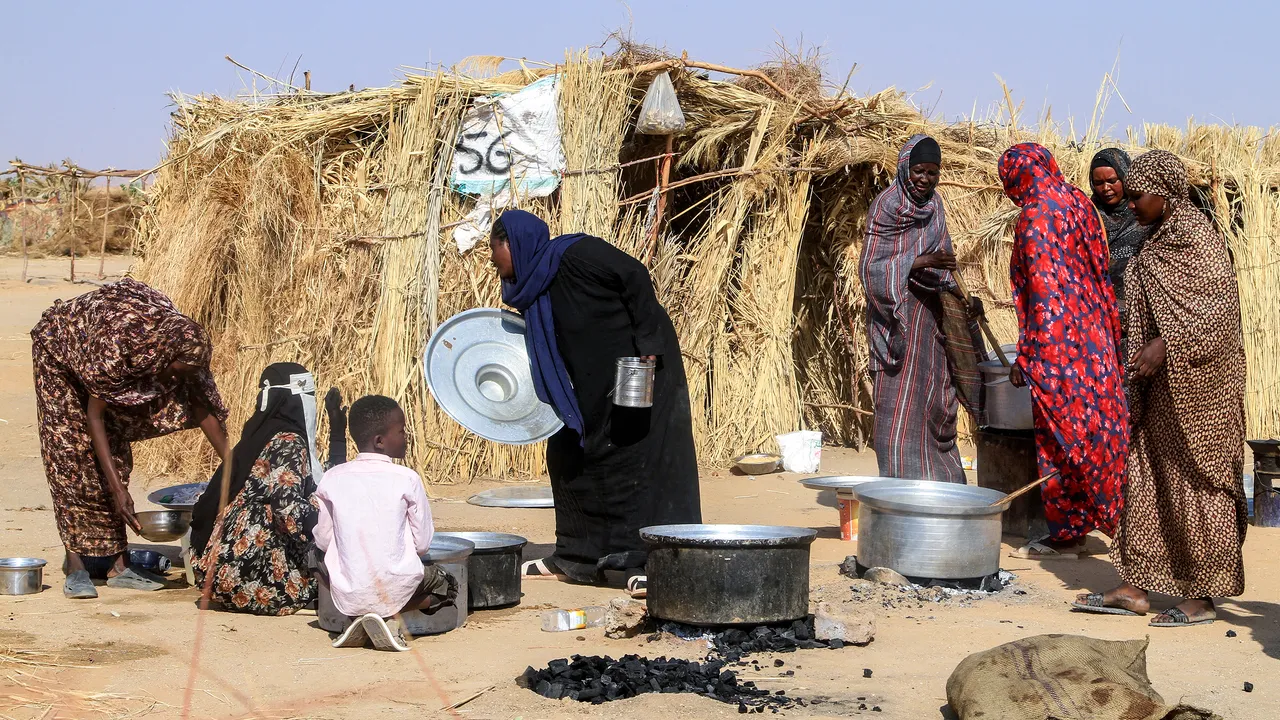
In 2021, Sudan’s military, in coördination with a paramilitary group called the Rapid Support Forces (R.S.F.), launched a coup. But the alliance between the Sudanese Armed Forces (SAF), led by Abdel Fattah al-Burhan, and the R.S.F., led by Mohamed Hamdan Dagalo, known as Hemedti, quickly crumbled, and by April of 2023, the two sides were openly at war. For two and a half years, that conflict has become a humanitarian catastrophe, with an estimated death toll in the hundreds of thousands, and possibly as many as four hundred thousand. More than ten million have been internally and externally displaced.
The Sudanese military still controls much of the north and east of the country, and is backed principally by Egypt; the R.S.F., which was accused of genocide by the Biden Administration in January, is backed by the United Arab Emirates (U.A.E.). It operates in the west, where it has recently taken control of the city of El Fasher, after a five-hundred-day siege. Nathaniel Raymond, the executive director at Yale Humanitarian Research Lab, which has reported on the siege using satellite imagery and other open-source material, recently said that the death toll in El Fasher in late October and early November alone may have exceeded the number of fatalities in the entire war in Gaza.
To talk about the conflict in Sudan, and the role that outside actors have played in it, I recently spoke by phone with Kholood Khair, the founding director of the Confluence Advisory, which focusses on issues of governance and security in Sudan. During our conversation, which has been edited for length and clarity, we discussed why the U.A.E. has gone to such lengths to back the R.S.F., how the war has scrambled alliances in the region, and how the war’s leaders turned the conflict into an ethnic struggle.
How much do you see what’s happening now in Sudan as a civil war, and how much do you see it as a proxy war driven by outside intervention?
I think at the outset it was a domestic conflict, and as far as we could tell the international community didn’t want to see a war in Sudan, and that included Sudan’s Arab neighbors. They felt that a war would be too destabilizing for the region, and that there were other ways to achieve their foreign-policy objectives. But the enmity between different countries that support either one side or the other has definitely increased. The U.A.E. is in direct competition with so many of the countries around Sudan. It has positioned itself with Ethiopia but very much against Egypt when it comes to Nile issues. It has positioned itself very much against Saudi Arabia and Turkey in relation to Red Sea access. It is in direct confrontation with the Houthis in Yemen. And because this war has become a battle between the politics of the Nile and the politics of the Red Sea, we’re seeing many different actors being sucked in.
This is still very much a domestic conflict in that bringing it to an end depends on a Sudanese resolution. I wouldn’t call it a civil war, although increasingly it’s taking on civil war-like qualities. I would call it an all-out war within the Sudanese security state, the largest part of which are the military and the R.S.F. And there are increasingly significant proxy elements, precisely because nations around Sudan have started to see that the only way that they can achieve their foreign-policy and commercial interests is through backing one side or the other.
When you talk about the politics of the Red Sea and the politics of the Nile, and how that’s sucked in neighbors and other actors in the broader region, what specifically do you mean?
When it comes to the Nile, the Egyptians have been very worried about the Grand Ethiopian Renaissance Dam, the GERD, which was inaugurated in September. Egypt has been trying to get Trump to back it against Ethiopia since his first term. If you remember, Trump said two things related to this back then. One, that Egypt’s Abdel Fattah el-Sisi was his favorite dictator. Two, that Egypt might have to blow up the dam, which it saw as a threat to its existence. And Egypt has framed the GERD as just that—a threat to its existence rather than as a development that could result in, for example, some of its share of the Nile water being somewhat diminished. Nile-based countries recently got together and signed a deal without Egypt because pretty much all the other countries in the Nile-based regions have realized that there needs to be much more equitable use of the Nile.
Under colonial agreements, particularly those signed by and put together by the British government, Egypt got the lion’s share of the Nile’s water, and other countries, including Sudan, got much, much less. Egypt wants to maintain as much as possible of that very favorable proportion of Nile water that it is legally entitled to under those agreements. And, of course, other countries, now very much coming into their own and developing their own use of the Nile’s water, do not want that. Ethiopia says that it has created the GERD not just for itself but for irrigation in Sudan, for controlling water levels, and for hydroelectric energy.
And so Sudan’s natural inclination is actually to support the GERD because Sudan needs regular electricity. It needs to be able to control irrigation so it can support its agricultural sector, and the dam can help regulate water levels during flooding season. But the political relationship between the SAF and the Egyptian military regime in Cairo is such that Sudan is effectively forced to act against its interest and support Egypt’s position on the dam, and the Nile in general. So what we’re seeing here is the serious, and almost paranoid, anxiety that the Egyptians have over their diminishing Nile-water entitlements. It’s causing a huge rift in the region, in particular between Egypt and Ethiopia.
The way this is now shaping up is that Egypt has formed an alliance with Eritrea, Ethiopia’s rival, and Somalia, also Ethiopia’s rival. And that alliance is supportive of the SAF. And, in opposition to that, the R.S.F. in Sudan has forged a relationship very much underpinned by the U.A.E. and Ethiopia. The concern now isn’t just what’s going to happen with the Nile’s water and the conflicts around that; it’s what happens if Ethiopia does go to war with Eritrea.
Which has happened in the past.
