

The GOP’s government shutdown became the longest in U.S. history on Wednesday, with no resolution in sight. And new polling suggests Democrats may have little incentive to budge anytime soon.
The findings come from KFF, a nonpartisan health policy research group, and they get at the heart of why negotiations remain stubborn: Americans aren’t particularly opposed to Democrats’ push to extend enhanced Affordable Care Act subsidies, which are set to expire on Dec. 30.
About half of Americans (48%) support Democrats continuing to “refuse to approve a budget unless it includes extending these tax credits, even if it means the government remains shut down,” according to KFF’s survey. A similar number (50%) favor ending the shutdown quickly, even if it means allowing health care costs to rise for some people.
That roughly even split may not seem overwhelming—but it’s notable for a few reasons.
For one, this is far from normal. When Republicans previously used government shutdowns to advance their priorities—such as defunding the ACA in 2013 or building a border wall in 2019—public support for those goals was weak. A 2013 New York Times/CBS poll found that fewer than 1 in 5 Americans thought defunding the ACA was worth a shutdown. And a CBS poll in 2019 found that just 28% backed shutting down the government to build a border wall.
Second, public opinion on Democrats’ new ACA push has remained remarkably stable.
On the first day of the shutdown, Oct. 1, a Washington Post poll found that a plurality of Americans (47%) supported Democrats holding out. A pre-shutdown Strength in Numbers/Verasight survey pegged support at 52% for withholding votes until Republicans agreed to restore funding for certain health programs, such as the ACA and Medicaid, the latter of which is not part of Democrats’ current demands.
Even as the shutdown drags on, Americans’ appetite for Democrats holding firm hasn’t meaningfully waned.
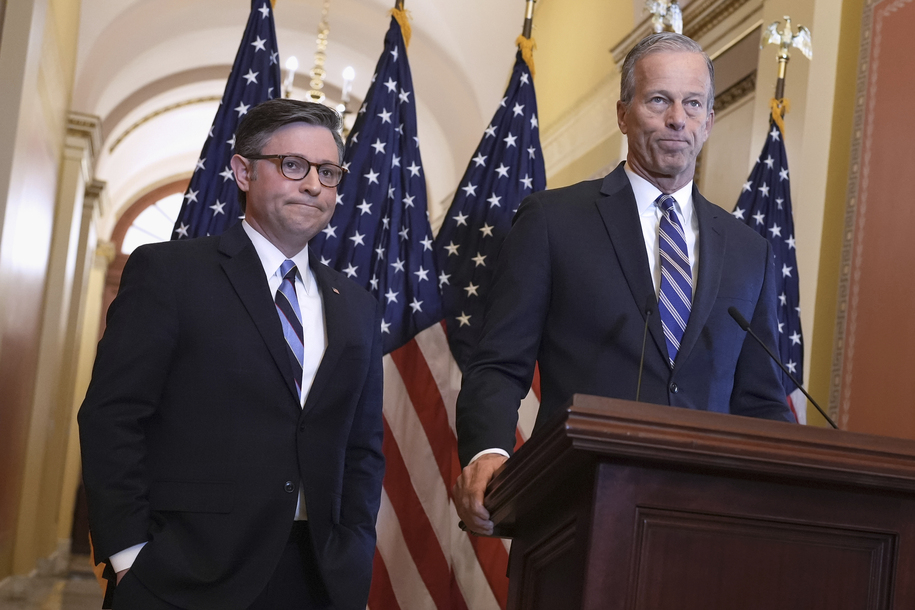
Republican House leadership, with House Speaker Mike Johnson at the center, is trying to sell America on the idea that Democrats are causing the shutdown. The truth is, as President Donald Trump has acknowledged, they have the votes to end the shutdown—they just have to kill the filibuster.
KFF’s polling highlights how sharply the shutdown divides along party lines. Among Democrats, support for holding firm on the ACA tax credits is nearly unanimous—81% say lawmakers should refuse to approve a budget without the extension. Independents are split almost evenly: 51% support continuing the shutdown to protect the subsidies, while 47% want a quick budget deal to reopen the government. Republicans overwhelmingly side against Democrats’ hard line—84% say lawmakers should approve a budget to reopen the government.
But the GOP has always had the power to end the shutdown. Republicans control the presidency, Congress, and the Supreme Court—and could, if willing, act to break the impasse by eliminating the filibuster. Their choice not to do so—nor negotiate meaningfully with Democrats—keeps the country in gridlock.
Notably, among Americans under age 65 who purchase their own health insurance, 55% support Democrats refusing to approve a budget without ACA subsidies, according to KFF’s data. Past KFF data indicate that nearly half of adults enrolled in marketplace plans identify as Republicans or lean Republican, highlighting the cross-party appeal of the policy goal.
In practical terms, the polling suggests Democrats have little incentive to back down. KFF’s data finds that 74% of Americans want to extend the ACA subsidies, and of that group, only 23% say they would blame Democrats if the tax credits expire at the end of the year. Meanwhile, 38% would blame Republicans, and another 37% would blame Trump.
In other words, the Democratic Party could continue driving a hard bargain, even as the GOP blames them for the shutdown—a narrative that has little traction given the public and political realities.
Indeed, Republicans have begun to hint at concessions, including potential votes to extend the ACA subsidies. And the shutdown appears not to have harmed Democrats politically: The recent Election Day results offered no evidence of voter backlash, and President Donald Trump has publicly suggested the standoff hurt Republicans instead.
In short, Democrats appear to be winning both the messaging battle and, for now, the shutdown war.
