

Unlock the Editor’s Digest for free
Roula Khalaf, Editor of the FT, selects her favourite stories in this weekly newsletter.
A push by more than 80 countries for plans to quit fossil fuels at a divided UN COP30 summit in Brazil failed, as they conceded to a less ambitious agreement that kept global co-operation on climate alive.
The summit in Brazil had been cast as critical for showing that 194 countries could continue to work together to curb greenhouse gas emissions, even as President Donald Trump pulled the US from the Paris agreement and declared global warming a “con job”.
The Brazilian hosts were under intense pressure to get an agreement, dubbed the Global Mutirão, a term for collective action, following the floundering of a UN plastics treaty and a global shipping emissions tax.
EU climate commissioner Wopke Hoekstra said there was “intrinsic” value in striking a deal as a show of multilateralism, after two weeks of negotiations were capped by threats of a collapse through the final night.
Flash points involved finance, adaptation, trade and gender language. The final deal agreed to triple finance for countries to adapt to climate change, a target rich nations had initially objected to.
“I’m not saying we’re winning the climate fight. But we are undeniably still in it, and we are fighting back,” said UN climate chief Simon Stiell.
Several countries led by the EU and Panama slammed as “unacceptable” measures for a separate agreement on how countries would adapt their systems, described as “not fit for purpose”.
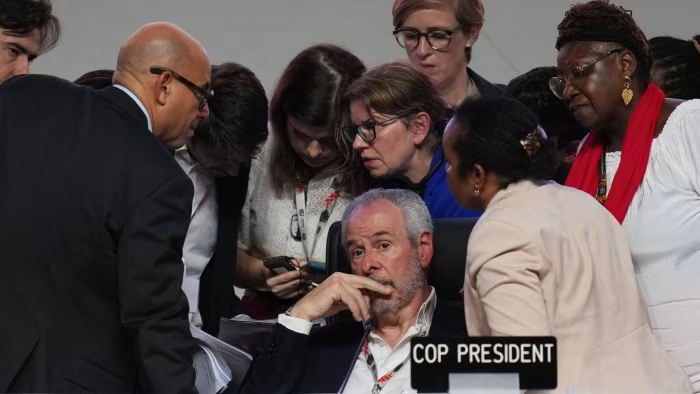
The divisions were laid bare when the Brazilian COP30 presidency was accused of ignoring objections from countries including Colombia, Panama and Uruguay at the final plenary and it was temporarily suspended. Russian and opposed Latin American delegates also sparred in their remarks.
While the final binding agreement failed to include a proposed road map setting out how countries could wean themselves off oil, gas and coal, COP30 president André Corrêa do Lago said Brazil as host country would use the next year to develop two road maps for each fossil fuels and deforestation.
Delegates from Colombia, which pushed for a transition from fossil fuels, raised objections about the UN process during the final plenary. © AP
“We know some of you had greater ambitions,” Corrêa do Lago told a packed plenary hall.
The EU and a handful of others had clashed with petrostates over fossil fuels and national climate action plans, while China also held out. India and African countries argued for more funding for developing nations.
Monique Barbut, France’s environment minister, said Saudi Arabia and Russia had worked in tandem to obstruct climate action, and the COP presidency’s attempts to mediate in a transparent way had been disappointing.
But the fact a deal could be struck at all during a time of US retrenchment was a victory of sorts, she said. “It is a deal without ambition but not a bad deal.”
The agreement included plans for a “global implementation accelerator”, a voluntary initiative aimed at driving efforts to keep “within reach” the Paris accord temperature goal to limit the rise to 1.5C above pre-industrial times.
The EU and other countries vehemently argued this must build on the deal made two years ago at COP28 in Dubai, for a shift away from fossil fuels by 2050, and to triple renewable energy and double energy efficiency by 2030.
Recommended
Ed Miliband, UK energy and climate secretary, said the agreement was an important step forward, especially as multilateralism came under pressure.
“Some people said after Donald Trump announced his withdrawal from the Paris Agreement, it will produce a domino effect. Actually, what you’ve seen is more than 190 countries reaffirm their commitment to Paris,” he said.
In an echo of wider geopolitical tensions, the issue of trade also appeared in the agreement after a strong push led by China and India, who had criticised Europe’s planned carbon tax on imports. Discussions set for next June would look at “opportunities, challenges and barriers” on trade, it said.
One area of key progress was a series of new financial pledges. The most substantial was more than $9bn in total from various countries to halt deforestation, which accounts for about a tenth of global emissions.
Mary Robinson, former president of Ireland and member of The Elders, said: “This deal isn’t perfect and is far from what science requires. But at a time when multilateralism is being tested, it is significant that countries continue to move forward together.”
Climate Capital
Where climate change meets business, markets and politics. Explore the FT’s coverage here.
Are you curious about the FT’s environmental sustainability commitments? Find out more about our science-based targets here
