

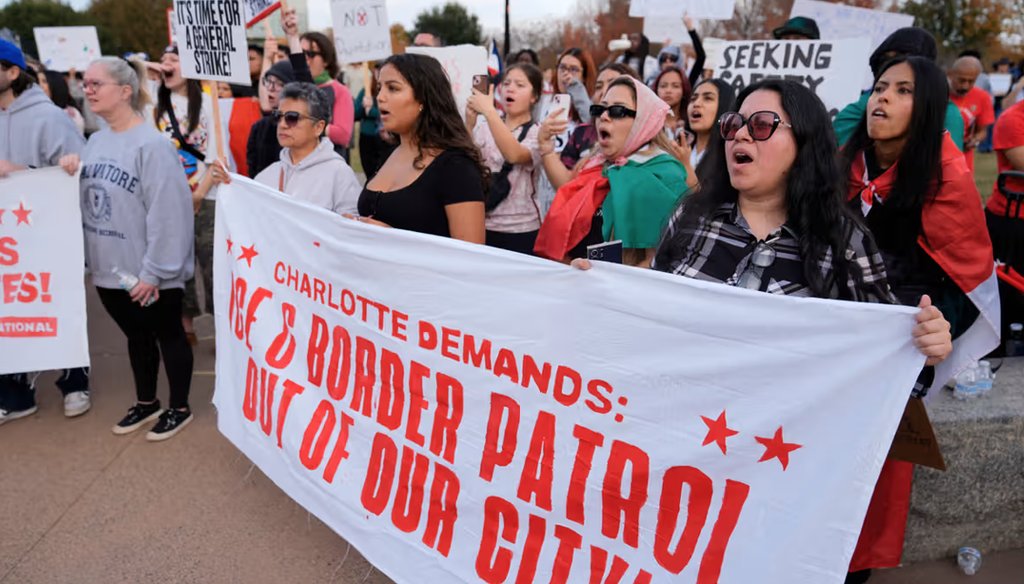
The Trump administration’s deployment of Border Patrol agents in North Carolina’s largest cities prompted a range of claims about the operation from all parts of the political spectrum.
Some of the claims about “Operation Charlotte’s Web” were misleading.
The Department of Homeland Security on Nov. 15 launched the operation in Charlotte and then expanded its efforts to Raleigh days later. The cities were the latest targets of the federal government’s stepped-up immigration enforcement, a campaign promise and top priority of President Donald Trump.
The operation’s stated goal: to capture immigrants who are in the U.S. illegally and have been previously arrested for criminal offenses. By Friday, Border Patrol reported that it had arrested about 370 people.
The operation is ongoing despite objections from local and state officials in Raleigh and Charlotte who worry about teams of agents disrupting their cities, which they claim are already safe. Gov. Josh Stein, a Democrat, criticized the operation as targeting everyday people for their skin color — a claim DHS has disputed.
“I call on federal agents to target violent criminals, not neighbors walking down the street, going to church, or putting up Christmas decorations,” Stein said Tuesday.
Here is a roundup of claims we found to be inaccurate or disputed.
Are North Carolina jails refusing to turn over arrestees to law enforcement ‘right now’?
That’s what Tricia McLaughlin, assistant secretary for public affairs for the Department of Homeland Security, said in an interview with Fox News. However, there’s no evidence it’s true.
“There’s about 1,400 criminal illegal aliens that, right now, are in North Carolina and Charlotte’s jails that they refuse to turn over to ICE law enforcement,” McLaughlin said in a video clip the department posted on X on Nov. 17.
It’s possible she misspoke. The department’s Nov. 15 press release about the operation says North Carolina officials ignored nearly 1,400 of the department’s requests — known as “detainers” — to hold immigrants in local jails so that federal immigration officials could pick them up. It’s unclear when those requests were made or if each one refers to a separate inmate. We asked the department about its numbers and McLaughlin’s claim. A department spokesperson said “CBP has no further information to provide.”
North Carolina sheriffs are legally required to notify ICE when they take someone into custody who they suspect is in the country illegally. They must also comply if ICE demands that the inmate be kept in custody for federal agents to pick up. North Carolina Republican lawmakers passed this law last year over the veto of then-Gov. Roy Cooper, a Democrat, who said it was unconstitutional and also infringed on the rights of sheriffs to run their jails how they see fit.
Do North Carolina cities have sanctuary policies?
The department’s Nov. 15 release said “sanctuary policies” prevented local officials from honoring immigration detainers. That needs clarification.
A decade ago, some North Carolina cities banned their law enforcement agencies from cooperating with federal immigration officials. Then in 2015, former Gov. Pat McCrory, a Republican, signed a law banning those types of policies. However, North Carolina sheriffs maintained the legal flexibility to ignore the detainers if they wanted.
Although most of North Carolina’s 100 sheriffs complied with detainer requests, some did not. Sheriffs in Wake and Mecklenburg counties, for instance, said honoring detainers would strain their relationships with people in their communities and potentially create legal issues. Some courts have said ICE detainers, which aren’t approved by any judge, violate the Constitution.
The GOP-controlled North Carolina General Assembly last year enacted the law requiring sheriffs to honor the detainers. A spokesperson for the North Carolina Sheriffs Association, which represents the state’s sheriffs and advocates on their behalf, said he believes all sheriffs are currently complying with the law.
The Mecklenburg County Sheriff’s Office is not blocking immigration officials from any of the 85 people in its jail who are suspected of being in the country illegally, office spokesperson Sarah Mastouri said. The Wake County Sheriff’s Office is also complying with detainer requests, office spokesperson Rosalia Fedora said. Between Nov. 1 and Nov. 19, federal immigration officials took into custody 28 people who were in the Wake County jail, she said.
Does the uptick in ICE raids harm broader public safety?
Democratic state Supreme Court Justice Anita Earls believes so. In a lengthy statement criticizing the raids, she wrote that the large national immigration crackdown “is making the public less safe, in part because it has resulted in abandoning the effort to stop serious crimes. These agents are being pulled off cases investigating sex trafficking, child abuse and terrorism.”
Earls is correct that ICE has taken thousands of federal agents off their work on other cases to help round people up in the raids in cities across the country. But does that make the country less safe? Not everyone agrees.
Trump personally ordered thousands of federal agents reassigned to ICE on his first day in office this year, writing in an executive order that he was doing so because “many of these aliens unlawfully within the United States present significant threats to national security and public safety, committing vile and heinous acts against innocent Americans.”
According to data analysis by the Cato Institute, a libertarian think tank, roughly one-fifth of all FBI agents, as well as half of all DEA agents, have been reassigned to working on immigration raids like the ones in North Carolina due to Trump’s executive order.
Ninety percent of the Department of Homeland Security Investigations staff has been reassigned to ICE, according to Cato. HSI is a unit of ICE but traditionally handles international criminal activity, rather than immigration enforcement. Those 6,198 HSI agents had previously been tasked with handling human trafficking, child exploitation, cybercrime, weapons export controls, intellectual property theft, drugs, and terrorism cases — the same issues Earls raised concerns over.
Trump wrote in his executive order that as long as he’s president, “the primary mission of [HSI] is the enforcement of … federal laws related to the illegal entry and unlawful presence of aliens in the United States.”
Did Charlotte traffic plummet after Border Patrol started its operation?
Some X posts claimed that traffic cleared around Charlotte after Border Patrol launched its operation. The Department of Homeland Security shared a post showing a map of Charlotte with clear roads, adding the caption: “You’re welcome.” And state data shows traffic dipped in some areas.
The state Department of Transportation monitors traffic on the major thoroughfares around Charlotte, such as Interstate 77, Interstate 85, Interstate 485, and U.S. 21. We wanted to compare traffic on Nov. 17 with traffic on Nov. 10 — the Monday after Board Patrol arrived vs. the Monday before agents arrived. The number of vehicles dipped between 1% and 7.9% depending on the road, a DOT spokesperson told us.
In the Raleigh area, Border Patrol agents ramped up their operation Tuesday and Wednesday. Traffic volumes were down 0.5% to 4.8% on Wake County thoroughfares on those days compared to the previous week, DOT said.
Are nearly 15% of Mecklenburg County’s public school students here illegally?
Stephen Miller, President Donald Trump’s deputy White House chief of staff, shared a news report on X that nearly 21,000 of the county’s students missed school on Nov. 17, adding: “So a conservative estimate is that one-seventh of a major southern public school district is here illegally.”
The Charlotte-Mecklenburg School System’s average daily membership is about 140,000 students, according to 2023-24 data collected by the state Department of Public Instruction. The number of students who missed class that day — about 21,000 — does come out to about one-seventh of the district’s student population, or 15%. But that doesn’t mean that the students who were no-shows are in the U.S. illegally.
The latest available data shows that nearly 8% of Charlotte-Mecklenburg students miss class on any given day.
Students often miss school because they are sick, have an appointment, or are on vacation. It’s also possible some students skipped school because they were afraid immigration agents would target them whether or not they are citizens. It’s difficult to know how many of the district’s students entered the U.S. illegally because the state doesn’t track its students’ citizenship statuses.
Did immigration agents shoot someone in Charlotte?
That’s what a video on social media claimed, showing a man being wheeled away in a stretcher as masked, armed federal agents kept watch on the crowd gathered nearby and filming.
McLaughlin said the social media post was false. The man in the stretcher was being taken into ICE custody, she said, but hadn’t been shot. She said he “had a panic attack and was taken to the hospital, where he attempted to escape by climbing into the ceiling tiles from the hospital bathroom. He was unsuccessful and was apprehended inside the ceiling by law enforcement.”
Is Border Patrol done with North Carolina?
Democratic leaders in Charlotte on Nov. 20 celebrated what they said was the end of the operation. Charlotte Mayor Vi Lyles wrote on social media: “It appears that U.S. Border Patrol has ceased its operations in Charlotte. I’m relieved for our community and the residents, businesses, and all those who were targeted and impacted by this intrusion.”
But, later that same day, federal officials said those announcements were far too premature. McLaughlin, the DHS spokeswoman, said “the operation is not over and is not ending anytime soon.”
In the Triangle, ICE has a permanent presence, it maintains a detention center in Cary. Local police investigated a “suspicious vehicle” parked near there Friday, even calling in a bomb squad, which ultimately deemed the vehicle safe.
