

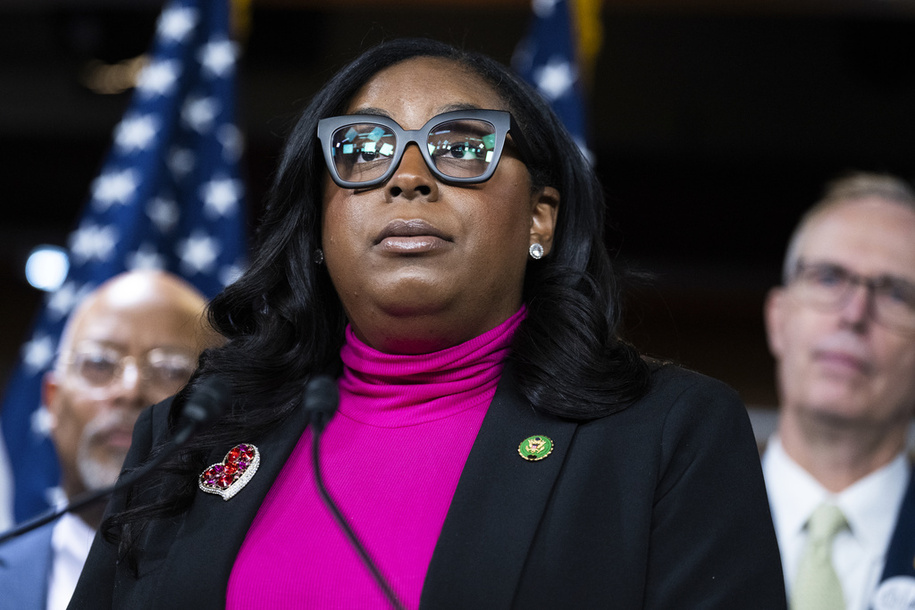
A federal judge on Thursday cleared the way for the Justice Department to move forward with its case against Democratic Rep. LaMonica McIver of New Jersey, who was accused of assaulting immigration agents outside of a privately run detention center in Newark.
McIver’s team—and Democrats more broadly—have long insisted that the charges are selective and retaliatory, arguing that she did nothing wrong and was acting squarely within her authority as a lawmaker to inspect the facility.
Democratic Rep. LaMonica McIver of New Jersey exits the grounds at Delaney Hall ICE detention facility in Newark on May 9.
Her attorneys, who maintain that she’s innocent, told The New York Times that they’re reviewing the ruling and plan to appeal now that the judge has rejected her immunity claims.
In his 41-page decision, Judge Jamel K. Semper dismissed McIver’s argument that she’s protected by constitutional safeguards for legislative activity, rejecting her claim that prosecutors were targeting her for political reasons.
“Even if a presumption of vindictiveness could be invoked in the pretrial context,” wrote Semper, a Biden appointee, McIver had “failed to demonstrate that such a presumption is appropriate here.”
Semper noted that the two House Democrats who accompanied her that day weren’t charged—undercutting her selective-prosecution argument—and concluded that the alleged assault was only “incidentally related” to her oversight visit. He also found that her conduct was “wholly disconnected” from her legislative duties.
McIver pushed back forcefully.
“I am disappointed in today’s decision,” she said in a statement. “From the beginning, this case has been about trying to intimidate me, stop me from doing oversight, and keep me from doing my job. It will not work.”
She added that she fears the ruling will “embolden the administration” but vowed that “this case is not over.”
The stakes are high: the indictment, which carries a potential decades-long prison sentence, was signed by Alina Habba—President Donald Trump’s former personal attorney who he tapped as New Jersey’s top federal prosecutor. It’s part of a pattern of DOJ cases brought against prominent critics of Trump, including New York Attorney General Letitia James and former FBI Director James Comey.
Semper’s ruling also comes amid a broader fight over congressional oversight. The Trump administration has already moved to restrict lawmakers’ access to immigration facilities and has effectively halted oversight visits during the shutdown.
New York Attorney General Letitia James has also been targeted by Trump’s Justice Department.
Speaking with the Times, McIver’s spokesperson Hanna Rumsey called the ruling “disappointing” and reiterated that the charges are “baseless.”
“This is not about one person,” Rumsey said. “This is about how the administration wants to use criminal charges to target political opponents.”
The confrontation at the center of the case unfolded on May 9, when McIver and two Democratic colleagues arrived unannounced at the Delaney Hall detention center as part of an oversight inspection.
Video captured immigration agents emerging from behind the gates to arrest Newark Mayor Ras Baraka on a trespassing charge. In the brief scramble that followed, McIver moved toward the mayor and allegedly used her forearms to “forcibly strike” an agent—though no one was injured. She, Rep. Bonnie Watson Coleman, and Rep. Rob Menendez then continued their tour of the facility.
Habba’s office dropped the trespassing case against Baraka 10 days later but announced it would pursue charges against McIver instead.
Her lawyers argue that the indictment should have been dismissed for multiple reasons, including protection under the Constitution’s speech-or-debate clause, and cited comments from Habba and Trump as evidence that she was being targeted for her political views. Habba boasted that “we could turn New Jersey red” while Trump declared that the “days of woke are over.”
Related | Trump’s DOJ is coming for Kat Abughazaleh—and she’s not backing down
Semper again disagreed, ruling that McIver hadn’t demonstrated “personal animus” from prosecutors. He wrote that she “has not met her burden of establishing that her predominant purpose in physically opposing the mayor’s arrest was to conduct oversight or gather information for a legislative purpose. No genuine legislative purpose was advanced by defendant’s alleged conduct.”
McIver is one of several elected officials across the country who have publicly confronted immigration agents and later found themselves facing criminal charges.
Her next hearing is set for Nov. 20.
But for now, the case against a sitting member of Congress who challenged Trump’s draconian immigration agenda is moving ahead—a reminder of the steepness of the legal and political costs of crossing the president.
