

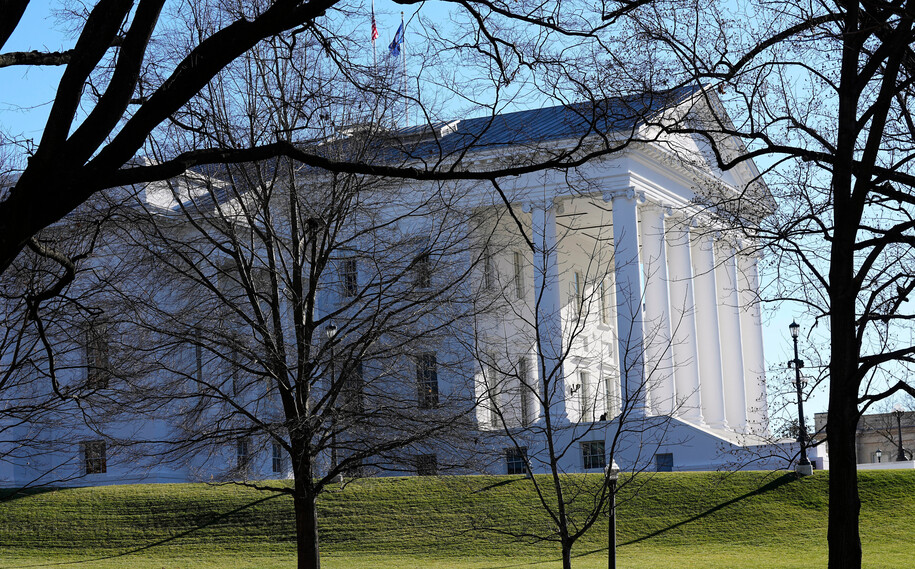
Virginia Democrats took a major step on Friday toward redrawing the state’s congressional map ahead of next year’s midterm elections—a high-stakes move with national implications.
The state Senate passed a constitutional amendment that would allow lawmakers to redraw districts before the end of the decade—but under limited circumstances and only until Oct. 31, 2030. The House of Delegates approved the measure earlier this week.
The plan would let Democrats sidestep the bipartisan redistricting commission that voters approved in 2020, a panel designed to keep mapmaking nonpartisan. To take effect, the amendment must pass the legislature twice, with an election in between, and then win final approval from voters. Lawmakers hope to complete that process early next year, in time for the 2026 midterms.
Democrats hold six of Virginia’s 11 congressional seats and see a chance to redraw the map in a way to give them two or three more Democratic-leaning districts. The strategy is aimed at countering Republican gerrymanders in states like Texas and Missouri, where GOP-led legislatures have pushed through mid-decade maps under pressure from the White House.
The effort is also tied to Virginia’s elections on Tuesday. Democrats are aiming to maintain or expand their 51-48 majority in the state House and flip the governor’s seat, where Democrat Abigail Spanberger is favored. Those wins would be crucial for passing the amendment in a second legislative session before sending it to voters.
Democratic gubernatorial candidate Abigail Spanberger, shown in June.
Of course, Republicans are fighting back. On Tuesday, state Attorney General Jason Miyares issued an opinion stating the amendment cannot be put before voters until after the 2026 elections. GOP leaders have also filed a lawsuit challenging the House of Delegates’ authority to redistrict and questioning how Democrats handled the vote. A judge declined to block the amendment for now, but a declaratory judgment trial is scheduled.
For Democrats, the push is defensive.
“We’re not trying to end the practice of fair maps,” state Sen. Schuyler VanValkenburg, a longtime supporter of the 2020 commission, told NBC News. “We are asking the voters if, in this one limited case, they want to assure that a constitutional norm-busting president can’t rig the entire national election by twisting the arms of a few state legislatures.”
Republicans, seemingly oblivious to how they started all this, view Democrats’ move as a “power grab.”
“This amendment doesn’t just trample the process that we have created and put in our Constitution. It betrays the people’s will,” state Sen. Glen Sturtevant told NBC. “What’s worse, it’s being done in the middle of an election. That’s not reform, that’s reversal. It’s not transparency, it’s a power grab.”
Virginia’s current congressional lines were drawn by special masters appointed by the state Supreme Court after the commission deadlocked in 2021. The resulting map was intended to give no partisan advantage, according to the Princeton Gerrymandering Project.
More than 65% of Virginia voters approved the creation of the commission in 2020, but Republicans in other states, eager to gerrymander their maps, forced Democrats’ hand here.
Virginia is now part of a broader national story. Democrats in California are seeking voter approval to bypass that state’s independent commission, while Republicans in Texas, Missouri, and North Carolina have already enacted new maps. Indiana’s GOP-controlled legislature is also scheduled to hold a special session on redistricting next week, which could result in another gerrymander intended to bolster the party’s slim majority in the House.
For Democrats, Virginia represents a rare chance to fight fire with fire—and potentially tilt the balance in the U.S. House in 2026.
