

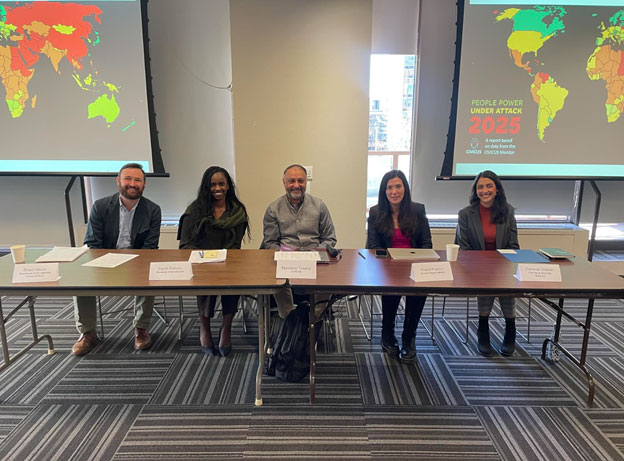
The panelists at the CIVICUS press briefing on the 2025 People Power Under Attack Report. Credit: Oritro Karim/IPS
UNITED NATIONS, December 11 (IPS) – Over the course of 2025, global civic space conditions have deteriorated sharply, with most countries experiencing some degree of obstructed civil liberties. As authoritarian governments strengthen their hold and have even escalated the use of military force to suppress public dissent, civilians report facing increasing limitations of freedoms of association, peaceful assembly, petition and religion, as well as notable crackdowns on press freedoms.
On December 9, CIVICUS Global Alliance published its 2025 People Power Under Attack report, which details the current conditions of civic space worldwide. The findings show that residents of 83 countries and territories now live with routinely denied freedoms—a stark contrast from the 67 countries recorded in 2020. Additionally, 15 countries have recorded considerable downgrades in civic freedoms, including the United States, France, and Germany, which were once seen as global models of democracy.
“We see a continued trend of attacks on people’s right to speak up, come together as a collective, and protest for their rights around the world,” said CIVICUS Secretary General Mandeep Tiwana ahead of the report’s launch. “In a context of rising authoritarianism and populism, no country seems immune from this deeply worrying trend.”
Only an estimated seven percent of the global population now live in countries with free or relatively free civic space—a staggering 50 percent decline from last year’s figures. This has raised alarm among humanitarian organizations, which stress the urgent need to safeguard civic freedoms as a foundation for accountable governance and inclusive democratic participation. CIVICUS highlighted three primary areas of concern: the detention of protestors, journalists, and human rights defenders. These trends underscore the accelerating breakdown of accountability for government corruption and human rights violations.
The report notes that governments detained protestors at more than 200 peaceful demonstrations across 82 countries, with authorities also disrupting protests in 70 countries, with 67 instances involving the use of excessive force. These operations targeted protests calling for action on issues such as government corruption, inadequate access to basic services, rising living costs, the climate crisis, and allegations of electoral fraud.
“We see protests as a crucial space where people can challenge injustice and can hold power to account but we are also watching that space shrink at a rate that should alarm us all,” said Joyce Bukuru, the Representative to the United Nations at Amnesty International.
Amnesty International has recorded the increasing frequency in which authorities suppress public dissent through three key trends. The first of which is that the legal environment for protest is “tightening very fast”. “Across the region, governments are adopting overly broad and outright punitive laws that make it harder for people to protest easily,” Bukuru said.
The organization also reported the widespread use of excessive force. Unlawful and violent policing tactics are routinely used by the government to silence dissent, with instances of arbitrary arrests, enforced disappearances, extrajudicial killings, and the use of weapons such as rubber bullets and stun grenades.
Protestors have increasingly been subjected to increased levels of surveillance, digital repression, and tech-facilitated abuse. Bukuru noted that AI-generated abuse is routinely used against activists, with some stating that they feel like “intimidation follows them everywhere”.
In Uganda and Thailand, Amnesty International recorded the use of tech-facilitated gender-based violence, in which female activists experienced smear campaigns, sexualized doctored images, and threats. “These tactics fundamentally change the risk calculus for anyone considering to engage in activism,” said Bukuru.
In the report, CIVICUS noted that repression of journalists remains pervasive globally. Arrests and detentions of journalists have been documented across 73 countries, with attacks being recorded in 54. Additionally, CIVICUS noted the rise of violations surrounding online freedoms, with roughly 11 percent of all violations occurring online. This includes internet and social media shutdowns, online censorship, coordinated disinformation and misinformation campaigns, and online threats.
The detention of human rights defenders is especially common in Africa south of the Sahara, the Americas, the Asia-Pacific, and the Middle East and North Africa (MENA). Female and LGBTQI+ activists are routinely subjected to threats of violence, attacks, and increased rates of detention.
“When human rights are not part of the conversation, that sends a message to the rest of the world,” said Widad Franco, the UN Advocacy Officer at Human Rights Watch (HRW). “When you see some kind of excessive response [from governments], the lack of human rights makes it much harder to protect people on the ground.”
CIVICUS emphasized the urgent need for stronger protections of civic space within the United States, with Tiwana warning of the significant global ripple effects that the current administration’s actions could trigger. Efforts by the current administration to suppress dissent, undermine freedom of association, and slash funding for foreign assistance risk setting a dangerous precedent for other governments to follow.
“The U.S. plays an outsized role around the world. When the U.S. signals that it no longer cares about democracy or human rights, it sends a strong message to [authoritarian governments] that they can do whatever they like,” said Tiwana. “Secondly, the U.S.’s own dismantling of USAID has triggered a reduction of funding by other wealthy democracies that are now repurposing the resources they give to civil society or democracy support programs towards their own economic interests.”
Tiwana noted that the United States’ current approach increasingly mirrors China’s model of transactional diplomacy, a shift that risks deepening global economic inequalities. This approach enables the wealthy to exert a disproportionate grasp over governance, while marginalized and lower-income groups continue to struggle for access to essential services and remain considerably underrepresented.
“It is unfortunate that the U.S. is following China’s cue and disregarding its long history of ensuring that human rights are a pillar of foreign policy,” said Tiwana. “Wealthy individuals are basically gaming the system and that is what is leading us into 19th century levels of inequality. People are being denied the agency to call out high-level corruption and to call out the denial of basic services.”
IPS UN Bureau Report
© Inter Press Service (20251211054452) — All Rights Reserved. Original source: Inter Press Service
Where next?
Related news
Browse related news topics:
Latest news
Read the latest news stories:
- CIVICUS 2025 Report Reveals Widespread Attacks on Civic Freedoms Worldwide Thursday, December 11, 2025
- Funding for Human Rights Organizations – including at the Grassroots Level – have Been Slashed Worldwide Thursday, December 11, 2025
- A New UN Secretary-General Needs the Blessings of the US –or Get Vetoed Thursday, December 11, 2025
- Human Right Day 2025 Wednesday, December 10, 2025
- International Funding for 30×30 Biodiversity Target Falls Billions Short of Global Goals Wednesday, December 10, 2025
- How Community Radio Is Powering Tanzania’s Climate Resilience Wednesday, December 10, 2025
- The Daunting Tasks Ahead for the New UN Secretary-General Wednesday, December 10, 2025
- Eastern DR Congo fighting kills scores, cuts food aid and drives mass displacement Wednesday, December 10, 2025
- World News in Brief: Gaza winter storm, $7 billion UNICEF appeal, support for emergency response fund Wednesday, December 10, 2025
- Global campaign reveals how human rights ‘are the basis of our existence’ Wednesday, December 10, 2025
In-depth
Learn more about the related issues:
Share this
Bookmark or share this with others using some popular social bookmarking web sites:
Link to this page from your site/blog
Add the following HTML code to your page:
CIVICUS 2025 Report Reveals Widespread Attacks on Civic Freedoms Worldwide, Inter Press Service, Thursday, December 11, 2025 (posted by Global Issues)
… to produce this:
CIVICUS 2025 Report Reveals Widespread Attacks on Civic Freedoms Worldwide, Inter Press Service, Thursday, December 11, 2025 (posted by Global Issues)
