

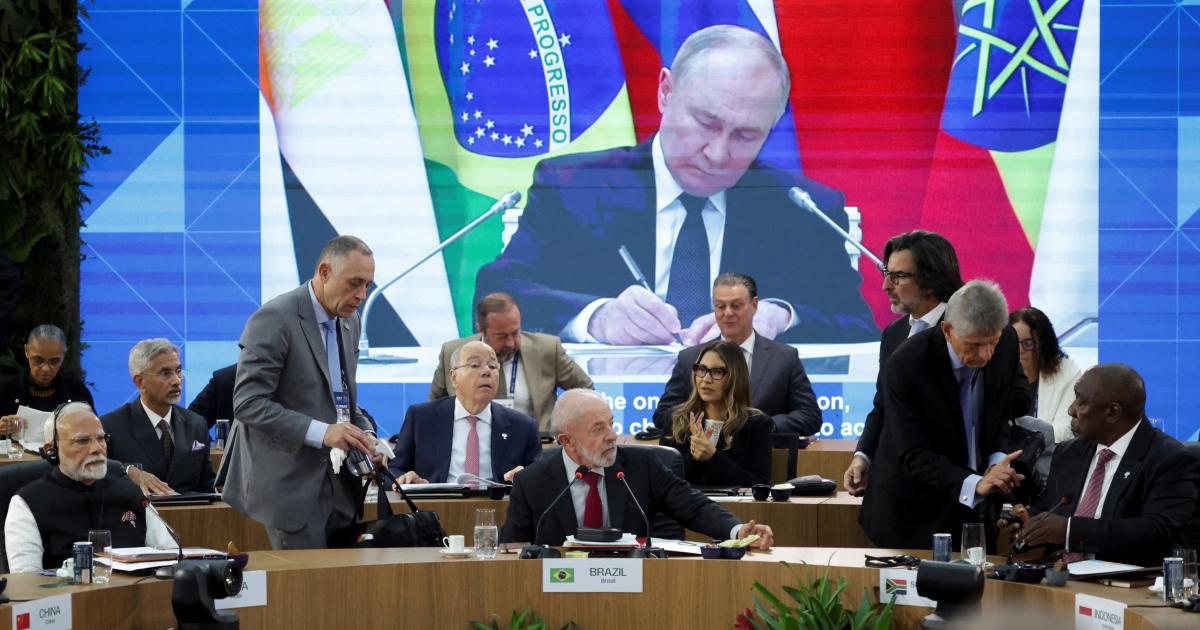
This year, the BRICS—a ten-country group whose first five members were Brazil, Russia, India, China, and South Africa—has gained a renewed sense of purpose thanks to one catalyst: the United States. With U.S. President Donald Trump’s return to the White House, the bloc looks, more than ever, like a necessary hedge against an increasingly erratic and fragmented global order. Many of Trump’s actions—including his chaotic tariff crusade against friends and foes, strikes on Iran and legally dubious military actions in Latin America, and withdrawal from the UN-supported Paris agreement on climate change—have sparked condemnation from the BRICS. Trump’s policies have put in stark relief BRICS’ raisons d’être: to help its members adapt to and build a less Western-centric world, gain greater leverage in their dealings with Washington, and find alternatives to Western-dominated institutions such as the World Bank and the International Monetary Fund.
But despite their shared interests, BRICS as a grouping is not ready to seize the moment. Its members—which now include Egypt, Ethiopia, Iran, Indonesia, and the United Arab Emirates—are too divided to turn the group into a real challenge to Washington. They vary significantly in their degree of antagonism toward the United States, and each wishes to maintain strategic autonomy. As a result, the bloc will struggle to mount joint action. To unite and marshal their collective strength, the BRICS would have to turn into something akin to the G-7—a U.S.-led group of economically advanced countries that, in the interest of promoting their common purpose and values, willingly sacrifice a significant degree of strategic autonomy. But the BRICS countries, whose bond is based mainly on a collective rejection of U.S. hegemonic power, won’t find the cohesion that could make the bloc an effective geopolitical force.
POWER IN NUMBERS
While previous U.S. presidents have largely ignored the BRICS, Trump has adopted a more confrontational stance. He has called the BRICS an “anti-American bloc” and has repeatedly threatened to impose 100 percent tariffs on its members if they were to replace the U.S. dollar as a reserve currency. For now, the Trump administration is not going after the bloc as a whole but picking fights with individual countries. Some BRICS members, such as China and Russia, are better equipped to weather U.S. pressure than others, such as Brazil, India, and South Africa. But all now have a clearer understanding that they are stronger together than apart: the more domineering the United States behaves, the more important the group is to its members.
For years, Beijing has warned fellow BRICS members that the U.S.-led order is unstable and subject to the political mood swings of Washington and its allies. The Chinese leadership has presented Trump’s return, and the United States’ unreliability as a partner in development, as evidence that Beijing’s push to build parallel institutions, such as the New Development Bank, was not premature but prescient. And the consequences of Trump’s “Liberation Day” tariffs, including volatility in the U.S. bond market and a fluctuating U.S. dollar, have spurred some developing countries to take steps to hedge against their exposure to the dollar. For China and its partners in the BRICS, these developments present an opportunity to leverage financial services that are not controlled by the United States, develop tools to reduce their dependence on the U.S. dollar, and facilitate trade in alternative currencies.
Moscow, too, sees advantage in the chaos that the Trump administration has sown. During the Biden administration, the United States and other Western countries imposed unprecedented sanctions against Russia in response to the Kremlin’s war of aggression against Ukraine. Trump’s return to the White House presented Russian President Vladimir Putin with an opening to improve, if not normalize, relations with Washington. Trump has dramatically scaled back financial support for Ukraine, but he continues to issue periodic threats against Moscow and has sanctioned Russia’s two largest oil producers. This is why Russia realizes that it needs to strengthen its partnership with fellow BRICS countries and leverage the grouping as a support network to withstand the Western sanctions pressure and to erode U.S. global dominance in finance and technology.
Trump’s policies have put in stark relief BRICS’ raisons d’être.
Trump’s crusade against Brazil, India, and South Africa has likewise set in motion forces that should, in theory, bring the BRICS members closer. Trump imposed 50 percent tariffs on Brazilian imports earlier this year, arguing that an investigation of former president Jair Bolsonaro was politically motivated. When Brazil’s top court convicted Bolsonaro of attempting a coup, Trump escalated further, sanctioning a Brazilian Supreme Court justice tied to the case and cancelling the visas of several Brazilian judicial and government officials.. These measures have only pushed Brazil to deepen its ties with fellow BRICS members. As one of Lula’s advisers recently pointed out, Trump’s attacks “are reinforcing our relations with the BRICS, because we want to have diversified relations and not depend on any one country.” Even before the Bolsonaro conviction, Lula had been currying favor with BRICS allies and paying official visits to China and Russia as well as Vietnam, which became a BRICS partner in June. But Trump’s bellicose approach is sure to accelerate this trend.
South Africa’s diplomatic friction with the United States has had similarly predictable results. Relations hit a new low following Trump’s meeting with South African President Cyril Ramaphosa in May. In a tense encounter that was widely broadcast and dissected across South African media, Trump ambushed Ramaphosa with false and inflammatory claims about a “white genocide” targeting Afrikaner farmers. Trump’s rhetoric echoed fringe conspiracy theories and played to segments of his domestic base, but it left South Africans across the political spectrum shocked and offended. The Trump administration had previously expelled South Africa’s ambassador, threatened to impose steep trade penalties, and canceled aid programs. For the South African leadership, the disastrous White House meeting was yet more evidence that the United States had ceased to be a trustworthy partner. Facing a peculiarly hostile administration in Washington, Pretoria has ample reason to pursue greater intra-BRICS cooperation—not out of ideological affinity with its members but out of the strategic necessity to protect itself against an erratic and punitive United States.
Even in India, a country that has spent the better part of the past two decades cultivating close ties with Washington, policymakers are keenly aware that they must hedge in the face of Trump’s unpredictability. This year, Washington has deported thousands of Indian nationals, stalled negotiations over a bilateral trade agreement, and imposed 50 percent tariffs on Indian products. Indian policymakers are now firmly committed to a strategy of “multialignment,” in which BRICS serves not just as a platform for cooperation among countries of the so-called global South but also as a geopolitical insurance policy when U.S. commitments are no longer credible.
Similar sentiments are palpable throughout the other BRICS capitals, where leaders fear that close partnership with the United States may become a liability. Unsurprisingly, the number of countries hoping to join BRICS, either as full members or partner countries, keeps growing. That list includes Bangladesh, Belarus, Bolivia, Cuba, Kazakhstan, Malaysia, Nigeria, Senegal, Thailand, Uganda, Uzbekistan, Venezuela, and Vietnam. The desire to diversify partnerships has not emerged because of Trump alone, of course. Turkey, for example, expressed interest in becoming a full member of BRICS well before Trump’s return. But the president’s second term has elevated multialignment from distant aspiration to urgent strategy.
MUDDLING THROUGH
And yet BRICS is not ready to take advantage of this moment. As the group has grown in size, so have its internal contradictions. This is not entirely surprising. Both Brazil and India, fearing the loss of their own influence and concerned about the group’s cohesion, had long opposed expansion, before giving in to Chinese pressure in 2023. Egypt, Ethiopia, Indonesia, Iran, and the United Arab Emirates all joined in the last three years.
At a BRICS foreign ministers meeting in Rio de Janeiro in April, member states failed, for the first time, to issue a joint communiqué. The deadlock underscored mounting divisions within the bloc over the pace and direction of de-dollarization, the level of antagonism toward the United States, and Beijing’s aspirations for leadership in the grouping. In this case, the source of disagreement was a topic of long-standing symbolic importance to Brazilian President Luiz Inácio Lula da Silva: reform of the United Nations Security Council. Both Egypt and Ethiopia objected to language that would have acknowledged South Africa’s aspirations for a permanent seat, highlighting the complications introduced by the group’s recent expansion. And this July, in an unprecedented development, several heads of state failed to participate in-person in a BRICS summit, and only half of the bloc’s ten member countries sent delegations; the others attended remotely.
The U.S. bombing of Iranian nuclear facilities in June could have unified BRICS. Several member governments were appalled by the strikes, arguing that the United States acted unilaterally, dangerously, and without regard for international norms. For China and Russia, the strikes confirmed long-standing critiques of U.S. militarism; for Brazil and South Africa, countries that have historically prioritized nonintervention and peaceful conflict resolution, the attack was seen as a reckless move that undermined global stability. For India, the assault was not only a violation of international law, but also an attack on a vital energy supplier. Yet in the end, the BRICS’ joint statement, published several days after the bombing, was remarkably vague, failing even to mention Israel or the United States, revealing the grouping’s incapacity to speak with one voice.
As BRICS has grown in size, so have its internal contradictions.
Friction is visible on other fronts, as well. China’s heavily subsidized exports, including steel, textiles, and cars, threaten local industries in countries such as Brazil and South Africa. The resulting tensions complicate intra-BRICS economic coordination, as governments face domestic pressure to adopt protectionist measures against Chinese goods. Although China is eager to use BRICS as a platform to expand its influence and advertise its governance model, other members remain wary of subordinating their interests to Beijing’s ambitions. A recent virtual summit of BRICS leaders, convened by Lula and aimed at developing a common strategy against U.S. tariffs, produced few tangible results.
Despite renewed urgency created by Trump’s return to power, BRICS remains hamstrung by the same structural weaknesses that have long limited its effectiveness: divergent national interests, conflicting economic priorities, and a deep mistrust of one another’s geopolitical ambitions. Expansion has only magnified those challenges, adding more actors and contradictions to an already unwieldy organization. Beijing may view Trump’s bellicosity as conclusive proof of the United States’ unreliability, but other members are reluctant to align too closely with China or to subordinate their own national agendas to a single leader. Group cohesion remains a long way off.
For the foreseeable future, the grouping is likely to continue muddling through—attracting new members, producing grand declarations, and occasionally coordinating positions, but falling well short of becoming the basis of a new model of global governance. Trump has reminded BRICS members why the bloc matters, while simultaneously exposing why it cannot rise to the occasion.
Loading…
