

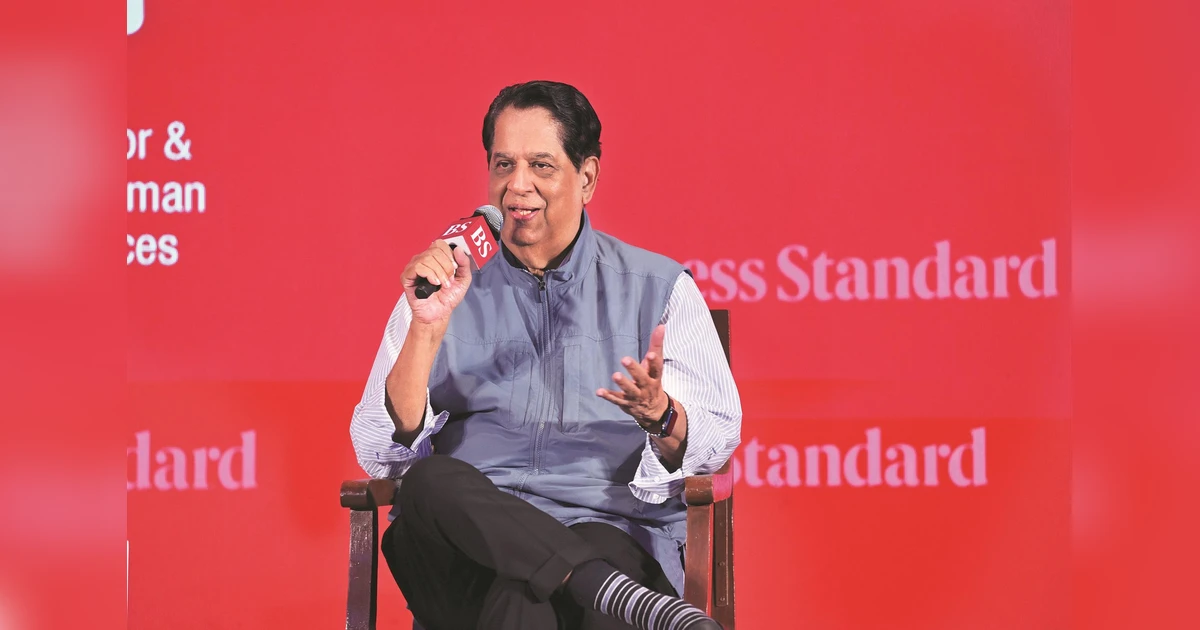
With technological and financial diversification reshaping Indian banking, K V Kamath, chairman and independent director, Jio Financial Services, talks to Tamal Bandopadhyay about the reduced dependence of companies on banks, and the need for lenders to reinvent themselves, focus on retail customers, and invest in the right technology.
There is a confluence of different financial entities — banks, non-banking financial companies (NBFCs), mutual funds, and more — creating channels for money flow. Could you explain what’s happening?
Yes, what you observe is clearly happening. Technology has made financial systems more seamless, allowing savings to move into various forms of investment, savings, and consumption channels, and so on. The layperson in India is now asking if banks are the only structure for such activities. People are deploying their savings in investment products that provide the highest returns on a risk-adjusted, tax-adjusted basis. This shift has gained momentum only in the past four or five years, with structural enablers like pension systems, insurance, and the mutual fund industry playing key roles. The capital market now operates parallel to the banking system, offering consumers more choice.
In the context of Indian banking, there are three things: Liabilities, assets, and fee income. For most of the banks, fee income has been declining. The free float has vanished. How are banks responding to this? Can they do anything about it?
There have been changes even before UPI (Unified Payments Interface). It might have accelerated this. For example, the free float banks enjoyed, like the overnight money in current accounts, has vanished. People can now invest that money in funds that earn returns. Banks need to rethink their operating models. There is a need to change the core model. This shift also means that the profile of the customer is changing. Corporate India’s dependence on banks for working capital is shrinking, and long-term loans are being financed through other channels like capital markets. So, banks need to focus on retail customers and rethink their model to cater to them effectively.
How should banks change their core models to adapt to these changes?
The core model is changing as far as large companies are concerned. They use the borrowing of working capital more in an opportune manner. As their balance sheets have become cleaner, they are able to use cash inflows for funding part of their working capital. So, corporate India’s core need for banks to provide working capital is getting leaner and leaner. There is a clear shift from term loans or working capital loans to alternative sources. Now, banks are increasingly looking towards the retail customer. Retail customers have become aspirants. They have more money, and with their savings they are looking for products. I wouldn’t say that there is any serious challenge for banks. But there is a challenge in repositioning yourself in a way, maybe reinventing yourself.
With the growth projections for India and a low credit-to-gross domestic product ratio, do you think banking in India will evolve to be on a par with that in developed countries, where the market plays a bigger role than banks?
As India grows towards being a Viksit Bharat, we will achieve our objectives and have higher growth in gross domestic product every year for the next 20 years. In China, it was the banks that grew the biggest and the quickest. In India, it is not only the banks, it’s the entire financial system which will grow at this pace and grow the fastest. We will see interesting changes happening and banks will be at the forefront, at least in the immediate future, along with capital-market players.
There’s a lot of talk lately about initial public offerings. However, much of the money raised is not for investment but is offer for sale, where promoters are selling their stakes. Is corporate India really raising funds from the market instead of banks?
A company is generating cash, which is meeting its growth needs. Thereafter, it goes public. That is a good thing because you are putting it on a proper governance structure. If the existing promoters dilute some of their own holding, I don’t see anything wrong in that unless somebody says there was something else behind it, which I am not seeing at all at this point in time. These are companies that have started earning profits at a level which they did not do earlier. I would think that this will be the way of the future.
With companies no longer relying heavily on banks for working capital and infrastructure loans, where does the core competence of banks lie? Do banks need to adapt?
You have painted a picture that banks will face if they don’t reinvent themselves. Because if the customer doesn’t want to borrow from you, there is very little you can do. So, from the corporate side, that’s going to only accelerate as we go along.
On the retail side, it is not that the customer doesn’t want money from you. The customer wants money from a bank. The question is: How are you competing with NBFCs? Because you have all the competitiveness the bank has. The NBFC sector cannot match your cost of funds. The regulator has put a moat around it. If you have the money, you need to figure out how you will put it to productive use. If you (banks) have to reinvent yourself in the bargain, you will have to reinvent yourself in the bargain. Reinvention is not a hugely difficult task. With technology as available today, you can reinvent yourself pretty quickly. The question is: Will you (banks)? And how quickly?
Why aren’t we seeing digital banks like Brazil’s New Bank or China’s My Bank in India?
Digital banks, like My Bank in China or New Bank in Brazil, have grown tremendously, with minimal staff and large customer bases. There is nothing that prevents incumbent banks in India from reinventing themselves to become like these banks. We need to reposition ourselves to take the opportunity. I don’t think they need regulatory support to reinvent themselves.
Do you think the Indian banking system is investing enough in technology?
They are probably investing too much. But they are not investing in the right technology. What you are investing is the same old thing. You need to invest for today. So, again, I don’t want to go down this road, but each bank has to question itself. Am I investing for today? Am I investing the way fintech is investing? Do you think they are investing?
There’s a concern that technology, including artificial intelligence, benefits scamsters more than customers. Is this a valid concern?
Scamsters exploit imperfections in any system. While technology improves customer experience, it can also create opportunities for scams if there are any flaws in the system. In banking, scams have been a constant challenge. The key is to innovate continuously and stay one jump step ahead of scammers. Digital banking requires constant vigilance from both the banks and customers to prevent fraud.
Regarding Jio, there’s been a lot of speculation. Can you share any insights?
I am chairman of the board of directors. Day-to-day decisions and any updates come from the management team, and they will share the game plan when they are ready.
