

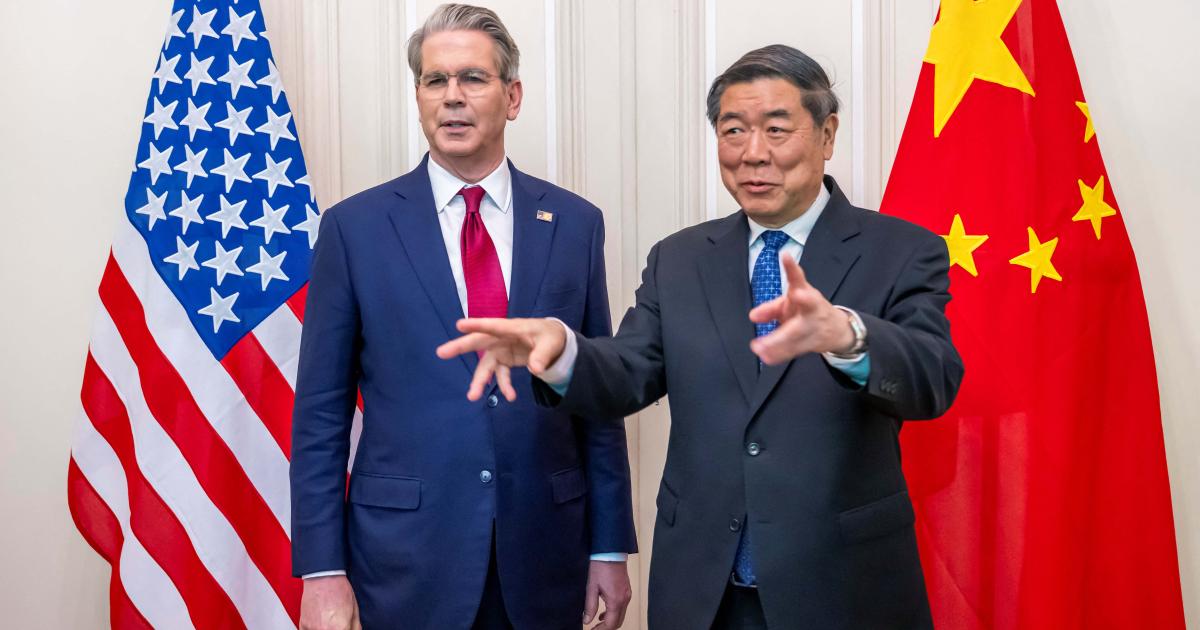
In the repeated cycles of confrontation and détente that define U.S.-Chinese relations, a paradox has emerged. Economic relations between the two countries are more fraught than ever: in early October, for the second time in just six months, the United States and China launched a trade war, imposing prohibitive export restrictions and threatening to raise tariffs to previously unthinkable levels.
Yet the U.S.-Chinese relationship also appears increasingly resilient. Although leaders in both Washington and Beijing have seemingly shrugged their shoulders at the rapid decoupling of the world’s two largest economies, the first bout of trade escalation in April and May gave way to a period of relative calm. Over the past ten months and even during the final two years of the Biden administration, U.S.-Chinese relations have been showing signs of rebalancing. Each time a crisis has arisen, such as when a Chinese unmanned high-altitude balloon flew into American airspace in 2023, U.S. and Chinese leaders have sought to quickly stabilize ties, suggesting that the world’s two largest economies still share a structural need for a broadly steady relationship.
These contradictory trends signal that the U.S.-Chinese relationship might be at an inflection point. Neither Washington nor Beijing harbors any illusions that the two countries can return to the pre-2017 era, in which interdependence and engagement, rather than decoupling and strategic competition, were its defining features. But short-term economic spats and tactical maneuvering for potential deals should not obscure the possibility that the United States and China can move beyond an era of adversarial competition toward a more normal relationship—one in which they can coexist peacefully in a state of cool but not hostile interactions. The meeting between U.S. President Donald Trump and Chinese leader Xi Jinping this week in South Korea presents a narrow but important opportunity for the United States and China to enter a new phase of bilateral relations.
AMERICA VERSUS THE WORLD
The possibility of an inflection point stems in part from changes in U.S. foreign policy. From Beijing’s perspective, Trump’s first term marked the onset of a period of strategic competition in which the United States, viewing China as its most serious adversary and competitor, sought primarily to contain or slow China’s economic and technological rise. It was, in other words, the United States versus China. Under President Joe Biden, Washington maintained the same goals but sought to do so in concert with its allies—the West versus China. For strategists and policymakers in China, both Trump and Biden believed that American and Chinese interests were fundamentally at odds, and therefore the only option was unyielding competition that left no room for compromise.
Although Trump has continued to pressure China in his second term, U.S. foreign policy has shifted. Trump has recalibrated the United States’ economic and security relations with the entire world. His so-called Liberation Day tariffs in April, for instance, targeted more than 100 countries, including many U.S. allies. The Trump administration has repeatedly pressured longtime U.S. partners in Europe to pay for more of their own security, even at the cost of straining ties. Trump’s approach can no longer be characterized as the United States or its allies versus China, but rather the United States versus the rest of the world.
In previous eras, the United States and China found ways to build a foundation on which the two countries could work together despite their disagreements. In the 1970s and early 1980s, they cooperated to counter the Soviet Union. After the Soviet collapse and the end of the Cold War, Beijing and Washington promoted economic integration and shared in the gains of globalization. In the past decade, however, as countries have turned away from globalization, the grounds of cooperation between the United States and China have eroded. But by more fully rejecting the entirety of the old model of globalization—and reorienting its foreign policy strategy away from targeting only China—the Trump administration has created an opportunity to establish a new basis for improved relations.
AFTER GLOBALIZATION
Although strategists and policymakers in Washington and Beijing alike tend to blame the deterioration in U.S.-Chinese relations on hostile policies from the other side, an alternative explanation is that the old model of globalization became unsustainable. Growing friction is a function of structural shifts as much as individual leaders.
China rose spectacularly in the post–Cold War era of liberal internationalism led by the United States. But by relying on a political and economic model distinct from Western liberalism, China’s rise effectively stretched the liberal order to its breaking point. The United States also benefited greatly from a liberal, unipolar world, but it failed to address the dislocation that globalization brought to its own economy and society, leading to intense domestic backlash.
The United States is now dismantling the system it built and led. Many Democrats and Republicans alike have pushed back on liberal internationalism and have instead embraced industrial policy and economic nationalism. Neither the United States nor China now accepts economic efficiency as a justification for dependence on the other side’s financial systems, critical goods, and advanced technologies. Countries cannot halt this process of deglobalization. They can only adapt to it.
China’s growing confidence may make that task easier. In recent years, the United States has imposed significant restrictions on China’s development through export controls on industries such as semiconductors. Yet China has continued to achieve technological breakthroughs. China’s growth rate has slowed, but the economy continues to expand. And Beijing has now found ways to pressure Washington, most notably by controlling the supply of rare-earth magnets on which many U.S. industries rely. A confident China can focus more on implementing sound economic policies at home and less on how U.S. pressure might hinder its goals. By doing so, China will continue to develop and may even improve its global standing relative to the United States.
In this context, policymakers and strategists in both China and the United States have a rare opportunity to temper their attitudes toward each other. Beijing could reconsider whether the United States is intent on thwarting China’s rise. Washington could reassess the dominant perception that China seeks to overthrow U.S. global leadership. A change in narratives will help move past the hostility that has prevented the two sides from working together more productively.
A REBALANCING ACT
The United States and China do not have to be friends, but they do have to avoid being enemies. A new type of relationship requires rebalancing how the two countries depend on each other. For decades, their economic ties were asymmetric: China relied on the United States’ monetary and financial systems, as well as its advanced technology, to fund its growth and provide the know-how it needed to develop its economy. The United States, in turn, depended on Chinese manufacturing to produce low-cost goods to consume. The fierce competition of the past decade has shattered that old pattern. The Trump administration has made clear that the United States will no longer accept a massive trade deficit with China, and Chinese leaders have expressed their uneasiness about reliance on U.S. financial and technological tools. Even before the trade war that broke out in 2018, the two countries had already started to decouple some parts of their economies.
In a relationship characterized by levelheaded stability, competition between the United States and China would endure. But both countries would need to regulate the intensity of the competition and establish clearer lines to demarcate where their economies and societies should interact and where they should be independent. Large-scale Chinese investment in the United States in electric vehicles and batteries, for instance, would make both countries more equally reliant on each other in manufacturing, technology, and finance. But investment should be limited to certain sectors in which both countries agree that collaboration is mutually beneficial. This type of interdependence is more stable—and likely more sustainable—than one in which the United States provides high-value inputs and China produces low-value outputs. Both sides would be more likely to feel they are benefiting from the economic relationship and seek to preserve the balance.
The conditions are ripe for an inflection point in U.S.-Chinese relations.
The two countries also need to recalibrate their geopolitical relations in the Indo-Pacific. The U.S. military routinely conducts reconnaissance missions and freedom of navigation operations near China’s coastline, insisting on its legal right to do so and the necessity of reassuring its regional allies of its security commitments. But these actions risk provoking a dangerous conflict between the world’s two largest military powers. The United States could lower regional tensions by reducing the frequency of these politically provocative actions. Instead, the United States could employ other technological means, such as satellites, to gather military intelligence, which would reduce the risk of military confrontation while allowing it to uphold its security commitments.
U.S. and Chinese leaders can also de-escalate tensions around Taiwan. The Trump administration could reassure Beijing of its position on the island’s future by formally opposing Taiwanese independence. In response, Beijing could reduce the frequency of military exercises and increase cross-strait exchanges. If leaders in Beijing believe there is hope for peaceful reunification, there is less urgency to use military force to resolve the question of Taiwan’s status. This arrangement aligns with Trump’s global vision of trying to broker peace in areas of long-standing conflict.
From the 1990s until this year, the United States prioritized a universal outlook, whereas China focused on nation building. Now, for the first time in decades, the U.S.-Chinese relationship involves two nationalist powers. Trump’s call to “Make America Great Again” and Xi’s vision of the “great rejuvenation of the Chinese nation” are both nationalist goals. Such nationalist visions are not necessarily in conflict. Instead, the United States and China can support each other’s rejuvenation, or at the very least, avoid impeding the other’s progress toward that goal. Trump’s “America first” approach suggests this is possible: when the United States focuses on itself in its foreign policy, it is often more restrained toward China, as has been the case in the South China Sea in the first year of Trump’s second term.
Neither the United States nor China can fully hobble each other’s economy, but each side has economic tools that can inflict real damage if adversarial competition continues unchecked. As Trump and Xi head to the negotiating table, the conditions are ripe for an inflection point in U.S.-Chinese relations that could set a path toward a more stable and effective relationship. Such a course correction is far from guaranteed. But it is a possible and worthy goal.
Loading…
