

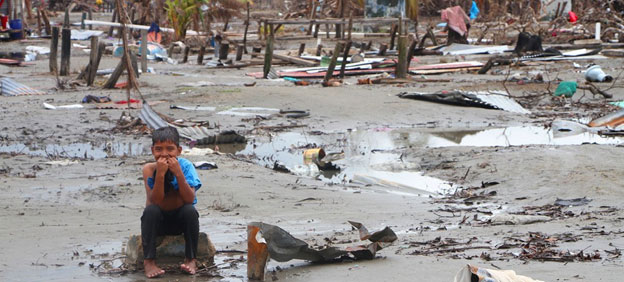
Credit: UNICEF/Gema Espinoza Delgado
STOCKHOLM, Sweden, November 14 (IPS) – The urgency of linking climate action with social and wider environmental priorities is clear. Climate change, environmental degradation and violent conflict are often deeply connected and even mutually reinforcing. At the same time, climate action can either support or undermine efforts to improve social justice and halt environmental degradation.
These connections are nowhere more visible than in global food systems, where environmental pressures, social inequality and economic shocks converge. And Latin America, where COP30 is taking place, could be central to the solution.
Climate change, violent conflict and economic crises are major drivers of food insecurity, while food production itself contributes to more than one-third of global emissions and accelerates biodiversity loss through land use change.
Despite steady growth in agricultural production over the past two decades, hunger persists: in 2024, around 8 per cent of the world’s population faced hunger, many of them small-scale farmers in crisis-affected regions.
Latin America’s paradox: ecological abundance amid social and environmental fragility
Latin America embodies the contradictions at the core of the global climate and development agenda: vast ecological resources and food production capacity coexist with significant inequality, environmental degradation, and social unrest.
Its ecosystems regulate carbon and water cycles essential to planetary stability and the region is the world’s largest provider of ecosystem services. Latin America also holds the greatest per capita availability of agricultural land and water, making it both the world’s largest net food exporter and a carbon sink.
Yet these assets face mounting pressure from deforestation, land-use change, and extractive industries. The degradation of forests, soils, and watersheds not only accelerates emissions and biodiversity loss but also deepens local grievances over land, livelihoods, and access to resources. This, in turn, heightens the risk of social tension and violence in a region marked by extreme inequality, widespread violence, and the world’s highest number of environmental conflicts.
Unequal land distribution and the expansion of extractive and agricultural frontiers perpetuate a cycle of degradation and displacement. Environmental decline erodes resilience to droughts, floods, and other climate impacts, undermines food security and increases competition over dwindling resources.
Climate change exacerbates these challenges: extreme weather events reduce crop yields and fuel migration, while the destruction of ecosystems diminishes the capacity of nature to buffer against future shocks.
Many of the region’s environmental conflicts stem from disputes over territory, water, and the impacts of large-scale projects that privilege short-term, growth over sustainable livelihoods. Criminal networks and weak governance exacerbate instability through illegal mining, logging, and land grabs, whereas violence against environmental defenders deepens distrust in state institutions.
Agriculture and governance at the crossroads
The agricultural sector lies at the centre of this nexus. It is a cornerstone of Latin America’s economy and a major source of global food supply. Agricultural exports grew 1.7 times between 2010 and 2023, generating a trade surplus of US$161 billion. Production and trade are projected to expand further by 2031.
Yet, if expansion continues to rely in deforestation and exclusion, it risks deepening insecurity, fuelling new conflict and ecological collapse. Without inclusive governance and environmental safeguards, economic growth will remain fragile and unsustainable.
Breaking these cycles requires an integrated approach that links governance, environmental justice, and sustainable land use. Strengthening land governance, protecting environmental defenders and supporting small-scale and Indigenous producers are essential to building resilience.
Secure land rights and respect for collective territories reinforce local autonomy and reduce pressures for extractive expansion. Protecting defenders safeguards those facing repression and violence in resource conflicts, while inclusive, locally rooted development pathways sustain livelihoods and reflect diverse worldviews for many rural populations, to which land is not only a resource but also a cultural identity.
Promising developments
The Escazú agreement provides a framework for embedding these principles in practice. Entering into force in 2021 and ratified so far by 18 Latin American countries, it is the region’s first legally binding treaty on environmental governance. Its three pillars – access to information, public participation, and justice for environmental defenders- make it not only an environmental agreement but also a democratic one.
By strengthening transparency and participation, Escazú promotes accountability and peaceful resource governance, helping to prevent the very conflicts that undermine climate resilience.
However, its transformative potential remains uneven. The majority of the region’s countries have yet to ratify it, whereas implementation in those that have is hampered by limited technical capacity, weak crisis response mechanisms, and, in some cases, a lack of political will. These obstacles, compounded by democratic backsliding in parts of the region and the declining global prioritisation of environmental issues, threatens to blunt its impact.
Yet, fully realising the promise of Escazú could provide the region with a solid foundation for more equitable resilient, and sustainable, food systems built rooted in transparency, inclusion, and accountability.
As COP 30 unfolds, Latin America’s experience offers a critical lesson to the world: climate action cannot succeed without social justice, transparency, and peace. The region’s experience shows that safeguarding ecosystems and empowering those who defend them are inseparable from ensuring food security and global stability.
Building resilient food systems and sustainable economies depends on empowering those who defend the land and ensuring that environmental governance benefits both people and the planet.
Dr Caroline Delgado is Director of the Food, Peace and Security Programme at Stockholm International Peace Research Institute (SIPRI)
IPS UN Bureau
© Inter Press Service (20251114054149) — All Rights Reserved. Original source: Inter Press Service
Where next?
Related news
Browse related news topics:
Latest news
Read the latest news stories:
- Latin America: a Test Case for Aligning Climate Action, Food Security and Social Sustainability Friday, November 14, 2025
- The AI Revolution – A Way Forward Friday, November 14, 2025
- Forcefully Deported Afghan Women Return to a Life of Fear and Anxiety Thursday, November 13, 2025
- We’re All in the Same Storm, Different Boats, Says Young Activist With Disability Thursday, November 13, 2025
- Brazil is Breathing Life into Climate Commitments—Human Rights Lawyer Thursday, November 13, 2025
- Poor Countries Welcome Loss and Damage Fund’s Call for Requests, Warn It Falls Short of Needs Thursday, November 13, 2025
- International Day for the Elimination of Violence Against Women, 2025 Thursday, November 13, 2025
- Public Health Besieged by Industry Interference Thursday, November 13, 2025
- From Haiti to Ethiopia: voices of climate displacement at COP30 Thursday, November 13, 2025
- World News in Brief: Typhoon generation, disability rights in Myanmar, new refugee-led climate fund Thursday, November 13, 2025
In-depth
Learn more about the related issues:
Share this
Bookmark or share this with others using some popular social bookmarking web sites:
Link to this page from your site/blog
Add the following HTML code to your page:
Latin America: a Test Case for Aligning Climate Action, Food Security and Social Sustainability, Inter Press Service, Friday, November 14, 2025 (posted by Global Issues)
… to produce this:
Latin America: a Test Case for Aligning Climate Action, Food Security and Social Sustainability, Inter Press Service, Friday, November 14, 2025 (posted by Global Issues)
