

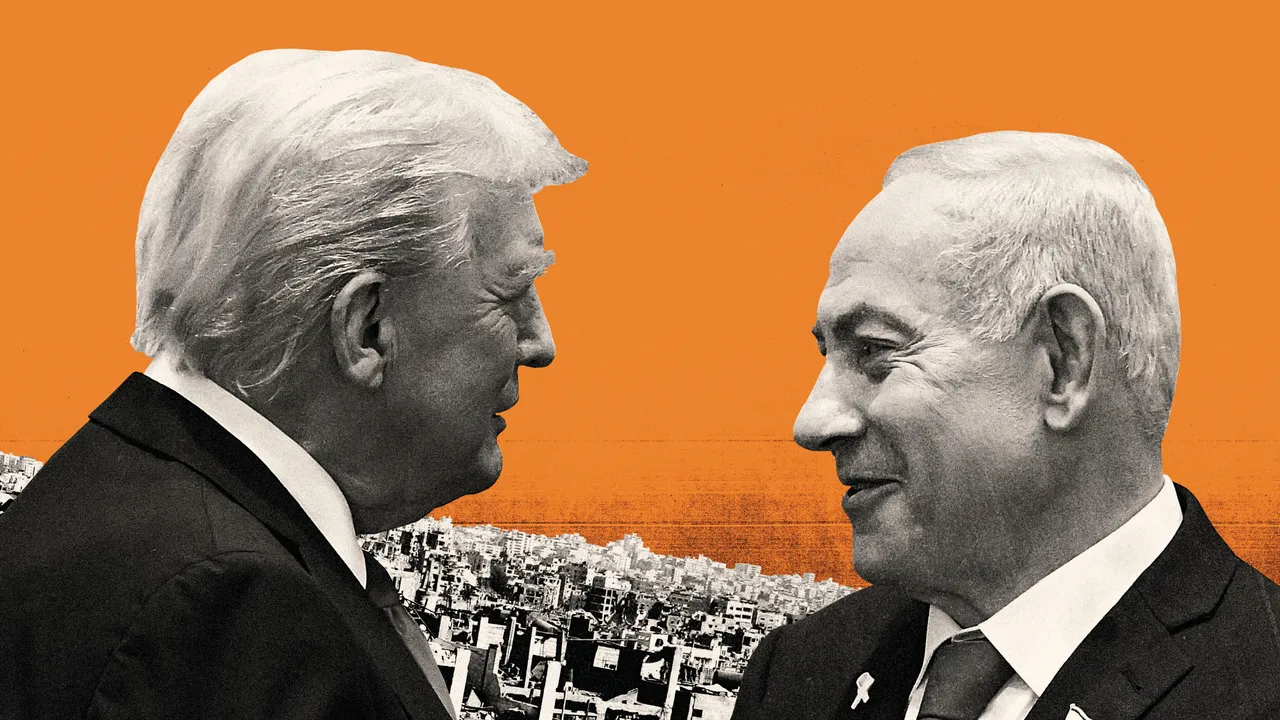
President Donald Trump arrived at Ben Gurion Airport on Monday morning, October 13th, just as Hamas was releasing the last surviving Israeli hostages after two years of cruel captivity and Israel had halted its devastating bombardment of Gaza. Since October 7, 2023, two thousand Israelis and sixty-seven thousand Palestinians had been killed. The Strip had been reduced to a landscape of destitution and ruin. A ceasefire that could, and should, have come long ago was finally, fitfully, taking hold.
In Jerusalem, Trump was greeted on billboards and in the Knesset as a modern Cyrus the Great—the Persian ruler who, in 538 B.C., allowed the Jews to return to the Holy Land from their Babylonian exile and rebuild the Temple. During Trump’s speech to the Knesset, two left-wing lawmakers, Ofer Cassif, a Jewish Israeli, and Ayman Odeh, a Palestinian Israeli, raised small placards reading “Recognize Palestine.” Guards swiftly hauled them from the chamber. The President praised the speed with which this modest protest was suppressed. “That was very efficient,” he said brightly. In his self-admiring rambling, Trump took time out to thank his lead negotiator, Steve Witkoff (a “Kissinger who doesn’t leak”), and one of his wealthiest patrons, Miriam Adelson (“She’s got sixty billion in the bank!”), then turned to trash Joe Biden—the “worst President in the history of our country by far, and Barack Obama was not far behind.”
It is impossible not to feel immense relief that this long, terrible war may at last be ending; it is also hard to ignore that the President’s decision to apply his sense of leverage and cunning to Prime Minister Benjamin Netanyahu owed little to consistent strategy, empathy, or conviction. Indeed, his reckless musings earlier this year about making Gaza a “Riviera of the Middle East” stoked the Israeli right’s fantasies of resettling the Strip and annexing the West Bank. They also deepened much of the world’s anger. The pivotal moment came on September 9th, when Netanyahu ordered an air strike on a residential building in Doha, hoping to kill four Hamas leaders who were then engaged in ceasefire negotiations. The strike missed its targets but clearly rattled Trump.
Like so many Presidents before him, he had indulged Netanyahu’s propensity to take American military and political support for granted. But the strike on Doha touched something more sensitive than principle: the bottom line. The Trump family’s business ventures are increasingly entwined with Qatari and Gulf capital. Trump compelled Netanyahu to deliver a scripted apology to the Qataris— a humbling that restored their confidence and amour propre, reassured Turkey and Egypt, and led these regimes to press Hamas into accepting the pending ceasefire agreement. The most consequential Israeli air strike of the war, in the end, was one that failed.
The President now hails “the historic dawn of a new Middle East.” When, during the hopeful years of the Oslo Accords, Shimon Peres used that phrase, he was mocked for his naïveté. Trump’s version owes less to diplomacy than to real-estate patter, the it’s-so-if-you-believe-it’s-so spirit he called on when insisting that Trump Tower had sixty-eight floors, though it actually had fifty-eight. As much as the President prizes “deal guys” over starchy diplomats, however, attaining peace in the Middle East is not so simple as unloading a defunct casino. The Administration cannot just declare an end to what the President calls “three thousand years” of conflict and move on to its domestic project of undermining the rule of law. History resists the shortcut.
The idyll of a “new Middle East” in Netanyahu’s triumphalist view is one in which, owing to his Churchillian leadership, the threats from Hamas, Hezbollah, Syria, Yemen, and Iran are all diminished or defeated. Behold the dawn. As for Netanyahu’s failure to safeguard the country on October 7th? All is forgotten. This willfully blinkered vision, or, more precisely, reëlection platform, ignores the cost in global opinion along with the moral and political fractures within Israel itself. It also overlooks the rage bred into the bones of young Palestinians, who have lost family members and friends but not their insistence on dignity and a home. Real progress in the region, real justice and stability, will require healing, constancy, imagination, and endurance—day after day, year after year, long past any one Administration.
