

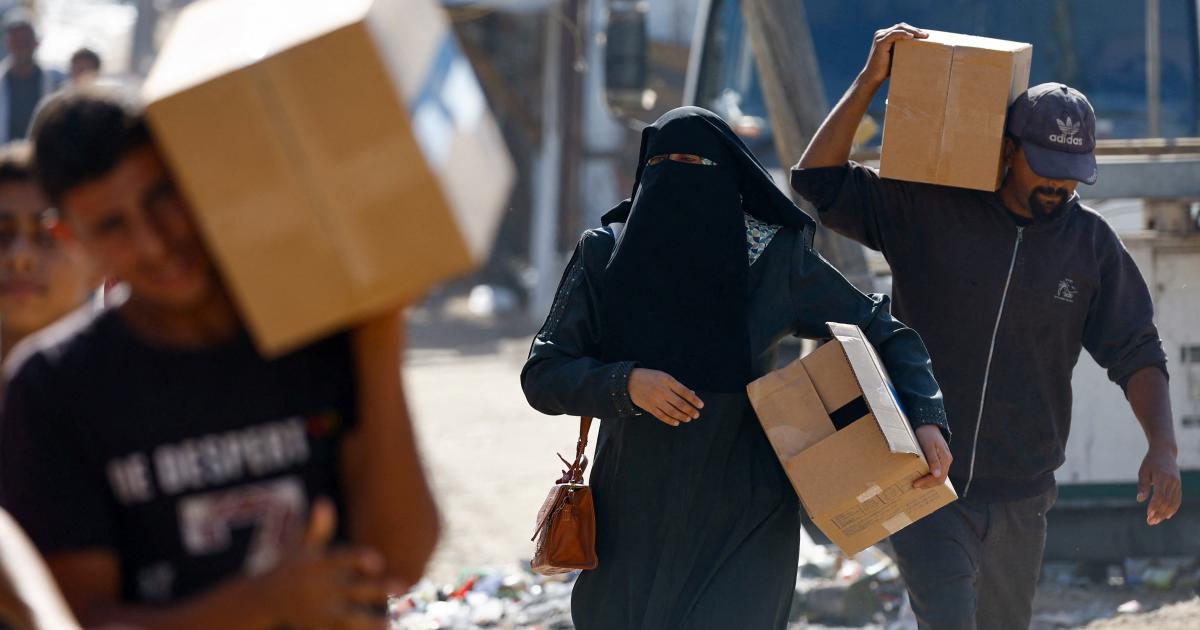
Among the many aims of the October 8 cease-fire deal between Israel and Hamas, flooding Gaza with humanitarian assistance ought to be one of the most achievable. According to U.S. President Donald Trump’s 20-point plan, “full aid” would be “immediately sent into the Gaza Strip” through neutral international institutions “without interference from the two parties.” The very first phase of the agreement called for 600 aid trucks per day to enter the territory unimpeded; in contrast to disarming Hamas or determining Gaza’s long-term security and governance arrangements, implementing such a measure is theoretically straightforward. On paper, after two years of horrific deprivation, serial displacement, and growing famine, it would finally allow the people of Gaza to begin to receiving adequate supplies of food, medicine, and other vital necessities.
Already in its first two weeks, however, the deal has fallen well short of these goals. Just days after the agreement had been reached, Israel announced that it was delaying the reopening of the crucial Rafah crossing—a primary conduit of aid from Egypt—and cutting in half the number of aid trucks it was supposed to allow in, on the grounds that Hamas had been too slow in returning the bodies of deceased hostages. (The International Committee of the Red Cross has said that returning the deceased hostages is a “massive challenge” that requires special equipment and could take weeks.) A few days later, the Israeli government threatened a full shutdown of aid flows in response to what it described as a Hamas “attack” on an Israel Defense Forces bulldozer in Rafah; it backed down under U.S. pressure once it became public that the IDF bulldozer had likely hit unexploded ordinance. Many of the largest NGOs are frozen due to new Israeli registration demands. And because of the continued closure of crossings in the north, much of northern Gaza remains effectively out of reach of aid deliveries, despite cleared roads to those crossings. The result of these actions is that most aid remains blocked, despite the terms of the deal. After an initial surge when the cease-fire was signed, aid flows remain far short of the minimum needed to halt the famine; as of October 21, the World Food Program reports that it has been able to bring in less than half the required volume of food aid.
This points to a problem that has been present throughout the war and even long before. Although international law requires humanitarian access to civilians regardless of the state of conflict between the warring parties, aid to Gaza has continually been used as a bargaining chip between Israel and Hamas, or restricted or blocked by Israel for capricious reasons. Moreover, by basing cease-fire deals on an aid-for-hostages framework, negotiators have implicitly given validation to Israel’s strategy of using the collective punishment of civilians in Gaza as a way to gain leverage or impose pressure on Hamas. The pattern of obstruction extends to the control and oversight of aid delivery itself. Since the early months of the war, Israel has refused to work with UNWRA, the UN agency for Palestinian refugees, which remains the largest and most capable relief actor in Gaza and a critical support to both Palestinian and international aid groups. And since the deal, Israel has refused to reengage with the agency, hampering large-scale relief efforts.
Despite these daunting challenges, the humanitarian crisis in Gaza can still be reversed. The United States has deployed a new Pentagon-led civil-military coordination center, the CMCC, which has oversight over the aid scale-up. If this entity takes strong leadership and acts as a bulwark against Israeli aid obstruction, it could prove instrumental. But to be effective on the ground, the coordination center must support rather than seek to supplant the UN-led aid coordination system. And the guarantors of the deal—including regional powers and European countries alongside the United States— will need to work closely to support the UN aid infrastructure, ensure that the deal’s humanitarian elements are upheld, and be ready to rapidly apply U.S. and international pressure in the face of any backsliding or interference. Given the many lives at stake if humanitarian aid falters, getting this right must be as much of a priority for the deal’s guarantors as the security elements of the agreement. As famine continues and winter approaches, every delay will take a toll.
FROM SIEGE TO STARVATION
After two years of war, Gaza’s population is in a state of extreme deprivation. The full blockade that Israel imposed on the territory beginning in March was a tipping point, and in August, the UN-affiliated Integrated Food Security Phase Classification officially declared a famine was underway in some parts of Gaza. More than 1.9 million people, nearly the entire population of the territory, have been displaced (and often re-displaced) by recurring IDF evacuation orders and sustained bombardment of civilian areas. And even with the cease-fire, many have no homes to return to: the UN estimates that 80 percent of the territory’s residential housing, and 89 percent of its water and sanitation infrastructure, have been damaged or destroyed. Gaza’s pre-war healthcare system has been virtually wiped out, with the World Health Organization reporting in May 2025 that 94 percent of hospitals had been damaged or obliterated.
This dire situation is not an incidental byproduct of the fighting, but a direct consequence of Israeli policies and tactics. In the immediate aftermath of Hamas’s October 7, 2023 attacks, Yoav Gallant, then the Israeli defense minister, publicly threatened a “complete siege” of the territory, including a total cut off of food, water, fuel, and electricity. An IDF spokesperson at that time described Israel’s tactics as “maximum damage.” As the subsequent record of the war has shown, the Israeli government made good on many of these aims. Even before it began its total blockade in March 2025, Israel frequently tightened restrictions on the flow of aid and ramped up bombardment to exert pressure on Hamas and to force Gazans to leave particular areas. Meanwhile, Israel’s campaign against UNRWA undercut the logistical infrastructure that long allowed international aid agencies to reach people in need across Gaza. In October 2024, the Israeli Knesset passed a law banning Israeli authorities from having any contact with the agency, which it alleges has been infiltrated by Hamas. After an investigation, the UN dismissed nine of the agency’s 30,000 staff members for Hamas ties, but found no evidence of the broader Hamas influence the Israeli government has claimed. Under the Biden administration, the United States urged Israel to allow the agency to keep operating.
In fact, restriction and obstruction of aid has a long pedigree in Israel’s engagement with Gaza, dating back to the looser long-term siege that Israel imposed on the territory after Hamas took power in 2007. Israel limited food imports to a caloric threshold just above starvation level, and blocked housing materials, infrastructure supplies, and other basic goods from entering the territory, labelling them as dual use—having potential military applications as well as civilian ones. For years, the Israeli government refused to clarify which items it considered dual-use, relenting only after a legal challenge by the Israeli human rights organization Gisha. Since Hamas’s October 7 attack and the start of the war in Gaza, aid agencies working in the territory reported similarly opaque and arbitrary rejections of hospital equipment and other essential goods by IDF inspectors. Even if the current cease-fire holds, these kinds of roadblocks are likely to persist.
To a degree, several ongoing international legal processes have brought new pressure on Israel to uphold aid access. In March 2024, the International Court of Justice concluded unanimously that Israel must take “all necessary and effective measures without delay, in full co-operation with the United Nations, the unhindered provision at scale … of urgently needed basic services and humanitarian assistance.” Although the Israeli government effectively ignored this order, the ruling underscored the broad international consensus that aid obstruction violates international law. (Even the Israeli justice at the ICJ, Aharon Barak, who opposed all of the court’s other measures in the case, supported this one.) Starvation crimes also formed a major part of the International Criminal Court’s indictments against Israeli Prime Minister Benjamin Netanyahu and Gallant, who resigned as defense minister this past January. And aid obstruction, starvation crimes, forced displacement, and attacks on health services featured prominently in a September 2025 UN inquiry report finding that Israel has committed genocide against Palestinians in Gaza. Although the Israeli government has dismissed each of these rulings, they could make it harder for Israel to fully evade responsibility for maintaining adequate flows of aid as the deal unfolds.
THE AMERICAN BACKSTOP
Even if Israel allows improved aid access, the challenges are vast. To have real impact on Gaza’s spiraling humanitarian crisis, a revitalized UN-led aid system will need to be backstopped by credible diplomatic support against obstruction or diversion. The UN and major humanitarian organizations must be allowed to distribute aid without interference, much as they could after the January 2025 cease-fire, which lasted until March. Whether through UNRWA or a differently configured UN leadership structure, the UN must lead and implement the relief and recovery effort. There is simply no viable alternative to this system, as the Trump plan seems to acknowledge and the ICJ has now reaffirmed in a new advisory opinion ordering Israel to allow UN agencies to provide aid to Gaza. UN agencies and NGOs have operated in Gaza for decades and have reach, capacity, and community trust that no other entity can match.
In this regard, the new U.S. civil-military coordination center, backed by 200 U.S. servicemen, has the potential to perform crucial monitoring and support and ensure that aid delivery is not obstructed. But the CMCC must not attempt to supplant or replace the vital leadership and coordination function of the UN system or allow Israel to do so. Israel’s attempt earlier this year to circumvent the UN and replace it with the Gaza Humanitarian Foundation—an organization operated by private military contractors under the supervision of the IDF —proved to be a deadly debacle that led to the killing of thousands of Palestinians desperate for food. Although the GHF has now suspended its activities, Israel will likely seek other means to control or restrict the aid operation. Throughout the war, the Israeli government placed heavy restrictions on what items could be brought in, and by whom, often to the point of absurdity. Aid groups reported Israeli inspectors rejecting convoys if syringes were shipped alongside other aid items, and refusing a range of critical aid supplies from anesthesia to tents to water treatment materials. One doctor told me that Israeli border guards had confiscated a bottle of aspirin from him when he entered on a medical mission. Apart from the brief cease-fire periods, the Israeli government also tightly controlled the internal movements of aid organizations within Gaza and frequently rejected movement requests or directed convoys through insecure or impassable areas.
Other past crises offer important lessons in how to address this kind of obstruction. For one, it is essential to have a credible arbiter that has real power to ensure that a belligerent party is not blocking aid. There are numerous precedents for this. As head of the foreign disaster relief office at USAID, I brokered one such mechanism related to Saudi Arabia’s blockade of Yemen in 2015, which produced one of the worst humanitarian crises of the contemporary era. Rather than grant the Saudis—a party to the conflict— veto power over aid inspections, the United States worked to shift the responsibility to the neutral UNVIM, the UN Verification and Inspection Mechanism. During the Syrian civil war, the UN Security Council endorsed a similar model, with the UN inspecting aid going into opposition-held northern Syria. Such an approach—allowing aid to flow in a verifiably safe manner and free from interference by either belligerent party in a conflict or post-conflict situation—is urgently needed for Gaza as well.
Trucks carrying Gaza-bound humanitarian aid and fuel in Rafah, Egypt, October 2025 Reuters
Regardless of whether or not it allows UN agencies to operate in Gaza, Israel is unlikely to agree to the UN as overall arbiter of the aid process. But Israel has shown it can cooperate with the United States and with partners in the Gulf. The United States must be prepared to call out violations of the deal by either side, and the new CMCC must use its position to support and facilitate—rather than direct—the work of UN and NGO aid groups. There is already a precedent: the Biden administration’s deployment of a temporary military pier to deliver aid to Gaza last year. Although the pier itself was a failure and eventually scrapped, the ability of the U.S. military to coordinate with the IDF and oversee the distribution of aid helped limit Israeli obstructionism. Drawing on that experience, an independent monitoring entity shepherded by the United States and other regional partners could provide important accountability for postwar aid delivery to Gaza and ensure that the aid access parameters of the deal are upheld.
U.S. backstopping of the aid process, moreover, must be more than a truck-counting exercise. High volumes of food and medicine alone will not make Gaza habitable again. International aid efforts must reverse and extinguish starvation; restore fully functional health and sanitation services throughout the territory; and ensure that Gazans have access to clean water and safe shelter. Gaza desperately needs items that the Israeli government has frequently impeded: emergency shelter supplies, infrastructure reconstruction materials; medical supplies; fuel and power generation, etc. And beyond bringing in a wider range of aid and rehabilitation supplies, aid groups must be allowed to operate safely and without impediment. They will need a substantial ramping up of new financing from donor countries, which has so far been slow to materialize. And they will need greater stability within Gaza to reduce the looting problems that have become widespread over the past year.
Re-establishing security will be essential. Criminality has shot up across the territory during the war; some of it is attributable to Israeli military support for clan gangs that have systematically looted aid convoys. Hamas’s retribution campaign against some of these gangs since the cease-fire has also created new challenges. The lack of security and the extreme desperation of the population mean that there will likely be widespread looting and so-called community “self-distribution” of aid during the early weeks of the aid surge. These problems also occurred in the first weeks of the previous cease-fire, which lasted from January to March of this year; once the level of aid reached an equilibrium with the population‘s needs, however, the looting abated. The same pattern is likely to play out now, and there have been some tentative indications already that looting may already be declining.
Diversion or manipulation of humanitarian aid by Hamas must also be prevented, although there is little evidence that this has been happening on any significant scale. Israel has frequently claimed Hamas looting as a pretext for its own restriction on aid delivery, but it has never provided evidence to back up those assertions, which have been refuted by successive international reviews as well as by former U.S. officials, including Jacob Lew, who served as U.S. ambassador to Israel under Biden.
READY AND WAITING
After two years of war characterized by gratuitous violence, famine, and systematic aid obstruction, Gaza finally may finally get a chance to breathe. A massive surge of lifesaving humanitarian aid is both a moral obligation and—given the structure of the peace deal—a strategic imperative. If the deal’s guarantors are unable to ensure aid delivery, it could lead to the collapse of the cease-fire itself. And even if the deal survives, a failure to make good on the humanitarian aims will drive yet more Palestinians into famine and worsen the already gruesome human toll.
These worst-case outcomes can be avoided. But to capitalize on the breathing room created by the deal, the guarantors will have to shield aid operations from the political manipulation that has plagued them since the war’s outset. Oversight and accountability will be crucial and will best be served if the United States and its regional and European partners establish a credible and robust coordination and oversight mechanism to uphold the deal’s humanitarian provisions. Above all, they most allow the UN and the many humanitarian organizations, which have years of experience in Gaza and the resources and tools needed, to finally do their jobs. By putting aid at the center of its deal, the Trump administration has rekindled hope that the crisis can finally be turned around. But that can only occur if humanitarian professionals are given the unfettered access, safety, and support they need.
Loading…
