

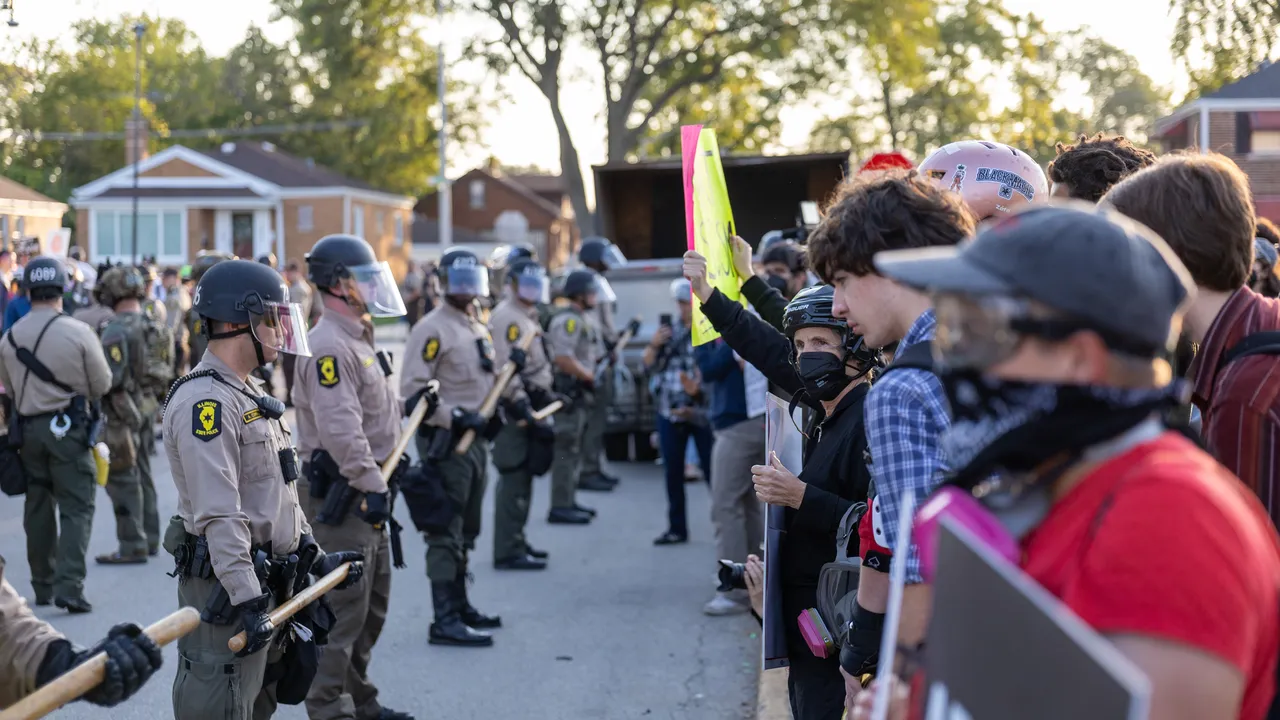
There is plenty of antagonism between ICE agents and anti-ICE protesters. But it is hard to conclude that the protesters’ resistance constitutes a rebellion or an insurrection. To many Chicagoans, the warlike atmosphere is the result of the increasing aggression of the federal government. Worthington, among others, has speculated that Trump is looking for a reason to put Chicago in an even tighter vise than it’s already in. “Sometimes I wonder if what the Trump Administration is doing is looking for cities that they know aren’t going to just take it lying down,” he said. “Part of me wonders if they’re not testing out, first, what they can get away with in different places, and, second, how they can provoke and escalate it to a point where we have a serious national crisis on our hands.”
One day at Broadview, Worthington met Rachel Cohen, a Harvard-trained lawyer who, last March, quit her job at the prestigious firm Skadden, Arps, Slate, Meagher & Flom, just before its leaders cut a deal with the Trump Administration. Since March, Cohen has grown a sizable social-media following for posts that combine organizing rhetoric and legal and political analysis. In her videos, she argues passionately and clearly, with the occasional expletive. In a post about Illinois Attorney General Kwame Raoul’s filing against Trump, to block the deployment of the National Guard, she says, “This complaint is fucking incredible; let’s go through it.” In another, she describes Trump’s legal strategy this way: he “loves to just do whatever the fuck he wants as things are litigated.” Cohen agrees with Worthington that the Trump Administration is looking for a pretext. “ICE has come to Broadview and escalated very intentionally,” she told me. “I’ve been hit directly with pepper pellets. Everyone I know who has been there consistently has had some form of really dramatic brutality against them by ICE agents.”
Conservatives and liberals alike have criticized certain tactics used by protesters—who, in some cases, have taunted officers, tried to block federal vehicles from exiting the Broadview facility, or chased federal agents in their own vehicles, honking their horns to warn that ICE is present. In an interview on NewsNation, the conservative anchor Leland Vittert asked Cohen, “Just from a political standpoint, do you really think that everybody wearing pink painters masks and trying to throw themselves on police cars and standing out there chanting is gonna help your cause?” (Cohen shot back that his question implied he was fine with federal agents tear-gassing protesters.) An editorial in the Chicago Tribune criticized protesters who have physically prevented ICE agents from doing their jobs, saying, “These militant activists are imperiling the far greater number of peaceful protesters striving mightily to make their voices heard without breaking the law.” Cohen told me, “It seems that many people are really determined to dismiss protest tactics that are disruptive, and I think that’s a real shame, because disruptive protest tactics and working within the system need to go hand in hand. I do know that if you give up entirely on working within the system, you guarantee that work within the system will fail.”
At the U.S. District Court in downtown Chicago, immigration attorneys like Jennifer Peyton and Khiabett Osuna, of Kriezelman Burton & Associates, work within the system to vigorously defend the rights of their clients. They both told me that they’re spending “one thousand per cent” of their time these days representing immigrants who’ve been detained during the current operation. Peyton was, until recently, a judge for the Chicago Immigration Court; Bondi fired her in early July. The termination e-mail that Peyton received didn’t provide a reason for her firing, but she has speculated that it could be because she was on a conservative-watchdog list for opposing Trump’s agenda. After her firing, Peyton accepted a position as partner at Kriezelman Burton. She has since been suing Bondi and Noem for unlawfully initiating the removal of her clients. “To be able to name Kristi Noem and Pam Bondi as defendants, it’s the best fucking feeling in the world,” she told me.
Osuna is Peyton’s junior colleague, and the daughter of Mexican immigrants. She said that many migrants who call her don’t have a case, and it’s painful to tell them that. “Yes, of course it’s about trying to get them legal relief,” she told me, but it’s also about saying to them, “I’m sorry this is happening to you. You should not be treated this way. You might not be granted asylum, but you have a right to tell your story. I’m gonna walk with you every damn step of the way.” She can successfully intervene in some cases where her clients have been unlawfully detained, and she can help them remain in the Chicago area instead of getting sent somewhere such as Texas. She told me that, these days, she’s focussed on trying to buy her clients time—time to be with their families, to sleep in their own beds, and to get their documents together, and time for either their life circumstances or American immigration policy to change.
