

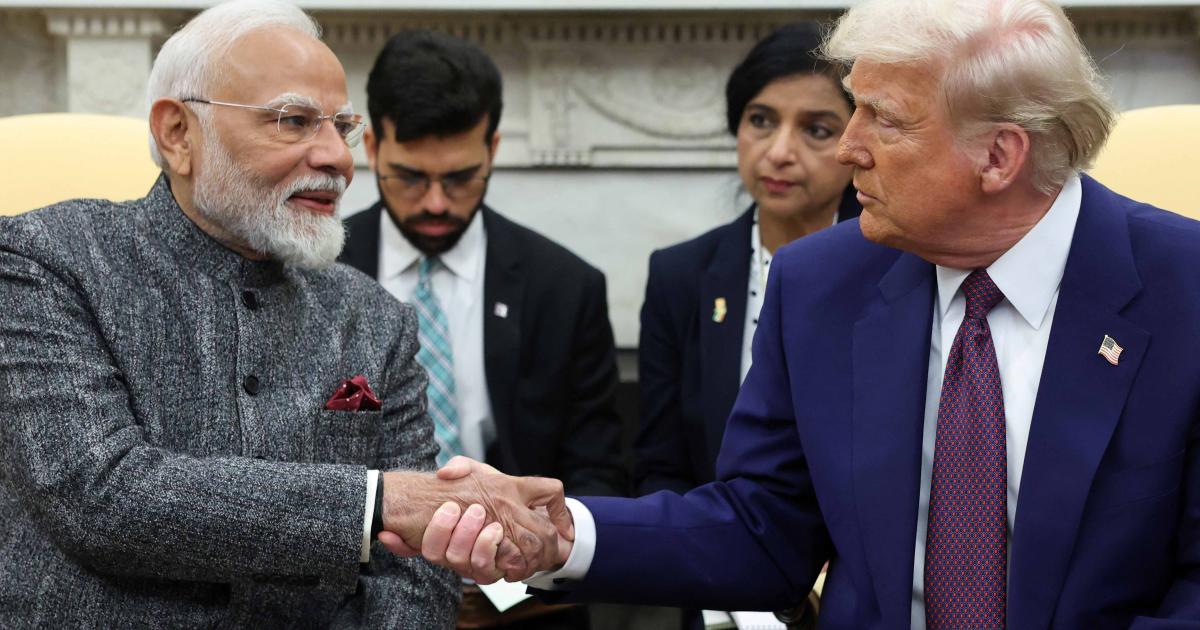
Over the last decade, India has drawn ever closer to the United States, tentatively aligning itself with Washington as it continues to eschew formal alliances. This approach has paid off, securing U.S. investment, defense cooperation, and technological exchange, as well as the sense that the friendship between the world’s two largest democracies would only grow. Indian policymakers were mostly untroubled when Donald Trump returned to the White House this year. They assumed that Washington valued the partnership and that ties would only grow stronger, not least because of the apparent chemistry between Trump and Indian Prime Minister Narendra Modi during the president’s first term.
But now, India must reassess its American gamble. Since the summer, Trump has departed from the policy of recent U.S. administrations and sought to pressure India. He increased tariffs to 50 percent on India in August, ostensibly as a penalty for its ongoing purchases of Russian oil. And he agreed to a raft of deals with India’s neighbor and rival, Pakistan, irking Indian officials. In apparent response, Modi attended the Shanghai Cooperation Organization summit in Tianjin in September 2025, where he met with Russian President Vladimir Putin and Chinese leader Xi Jinping; his presence made it seem as if India were aligning with U.S. competitors. Putin will be visiting New Delhi this week, where his meeting with Modi risks giving the same impression.
This signaling, however, is not tantamount, as some observers have suggested, to India abandoning its recent foreign policy strategy for a wholly different approach. Instead, the path that India seems to be taking—and, indeed, should be taking—is a form of what its foreign policy establishment often calls “multialignment,”an orientation designed to build stronger ties with many countries, even if those states have contradictory interests.
Despite the friction of this year, the United States will remain India’s most important partner, albeit a more erratic and occasionally troublesome one. India will also continue to cultivate relationships with economically and technological capable middle powers, including Australia, Japan, Singapore, and the Gulf states. But the place where Indian foreign policy might have the most to gain is in Europe. Although not a like-for-like replacement for the United States, Europe is a reliable partner with strong technological capabilities, shared concerns about Chinese coercion, and a steadier foreign policy than that currently evident in Washington. By pursuing a renewed multialignment in this way, New Delhi can try to hedge against both American unpredictability and Chinese aggression while maintaining the strategic autonomy that has long been central to its foreign policy doctrine.
HOW TO BE MULTIALIGNED
India’s most striking response to American pressure came over the summer when Modi visited China. The images of the Indian prime minister alongside Xi and Putin were powerful, signaling a desire to recalibrate relations with China, in particular. Some Western observers also saw Modi’s decision in August to invite Putin to New Delhi in December as evidence of a larger Indian pivot toward U.S. adversaries. But that misread India’s intent. With its relationship to Washington deteriorating, New Delhi was instead seeking to muddle through, not to abandon the underlying strategic calculus that led it to turn toward the United States in the first place. Planned months in advance, Modi’s visit to China was not a reaction to Trump’s tariffs but an effort to repair damaged ties with Beijing after a year of relative stability along India’s disputed border with China. What India wanted was to carefully rebuild badly damaged ties, not launch a new era of Sino-Indian alignment; Modi pointedly declined to attend the military parade to which Xi invited North Korean leader Kim Jong Un. With China, India is in essence doing little more than what many others have done now that Trump is back in the White House: managing differences and avoiding crises with China while simultaneously seeking to stabilize ties with the United States.
The significance of Putin’s visit this week to New Delhi should also not be overstated. To be sure, Moscow remains a significant partner. India is still dependent on Russia for arms and military equipment, and it will remain so for some time. India is also in no rush to push Russia away as it worries about Moscow’s ever-closer alignment with Beijing. But the limits of this partnership are real. India’s purchase of German submarines in August reflects its strategy of diversification in procurement. It has been gradually reducing its reliance on Russian defense hardware every year for the past 15 years. Russia offers India little in terms of investment capital or cutting-edge technology, two areas that are critical to the country’s long-term development ambitions. Leaders in New Delhi appreciate the long history behind ties with Moscow but recognize that there’s not much room for growth in the relationship. In short, they know that India’s future lies elsewhere.
That future, in India’s view, will invariably be multialigned, an orientation that reflects a sound understanding of the country’s strategic context. China remains India’s primary challenge. Russia is a diminishing asset. And India requires economic investment and advanced technology to speed growth and enhanced military capabilities to better defend itself in a tricky neighborhood. The tilt toward the United States in the twenty-first century stemmed from these realities, as did India’s deepening ties with Australia, Japan, and South Korea, as well as a number of states in the Middle East and Europe. Trump’s recent pressure campaign does not undo these underlying imperatives. Indeed, India’s dilemma is remarkably similar to that of many other American partners and allies in the Trump era—namely, how to replace what the United States is now less likely to provide. New Delhi must find alternative sources of technology, defense cooperation, and economic partnership, while also managing its complex relationships with Beijing and Moscow.
India will view the United States warily after this year’s turmoil.
The trajectory of India’s relationships with China and Russia should be clear. Some further thaw between New Delhi and Beijing is of course possible, but it will be severely limited by the underlying structural fact of their regional rivalry.India, for instance, may consider removing some controls on Chinese access to its domestic market that were introduced after border clashes in 2020. It could also lift its ban on the Chinese social media app TikTok as a goodwill gesture. The risks that China poses to India remain all too real, however, including the unresolved border dispute and the weaponization of certain supply chains that are largely controlled by China. India will try to pursue a stable relationship with China, without any illusions of deep partnership. India also wants to maintain solid ties with Russia, in large part to preserve access to spare parts for the Indian military’s Russian-sourced military hardware and to prevent Russia from becoming so isolated that it becomes a near-vassal state of China.
The question of how to manage Washington is more complicated. The United States will under most likely scenarios remain India’s most important partner for technology and investment, no matter the current disruption in relations. The two countries are also still collaborating in critical areas: the newly established U.S. Office of Critical and Emerging Technologies is working with Indian counterparts to streamline AI infrastructure partnerships, for instance. Silicon Valley has a serious interest in India. Washington provided New Delhi with a laundry list of regulatory issues to resolve to help American tech firms to invest in data centers in India. Anthropic CEO Dario Amodei visited New Delhi and Bengaluru in October with the hope of opening an office in India. And all the big U.S. tech companies will be represented in February at a major AI summit in India, hosted by Modi.
For India’s part, its pharmaceutical companies are still looking to invest in the United States despite threats of tariffs as they seek to lessen their dependence on Chinese suppliers. Indian companies have begun reducing oil imports from Russia following American sanctions on two large Russian firms at the end of October. In the midst of their friction, Trump wished Modi well on his birthday in September. The U.S. president also continues to refer to Modi as a “great man” who is “tough as hell.” The first part of a trade deal between India and the United States, which has been negotiated for several months, may be completed by the end of this year or early next.
Even so, India will view the United States warily after this year’s turmoil. New Delhi now worries about American reliability—and understandably so. It is also troubled by the Trump administration’s new closeness to Pakistan, which Washington sees as an increasingly useful partner; Pakistan could send peacekeeping forces to Gaza, for instance, and help facilitate critical mineral agreements in Central Asia. Trump has spoken warmly of Pakistan’s military and civilian leaders and welcomed them to the White House on multiple occasions this year. None of these moves help Indian-U.S. ties.
THE CALL OF EUROPE
It is against this backdrop that a pivot to Europe makes sense. For decades, the relationship between India and Europe has underperformed its potential, especially when measured against the progress that India has made in moving closer to the United States. Europe is one of India’s largest trading partners. The sheer size of the Indian economy and its growing consumer class is attractive to European countries. The need to do more with India prompted the Council of the European Union to approve a “new strategic EU-India agenda” in October, highlighting the ambition to establish stronger technology and investment ties. Both India and the EU remain committed to climate action, even if they have differences on emissions targets. India has maintained close ties with France, Italy, and the United Kingdom, but until recently it had only limited engagement with many other significant European countries, such as Germany, and with the European Union more broadly.
But that is changing. High-level visits to Europe from Modi and External Affairs Minister Subrahmanyam Jaishankar have established an EU-India Trade and Technology Council that is designed to bring the two sides closer together. European Commission President Ursula von der Leyen travelled to New Delhi this year with the entire gamut of European commissioners, an unusual move designed to boost cooperation across multiple sectors. India’s position on the war in Ukraine—it refused to condemn Russia and has continued to purchase Russian oil—lost it friends in Europe. But Europe’s strategic reawakening since 2022 and significant military buildup following the full-scale Russian invasion of Ukraine position it as a more credible partner in Indian eyes. It now has the potential to be a more credible security partner, too, both in terms of weapons sales and in emerging domains such as space and cybersecurity.
Indian and European officials are also concerned about China. Europe views Chinese trade practices, including hefty state subsidies, forced technology transfers, and overproduction, as existential threats to its industrial base. India worries not only about unresolved border disputes and strategic competition in South Asia but also about its dangerous economic dependencies on China in manufacturing, rare earths, green technology, and other sectors—areas of major concern in Brussels, too. Technology cooperation, particularly in artificial intelligence, represents another major opportunity.
Europe can offer expertise in other critical niche areas. India and Europe could work productively together on renewable energy and quantum computing, areas in which U.S.-Indian collaboration is lacking. European labs and Indian incubation hubs are planning to set up a biotechnology corridor that would facilitate joint investment and manufacturing. The Trade and Technology Council, despite its admittedly slow start, provides an institutional framework for advancing cooperation. Of course, many obstacles remain. In September, the EU proposed a new agenda to boost bilateral relations with India, which included expanded cooperation in defense and technology. The launch of this agenda was nearly derailed after India participated in a joint military exercise with Russia and Belarus, a reminder of lingering European sensitivities over Ukraine. Even so, a much-anticipated new trade agreement is likely to be completed before a planned summit in New Delhi in January, along with new agreements on security cooperation, migration and energy—the latter designed to tempt India away from the lure of Russian oil and gas. These discussions aim to cement an economic foundation for a broader strategic partnership. To be sure, Modi and von der Leyen will still likely have to intervene in helping both sides overcome hurdles in finalizing these deals.
THE ULTIMATE IRONY
Both Europe and India face similar predicaments that could bring them closer together. Neither side feels able to rely on the United States as they once did. Both seek new partnerships to help protect themselves from a more capricious Washington. Until only six months ago, India seemed destined to align ever more closely with the United States, in part to fend off future Chinese aggression. Now, Trump’s pressure campaign means that India will pursue a renewed multialignment, not out of ideological conviction but as a practical necessity. The ultimate irony of Trump’s approach is that it is producing precisely the outcome it sought to prevent: a more multialigned India, invested in multiple partnerships and less susceptible to bludgeoning pressure from the United States.
Loading…
