

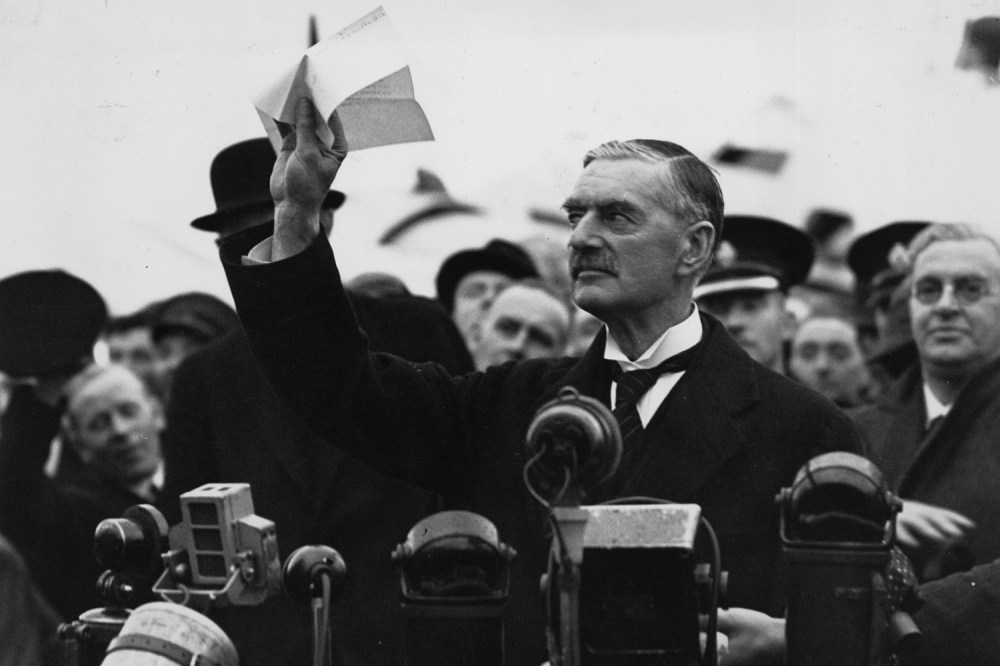
The 1938 Munich Agreement left the Czechoslovak state with no choice but submission. Led by Prime Minister Neville Chamberlain, Britain joined France and Italy in accepting Adolf Hitler’s demands for Czechoslovak territory. The Führer managed to neutralize two of the country’s other neighbors, Poland and Hungary, by offering them other chunks of Czechoslovak land—which also effectively thwarted the Soviet Union (another ally of Czechoslovakia at the time) from intervening, since the Poles refused to allow Soviet troops to cross their territory.
At the time, Czechoslovakia had one of Europe’s most advanced arms industries and might have been able to marshal an effective defense with a bit of allied support, but it was left on its own. A few months later, Hitler’s armies marched into other parts of Czechoslovakia that Chamberlain had not already given him.
The 1938 Munich Agreement left the Czechoslovak state with no choice but submission. Led by Prime Minister Neville Chamberlain, Britain joined France and Italy in accepting Adolf Hitler’s demands for Czechoslovak territory. The Führer managed to neutralize two of the country’s other neighbors, Poland and Hungary, by offering them other chunks of Czechoslovak land—which also effectively thwarted the Soviet Union (another ally of Czechoslovakia at the time) from intervening, since the Poles refused to allow Soviet troops to cross their territory.
At the time, Czechoslovakia had one of Europe’s most advanced arms industries and might have been able to marshal an effective defense with a bit of allied support, but it was left on its own. A few months later, Hitler’s armies marched into other parts of Czechoslovakia that Chamberlain had not already given him.
Today’s Ukraine is not 1938 Czechoslovakia. Yet the 28-point “peace plan” negotiated between the United States and Russia and leaked to the media late last week suggests that U.S. President Donald Trump considers the Munich deal a precedent. Like Chamberlain, he seems to believe that he can make a deal with Russian President Vladimir Putin about Ukraine’s land and future over the latter’s head.
But this calculation is flawed. It betrays Trump’s fundamental misunderstanding of European geopolitics—both Russia’s unbroken designs to control Ukraine and the Ukrainians’ continued willingness to fight for their land and independence.
According to several reports, Trump’s emissaries told Ukrainian leaders that they must accept the proffered terms by Nov. 27 or face the consequences. Trump has also returned to his old habit of blaming Ukraine for the war, scolding Kyiv for supposedly expressing “zero gratitude for our efforts” following a U.S.-Ukrainian meeting in Geneva on Nov. 23.
That meeting reportedly produced substantial changes to the original 28 points, but few other details have emerged, and any revisions would still need Trump’s and Putin’s approval. Like Chamberlain, Trump seems to believe that he can impose a fait accompli on the Ukrainians that they will have no choice but to accept. Washington, he seems to think, has the power to force Kyiv to do what it wants.
Perhaps he will get away with it. But I see little reason to believe that he is right.
First, unlike the tragic victim of the Munich Agreement, Ukraine has plenty of friends left, including most of the European Union, Britain, Canada, Japan, South Korea, Taiwan, and Australia. At this point, European nations have provided Kyiv with more military aid than the United States. They have done an impressive job of supplying Ukraine with a wide range of weapons, including howitzers, artillery shells, long-range missiles, and fighter planes. The Europeans have also invested billions in supporting Ukraine’s domestic defense industry.
Granted, there are several areas where the Europeans will have trouble picking up the slack if Washington withdraws all of its assistance to Kyiv. For example, they probably won’t be able to supply advanced U.S.-style satellite intelligence, and they may also have difficulty resupplying the Ukrainians with U.S.-made Patriot air defense missiles.
Military support is not the only challenge. The Ukrainians have also received enormous amounts of financial and humanitarian aid, enabling Kyiv to continue paying civil servants and maintain economic stability. The United States used to contribute a big chunk of this money—but over the course of this year, the European Union and several non-EU countries have provided nearly all of it.
In March, when the Europeans were already providing the lion’s share of aid, a report from the Kiel Institute for the World Economy noted that the donations amounted to a mere 0.1 percent of their combined GDP; to make up for the loss of U.S. aid since 2024, the report argued, Europe would need to roughly double its annual support to 0.21 percent of the continent’s combined GDP. The authors noted that several EU members had already reached that level.
They could do even more if they could bring themselves to tap into the roughly $200 billion of frozen Russian assets that are under European control. The Europeans have been reluctant to do this so far, but it may well be that the new Trump “peace plan”—which proposes that the Ukrainians cede large amounts of territory to the aggressor and freezes them out of NATO while dramatically reducing their ability to defend themselves—is sufficiently scandalous that it will motivate them to take the necessary steps.
The challenges are real. Even so, what all of this should demonstrate is that Kyiv, to use Trumpian language, still has plenty of “cards” at its disposal. His own drastic cuts of support to the Ukrainians have, if anything, reduced the amount of leverage that he can bring to bear. Kyiv is no longer as dependent on Washington as it used to be.
In light of this reality, it’s unclear why the Ukrainians would agree to this one-sided plan, whose odd formulations appear to have been translated from Russian-language talking points. It would impose drastic cuts on Ukraine’s military, diminishing its ability to fend off the next Russian invasion. It would force Kyiv to surrender vast territories, including critical parts of the eastern Donbas region that Russia has been unable capture in 11 years of warfare. It would also forever bar Ukraine from joining NATO.
For the record, Kyiv has previously expressed a willingness to consider future neutrality as long as its security could be guaranteed—but this plan offers no concrete or credible path toward such an assurance. Territorial changes of the type stipulated by the plan are prohibited by the Ukrainian Constitution, not to mention the United Nations Charter and other international agreements signed by both Russia and the United States.
The plan also includes demands for Ukraine to open itself to Russian influence; Point 20 specifies, for example, that “All Nazi ideology and activities must be rejected and prohibited”—a reference to Russia’s repeated but unfounded claim that Ukraine is under the control of a Nazi regime. Most Ukraine analysts I know agree that any Ukrainian leader who tried to allow this plan to become a reality would probably face immediate removal—either by the military, a popular uprising, or both.
Nowhere does the plan even pretend to acknowledge the wishes of the Ukrainian people, who have been fighting and dying for more than a decade to defend their national sovereignty. (“National sovereignty” is a phrase that MAGA acolytes love to pronounce on any occasion—just not, apparently, when it applies to a democracy that is actually in the process of fighting for its life.)
Bizarrely, the plan also says nothing about how it is to be ratified. The usual mechanism would involve some form of parliamentary approval, a fact that seems to have escaped its drafters. The plan makes one brief mention of Ukraine’s democratic institutions, stipulating that Kyiv must conduct elections within 100 days of the plan’s adoption. This, too, would violate the Ukrainian Constitution, which does not allow for elections during wartime.
Notably, there is nothing in the document that imposes a similar election requirement on the Russians—an implicit recognition, perhaps, that elections under Putin’s dictatorship are utterly meaningless.
Most importantly, however, the plan does not address the root cause of the conflict: Russia’s aggression against a neighboring state and its refusal to recognize Ukraine’s right to exist as a fully sovereign country. The most cynical aspect of the plan is Point 26: “All parties involved in this conflict will receive full amnesty for wartime actions during the war and agree not to pursue claims or further settle grievances.”
This is a brazen get-out-of-jail-free card for Putin and his minions, who bear full moral, political, and historical responsibility for unleashing this unnecessary war. Without accountability for Russian war crimes, there will never be a stable peace. Without punishment for its aggression, Russia will have every incentive to invade and attack again whenever it sees fit.
This is not a plan for peace. It is a plan for Russian victory and Ukrainian capitulation. The spirit of 1938 has been resurrected.
