

Unlock the Editor’s Digest for free
Roula Khalaf, Editor of the FT, selects her favourite stories in this weekly newsletter.
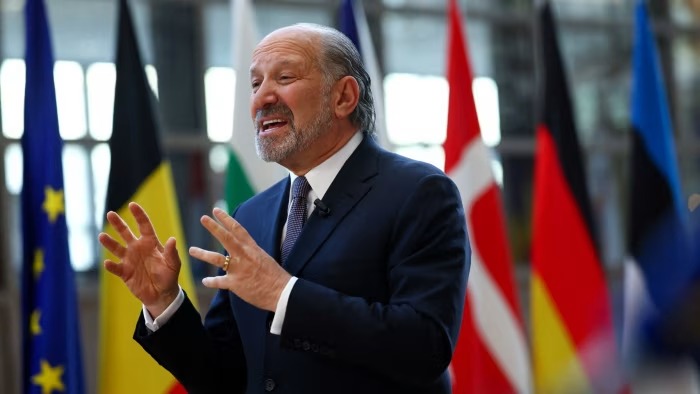
The EU must loosen tech regulations if it wants the US to lower tariffs on its steel and aluminium, commerce secretary Howard Lutnick said on Monday.
He told reporters during a visit to Brussels that the bloc must reduce controls on digital companies if it wanted exemptions to the 50 per cent levies the US imposes on EU metals.
“If they can come up with a balanced approach [to technology regulation] then we will, together with them, handle the steel and aluminium issues and bring that on together. So that is on the table,” Lutnick said.
He also said Brussels should “solve” outstanding cases against Google, Microsoft and Amazon and “create a framework that we are comfortable with”. Tech regulation touched only US companies because of their size, he argued.
Washington has long railed against the EU’s digital rule book, especially the Digital Markets Act, which aims to curb the power of Big Tech companies, and the Digital Services Act, which polices content online. In August, US President Donald Trump took to social media to threaten tariffs and export controls on countries with taxes, rules or regulations that “discriminate” against US tech companies.
Lutnick spoke after he and US trade representative Jamieson Greer met EU trade ministers, and as American officials grow increasingly frustrated with the bloc’s slow pace of implementing the first portion of the trade deal struck between Trump and European Commission president Ursula von der Leyen in Scotland in July.
The bloc has consistently dismissed US calls to water down its digital rule book, though it is delaying some rules relating to artificial intelligence. “We are always open to discuss with like-minded partners all topics and potential concerns, but this does not change the fact that Europe has its sovereign right to legislate,” the commission said in response to Lutnick’s comments.
Brussels argues that its digital legislation does not take into account where companies are based. The bloc is, for example, investigating Chinese companies such as Temu and Shein under the DSA.
But since July’s deal, there has been a fresh lobbying push from Big Tech companies and the US administration against the bloc’s digital rules, showing Washington is not backing down.
During the meeting with Lutnick and Greer, EU technology commissioner Henna Virkkunen emphasised “the importance of our DSA and DMA to protect our citizens and business in the online world”, according to a commission official.
The commission in September fined Google €2.95bn for its search advertising practices. It is at present assessing whether Google’s response goes far enough to appease Brussels’ regulators. The bloc is also in discussions with Meta and Apple about changing a range of business practices after the two companies were fined a total of €700mn in April. It also announced new investigations into Microsoft and Amazon’s cloud computing services last week.
Many EU members were frustrated that tariffs on steel and aluminium were not changed under the July trade deal, which reduced most US tariffs on goods from the bloc to 15 per cent.
As part of the deal, Brussels agreed to drop tariffs on US industrial goods and on some US food products.
Since then, the US has introduced 50 per cent tariffs on steel and aluminium contained in a range of products, including tractors, cranes, washing machines and refrigerators. It is weighing up expanding the tariffs further to include bicycles and cake tins.
European trade commissioner Maroš Šefčovič said he hoped that the 50 per cent tariffs the EU had proposed to levy on imported steel above a certain quota should encourage the US to reduce its own duties in a joint campaign against countries that are overproducing — although he did not name China directly.
Recommended
Šefčovič said the EU would “respond” to the US concerns as long as it was “prepared to respond to our inquiries and our solution on steel and other subsectors, which are important for us”.
However, a commission official stressed that “steel and digital are completely unrelated”.
Lutnick and Greer said they wanted to create a single transatlantic marketplace and reduce the US trade deficit with the EU. In 2004, this stood at $236bn for goods.
Šefčovič also claimed that the EU was making progress on its pledge to buy $250bn worth of energy products from the US annually for the next three years, despite analyst estimates that it will be almost impossible to achieve.
He said the EU had so far procured $200bn worth of US energy this year. The Institute for Energy Economics and Financial Analysis found that across liquefied natural gas, coal, oil and nuclear reactor technology, only $101bn worth of imports had been bought from the US between January and September.
But the commission said it expected LNG imports to increase 50 per cent year on year and that there were “major purchases of US nuclear technology to be completed later this year”.
Additional reporting by Alice Hancock in Brussels
