

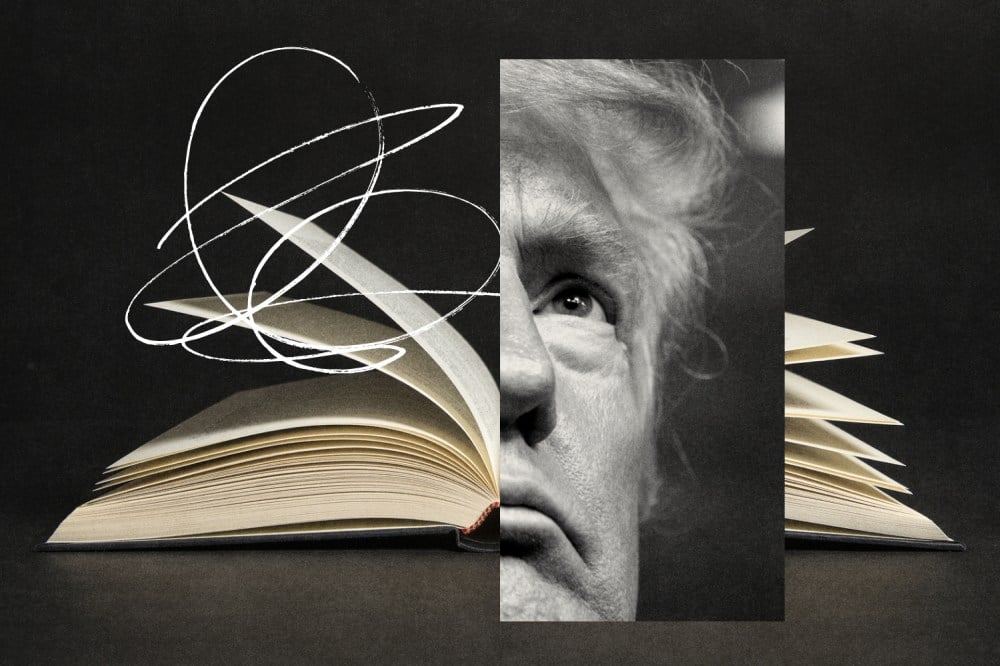
When tackling a work of critical theory, much of one’s mental energy goes towards figuring out what the text is actually about. Political Fictions: From the Middle Ages to the “Post-Truth” Present is no exception. The book by Patrick Boucheron, a French medieval historian, “illuminates today’s political situation by examining the relationship between government and storytelling,” according to the publisher’s website.
But that’s not entirely accurate. Boucheron does not wish to examine the rhetorical skills of statesmen past and present, as this description might suggest. His goal is much more ambitious: to explore how works of fiction, from Dante Alighieri’s Divine Comedy to HBO’s Game of Thrones, create new ways of thinking about power and subsequently reshape political reality in their own image. A synthesis of the author’s previous scholarship, Political Fictions is not an original text, but a transcription and translation of a series of lectures delivered in French at the Collège de France in early 2017. The occasion at the time was the first inauguration of Donald Trump as U.S. president, a moment which demonstrated—not for the first time in history—that the “exercise of power no longer had to concern itself with truth.”
When tackling a work of critical theory, much of one’s mental energy goes towards figuring out what the text is actually about. Political Fictions: From the Middle Ages to the “Post-Truth” Present is no exception. The book by Patrick Boucheron, a French medieval historian, “illuminates today’s political situation by examining the relationship between government and storytelling,” according to the publisher’s website.
Political Fictions: From the Middle Ages to the “Post-Truth” Present by Patrick Boucheron, Other Press, 400 pp., .99, November 2025
Political Fictions: From the Middle Ages to the “Post-Truth” Present by Patrick Boucheron, Other Press, 400 pp., $14.99, November 2025
But that’s not entirely accurate. Boucheron does not wish to examine the rhetorical skills of statesmen past and present, as this description might suggest. His goal is much more ambitious: to explore how works of fiction, from Dante Alighieri’s Divine Comedy to HBO’s Game of Thrones, create new ways of thinking about power and subsequently reshape political reality in their own image. A synthesis of the author’s previous scholarship, Political Fictions is not an original text, but a transcription and translation of a series of lectures delivered in French at the Collège de France in early 2017. The occasion at the time was the first inauguration of Donald Trump as U.S. president, a moment which demonstrated—not for the first time in history—that the “exercise of power no longer had to concern itself with truth.”
It was also a moment when, after having mocked, ignored, or underestimated Trump as a candidate, academia somewhat begrudgingly realized it had no choice but to start taking seriously the movement Trump spearheaded and represented. Debates were started that continue to this day. Chief among them is the question of whether he should be considered an authoritarian figure who marches to the beat of his own drum—or a demagogue who dances to a tune set by his followers. Boucheron, by way of introducing his thesis, proposes a third explanation: that dictators act neither to satisfy their own desires nor to meet the expectations of their subjects, but according to political fictions that predate both ruler and ruled.
George Orwell’s 1984, Thomas Hobbes’s Leviathan, and Niccolò Macchiavelli’s The Prince
George Orwell’s 1984, Thomas Hobbes’s Leviathan, and Niccolò Machiavelli’s The Prince.
Boucheron’s definition of political fictions—which, he stresses, are different from myth, ideology, and collective memory—requires careful delineation. With “fiction,” he does not mean the familiar category of literature, but—as per its Latin root—anything that is invented, imagined, or constructed. Consequently, his lectures not only touch on fiction in the bookstore-and-library sense of the word, like Orwell’s 1984, but also on statues, paintings, and philosophical treatises, like Thomas Hobbes’ Leviathan and Niccolò Machiavelli’s The Prince. To the author—who, echoing the likes of Michel Foucault, distills authority to the ability to decide what’s true and what’s false—fiction is not the opposite of fact, but the means through which facts are brought into existence. Political fictions, born from yesterday’s discontents, prophesize the realities that tomorrow’s leaders strive to create, knowingly or not.
Political fictions come in various shapes and sizes. They include, for example, the Gesta Hungarorum—a late 13th century ethnonationalist text that transforms Hungary’s ancestors, the Huns, from a Central Asian barbarian horde into a model society of quasi-Christian egalitarianism. Another of Boucheron’s examples is the familiar phrase “The king is dead, long live the king,” which distinguishes between a monarch’s mortal body and his supposedly immortal function. One political fiction that the author discusses at particularly great length is that of the Eucharist or Holy Communion, an essential Christian rite where the faithful consume bread and wine. Initially, as attested to by the writings of early theologians like St. Augustine of Hippo, these were understood as metaphors for the body and blood of Christ—nothing more, nothing less. Over time, though, this metaphorical thinking was supplanted by the idea of transubstantiation: the belief that, in the performance of this ritual, the bread and wine are actually physically transformed into the things they represent. More than theological semantics, this development changed the Catholic Church from a devotee of the divine into its earthly substitute, enabling the papacy to become one of the premier political forces of the Western world.
Italy’s Benito Mussolini, the 1701 painting Portrait of Louis XIV in Coronation Robes, and Russia’s Vladimir Putin
Italian dictator Benito Mussolini, the 1701 painting Portrait of Louis XIV in Coronation Robes, and Russian President Vladimir Putin.
Betraying the premise contained within its title, Political Fictions largely confines itself to medieval Europe, where Boucheron feels most at home. Only rarely and always briefly does he fast-forward to the present, leaving it to the reader to work out what his musings on Ambrogio Lorenzetti’s 14th century frescoes or the carvings on Guido Tarlati’s cenotaph can teach us about life in our current age of alternative facts and fake news. Creating this relevance is a daunting task, considering the specificity of his observations, but not impossible. Boucheron’s comments on Hyacinthe Rigaud’s famous 1701 Portrait of Louis XIV in Coronation Robes—which he argues heralded the distillation of feudal society’s abstract, composited body politic into the physical body of a single, absolute ruler—also anticipated the preoccupation with the physicality and virility of more recent authoritarian leaders like Benito Mussolini and Vladimir Putin, both known for their bare-chested public appearances. Then, as now, the health of the sovereign functions as a synonym for the health of the sovereign nation as a whole.
Today, Boucheron asserts, the most powerful political fictions are no longer propagated by books, cenotaphs, or paintings, but by popular films and TV shows. He notes how Game of Thrones foreshadowed the post-truth present insofar as it abandoned Lord of the Rings author J.R.R. Tolkien’s long-dominant take on the fantasy genre. Where Middle-earth’s apocalyptic showdowns between absolute good and absolute evil borrow heavily from Christian and proto-Christian mythology, Westeros presents a more Machiavellian, materialist, and morally ambiguous worldview, where power is treated as an end in itself and government is judged “on its results and not on its principles.”
Boucheron also notes, as many other observers did at the time, how Trump’s 2017 inauguration speech—in which he spoke of taking power from Washington and giving it “back to you, the American people”—bore an uncanny resemblance to the one delivered by Bane, the supervillain in Christopher Nolan’s The Dark Knight Rises, parts of which were filmed at Trump Tower in New York. Trump has since been compared to another comic book villain: the Joker. Brought back from obscurity by actor Heath Ledger in The Dark Knight, the character—cynical, humorous, detached from reality, and beyond the point of parody—was unlike any criminal Batman had ever faced and, ultimately, the only one he couldn’t defeat. Released before Barack Obama entered the White House, The Dark Knight offered a glimpse of the post-Obama era, when Trump, much like the Clown Prince of Crime, achieved success not in spite but because of breaking with a tried and tested mold.
The Joke in The Dark Knight, Game of Thrones, and Bane in The Dark Knight Rises.
The Joker in The Dark Knight, a Game of Thrones promotional poster, and Bane in The Dark Knight Rises.
In a subtle but significant twist on recent scholarship on historical revisionism, Boucheron’s theory of political fictions posits that the present doesn’t rearrange the past so much as the past prearranges the present. The author points to the German philosopher Hans Blumenberg, whose 1979 Work on Myth demonstrates just how closely various world leaders have tried to follow in the literal and metaphorical footsteps of their idols. According to Blumenberg, many of Adolf Hitler’s strategic blunders during World War II resulted in large part from his desire to emulate Frederick the Great and Napoleon Bonaparte, who in turn planned their own military campaigns to mirror the legacy of Alexander the Great. (Boucheron describes Napoleon’s 1798 invasion of Egypt and Syria as rummaging “in the Alexandrian storehouse of political imagination.”) Here, too, contemporary examples come to mind, from Putin’s determination to restore pre-Soviet imperial glory to Trump aping the protective tariffs of William McKinley.
Though powerful and pernicious, no political fiction lasts forever. As Boucheron repeatedly states, each can be turned “inside out like a glove” to bring about their own undoing. The fiction fabricated by the Sun King’s well-dressed portrait was turned inside out during the French Revolution, when Louis XVI—afraid of meeting the guillotine—attempted to flee Versailles disguised as a valet. Quoting the 19th century French historian Jules Michelet, Boucheron wonders if anyone “would have dared [to] arrest” the king had he worn the robes and regalia that signified his unalienable right to rule as head of the ancien régime.
This article is featured in the FP Weekend newsletter, a curation of our best book reviews, deep dives, and other reads that take a step back from the drumbeat of the news. Get the lineup directly every Saturday.
This article is featured in the FP Weekend newsletter, a curation of our best book reviews, deep dives, and other reads that take a step back from the drumbeat of the news. Get the lineup directly every Saturday.
Sign Up
By submitting your email, you agree to the Privacy Policy and Terms of Use and to receive email correspondence from us. You may opt out at any time.
Enter your email
Sign Up
Loading…
Boucheron offers another, similar example of a political fiction being erased through its own inversion by way of the tragic life of Ernst Kantorowicz. A Polish Jewish medievalist, Kantorowicz achieved widespread acclaim with his 1927 biography of the Holy Roman Emperor Frederick II, which—in keeping with the romantic nationalist currents of the time—presented its subject as a Nietzschean superman who fused the powers of state and church into a single, indivisible office. Later, the biography’s influence on Nazi elites—Heinrich Himmler was said to have kept a copy on his nightstand—compelled Kantorowicz to reconsider his most successful work. “Cured of the political mysticism that dizzied his youth,” he wrote his other magnum opus, The King’s Two Bodies (1957), as a means of dismantling and delegitimizing the ideas he’d espoused before the Nazis’ rise.
Perhaps the most salient aspect of Boucheron’s lectures are his deliberations on the political limits of satire and parody—a topic which, though heavily debated as of late, remains poorly understood. Asked in 2017 why they didn’t lampoon Trump to the extent they lampooned previous presidents, the creators of the animated sitcom South Park—which more recently pivoted to parodying Trump directly—said that “what was actually happening was much funnier than anything we could come up with.” Boucheron agrees with this sentiment, explaining Trump’s immunity to mockery as follows: “The surest way never to be caricatured is to be one’s own best caricature. That’s why being ridiculous is not fatal in politics; what’s fatal, or potentially so, is being ridiculed. But if you make yourself ridiculous, so extremely ridiculous that no one can do you better, then you’re untouchable.”
A mural of Donald Trump dressed as the Joker threatening the Statue of Liberty. Text above reads “The hell do you have to lose?”
A woman poses for a photo in front of a mural of Donald Trump as the Joker in Miami on Oct. 27, 2016.Rhona Wise/AFP via Getty Images
Trump’s immunity can also be explained by taking a closer look at how satire and parody actually work. Studied up close, these forms of comedy don’t ridicule so much as they reveal what is unseen and unspoken. They unmask, and that means they work only when there is a mask to take off. George W. Bush could easily be satirized and parodied, because his administration’s public justification for starting the Iraq War—the alleged existence of weapons of mass destruction—obscured the real motivations. Trump lies, too, and frequently at that. But unlike Bush’s lies, they don’t obfuscate the truth so much as disregard its importance. As a result, there is nothing for satire and parody to reveal about Trump that Trump himself has not already revealed.
A large part of Boucheron’s appeal as an academic is rooted in the density and abstruseness of his research, which, unless you’re intimately familiar with Michel Foucault and the Frankfurt School, will not reveal its wisdom without strenuous effort on part of the reader or listener. That’s not to say that Political Fictions frustrates without cause. Like Slavoj Zizek’s recently published collection of essays about civilizational thinking, Against Progress, or John Berger’s seminal 1972 TV series, Ways of Seeing, about how culture and ideology warp visual perception, Political Fictions is a challenging read mainly because its subject—the artificiality of truth—is now so ubiquitous, so omnipresent, so close to our noses that we no longer take notice of it. That, of course, is precisely why we should.
