

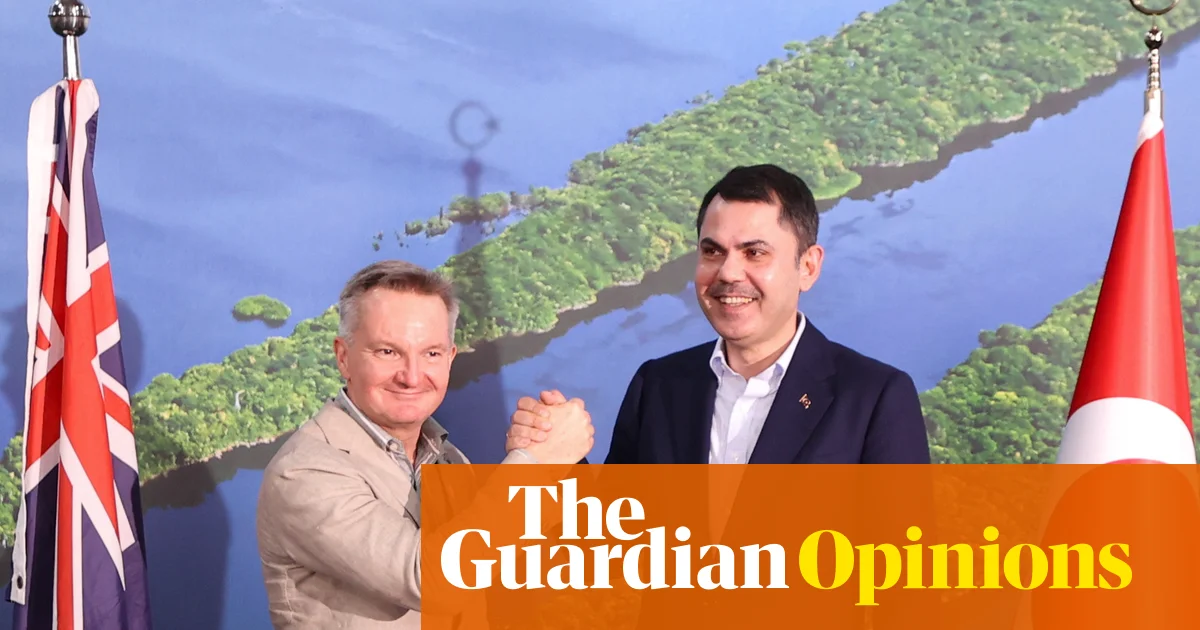
The Cop30 climate conference has finally come to an end, with Australia having lost out on the grand prize of hosting next year’s gathering. But Australia’s formal partnership agreement with Turkey nevertheless provides an opportunity to secure unparalleled global influence and turbocharge our own transformation to a net zero, green export economy. Here are three ways to make it happen.
First, Chris Bowen’s new role as Cop31 “president of negotiations” puts the climate and energy minister at the helm of the most complex and consequential multilateral process in the world.
The process is easily and often criticised as a triumph of incrementalism, but the negotiating texts are where the geopolitical rubber hits the road, capturing important statements of political will and a tapestry of international commitments that galvanise global consensus.
Bowen’s new and somewhat unprecedented role makes him the curator and custodian of language capable of becoming the new zeitgeist guiding government and business action alike. A global goal to triple renewable energy and double energy efficiency are now benchmarks for the world’s efforts. One idea is for Bowen to consider proposing an electrification target to these objectives, bolstering efforts in an area that is currently lagging behind.
Second, and most central to the government’s narrative in recent weeks, is delivery on the much-vaunted “partnership with the Pacific”. Bowen has spoken of his motivation to ensure the Pacific’s voice is heard internationally and the region’s priorities reflected fully in next year’s deliberations – a high yardstick.
In that vein, Bowen’s deal with Turkey secures a commitment to hold the annual pre-Cop gathering in the Pacific. While this is usually a relatively small affair for senior officials, Australia has projected a much higher aspiration for attendance by world leaders and ministers, hopefully with a core focus on a plan to make the Pacific the first 100% renewable energy region in the world, fully capitalise the Pacific Resilience Facility and innovate solutions to integrate oceans and climate conservation efforts.
But a Pacific pre-Cop must also serve as a preparatory stepping stone, or rather an ambitious springboard, to set parameters and expectations for an ambitious Cop31.
It is notable that in Belém, Australia at the last minute joined a number of Pacific islands, Latin Americans and a spattering of Europeans to promote a new declaration for the just transition away from fossil fuels, by far the strongest statement Australia has ever made on the issue.
At one level, the statement simply reflects the reality that we need to achieve deep, rapid and sustained reductions in global emissions to reach net zero emissions by 2050 or earlier if we are to achieve the goals of the Paris agreement (once again highlighting the inconsistency embedded in the Coalition’s new policy position). Broader efforts to secure a more formal and universal timeline and trajectory for transitioning away from fossil fuels ultimately failed in Belém, but these calls will only get louder. We need to grapple now with our addiction, and quickly decarbonise not just our national electricity market, but our trade balance sheet as well.
Third, while Bowen’s role will not formally kick off until Cop31 opens next November, in reality it begins next week. Friday’s detailed agreement with Turkey commits him to conduct an extensive process of consultations, preparations, and communications to shape the contours and build momentum for the negotiated outcomes in Antalya.
But this is not just about negotiated outcomes. There will be new and unprecedented high-level contacts, networks, platforms and other opportunities for him to highlight Australia’s climate leadership and energy transition in partnership with a number of thematic “champions” we will jointly appoint, and this will help us take our national efforts to the next level.
skip past newsletter promotion
Sign up to Clear Air Australia
Adam Morton brings you incisive analysis about the politics and impact of the climate crisis
Privacy Notice: Newsletters may contain information about charities, online ads, and content funded by outside parties. If you do not have an account, we will create a guest account for you on theguardian.com to send you this newsletter. You can complete full registration at any time. For more information about how we use your data see our Privacy Policy. We use Google reCaptcha to protect our website and the Google Privacy Policy and Terms of Service apply.
after newsletter promotion
We should seek to do things like translate our new dialogue with China on green steel into a final investment decision for a first pilot green steel production plant, and start building our new, value-add green export industry. And we should look to leverage every visit by a world leader to Australia next year to secure a series of big, juicy climate or green industry-related investment to help inject real world momentum and energy into the negotiating process Bowen now oversees.
Through that lens, and in parallel to Cop31 diplomatic preparations, Australia should be thinking about what it can do to bring the “world’s largest green trade fair” component of a Cop to Adelaide, the previous candidate for an Australian Cop31. This will require some creativity, but it is exactly the kind of launching pad we need to attract international interest, technology, and investment to fully harness our new Future Made in Australia green industrial policy. An event like this is unlikely to cost us a dime, but instead deliver a substantial return on investment through new economic opportunities, jobs and exports.
Diplomacy rarely produces black and white outcomes. There is no sugar coating the fact that, based on the overwhelming support for our bid, and the depth of the government’s policy preparations, Australia deserved a chance to host Cop31 in partnership with the Pacific. But we are where we are. The most important thing now is to ensure that our Cop31 role delivers tangibly for the Australian people, our companies and the Pacific.
Thom Woodroofe is a senior international fellow with the Smart Energy Council and a former climate diplomat
Dean Bialek is a former diplomat and international lawyer with 15 years of Cop experience
