

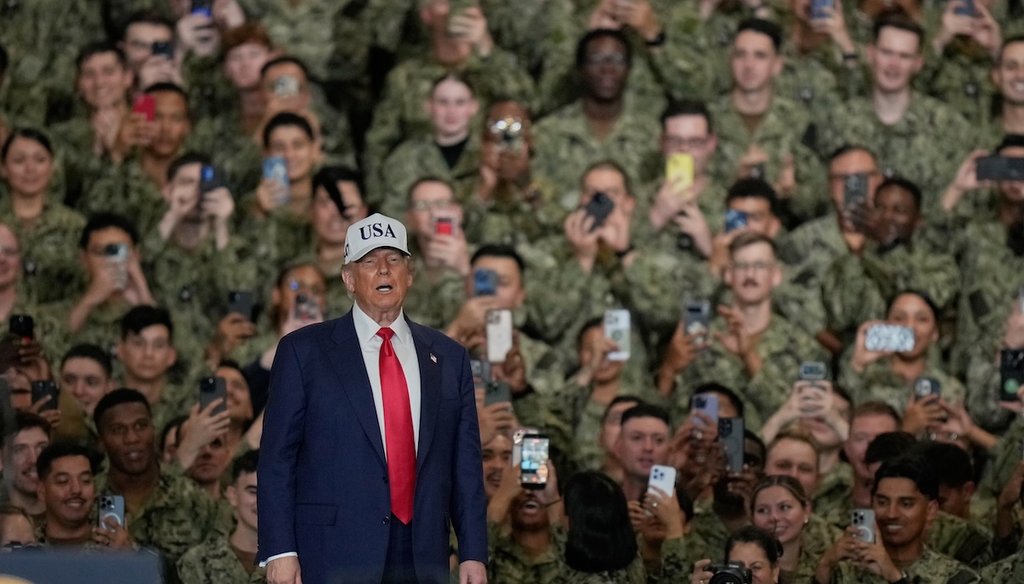
After Democratic lawmakers who are military and intelligence agency veterans posted a video urging U.S. service members not to carry out illegal orders, President Donald Trump attacked the lawmakers on Truth Social, saying they had committed sedition.
The lawmakers’ Nov. 18 video featured Sens. Elissa Slotkin of Michigan and Mark Kelly of Arizona and U.S. Reps. Jason Crow of Colorado, Maggie Goodlander of New Hampshire, and Chrissy Houlahan and Chris Deluzio of Pennsylvania.
In the video, the lawmakers introduced themselves and said which military branch or intelligence agency they served in. Then, taking turns, the lawmakers said:
“We want to speak directly to members of the military and the intelligence community who take risks each day to keep Americans safe. We know you are under enormous stress and pressure right now. Americans trust their military. But that trust is at risk. This administration is pitting our uniformed military and intelligence community professionals against American citizens. Like us, you all swore an oath to protect and defend this Constitution. Right now, the threats to our Constitution aren’t just coming from abroad, but from right here at home. Our laws are clear: You can refuse illegal orders. You can refuse illegal orders. You must refuse legal orders. No one has to carry out orders that violate the law or our Constitution. We know this is hard, and that it’s a difficult time to be a public servant. But whether you’re serving in the CIA, the Army, our Navy, the Air Force, your vigilance is critical. And know that we have your back. Because now, more than ever, the American people need you. We need you to stand up for our laws, our Constitution, and who we are as Americans.”
The video did not specify what orders the lawmakers were referring to.
In one of Trump’s first Truth Social posts about the video, he said, “This is really bad, and Dangerous to our Country. Their words cannot be allowed to stand. SEDITIOUS BEHAVIOR FROM TRAITORS!!! LOCK THEM UP???”
Another one of Trump’s Nov. 20 posts said, “It’s called SEDITIOUS BEHAVIOR AT THE HIGHEST LEVEL. Each one of these traitors to our Country should be ARRESTED AND PUT ON TRIAL. Their words cannot be allowed to stand – We won’t have a Country anymore!!! An example MUST BE SET.”
In another post, Trump wrote, “SEDITIOUS BEHAVIOR, punishable by DEATH!” Trump also reshared Truth Social posts from other users who said the lawmakers should be indicted or hanged.
His statements followed other Republicans criticizing the video.
Defense Secretary Pete Hegseth called it “Stage 4” Trump Derangement Syndrome in an X post. Sen. Marsha Blackburn, R-Tenn., told Fox News, “It is inconceivable that you would have elected officials that are saying to uniformed members of the military who have taken an oath that they would defy the orders that they have been given to execute their mission.”
Legal experts told PolitiFact that Trump’s sedition accusation doesn’t hold up. They said they see no path for charging the Democratic lawmakers under any form of sedition law.
“Absolutely not,” said Rod Smolla, a Vermont Law and Graduate School law professor. “They are not conspiring to overthrow the government — they are expressing their views critical of orders coming from the president that they believe are illegal.”
In a Nov. 20 press briefing several hours after Trump’s posts, a reporter asked White House Press Secretary Karoline Leavitt if the president wanted “to execute members of Congress.” Leavitt said he didn’t. She said the lawmakers’ video encouraged service members to defy the president’s “lawful orders,” which “could inspire chaos, and it could incite violence, and it certainly could disrupt the chain of command.”
The lawmakers’ video referred to unlawful orders, not lawful ones.
On Nov. 19, Slotkin posted an excerpt on X from a panel discussion during which she said some service members have expressed concerns about recent U.S. military activity off the coast of Venezuela. Legal experts have told PolitiFact that military strikes on boats in the Caribbean that the U.S. suspects of carrying drugs raise legal questions.
Slotkin and the other Democratic lawmakers released a joint statement following Trump’s Truth Social posts, saying: “What’s most telling is that the President considers it punishable by death for us to restate the law. Our servicemembers should know that we have their backs as they fulfill their oath to the Constitution and obligation to follow only lawful orders. It is not only the right thing to do, but also our duty.”
Sen. Elissa Slotkin, D-Mich., speaks at the Center for American Progress, a liberal think tank, on June 26, 2025, in Washington, D.C. (AP)
What is sedition?
Sedition broadly refers to anti-government conduct and takes two forms: libel and conspiracy.
“Seditious libel” refers to anti-government speech. From the 1798 Sedition Act to the 1918 Sedition Act, laws targeting seditious speech have been controversial because they clashed with the First Amendment, which protects freedom of speech.
Courts began ruling against such laws in the late 1950s, culminating in the 1969 U.S. Supreme Court decision in Brandenburg vs. Ohio, which set a high bar for conviction based on speech. The court said the conduct resulting from speech needed to be imminent, likely and intended by the speaker.
That and other judicial decisions made clear that “even speech that advocates lawbreaking in the abstract is protected,” said Timothy Zick, a College of William & Mary law professor. And in this case, the lawmakers “are urging that the law be upheld, not violated.”
The other form is “seditious conspiracy.” Under this law, it is a crime for two or more people to “conspire to overthrow, put down, or to destroy by force” or levy war against the U.S. government, or to use force to take government property, oppose the authority of the government or prevent “the execution of any law.”
Carlton Larson, a University of California-Davis law professor, said the seditious conspiracy statute likely would not apply to the lawmakers’ comments. The law “requires an agreement to commit certain unlawful actions,” Larson said. “Encouraging the military not to obey unlawful orders is not an agreement under the seditious conspiracy statute.”
The repeated use of the phrase “by force” in the legal statute is a key feature legally protecting the lawmakers’ video, experts said.
The video doesn’t include anything “indicating an agreement to use force against the authority of the United States,” said Geoffrey S. Corn, the chair of criminal law at Texas Tech University and director of its Center for Military Law and Policy.
On Truth Social, Trump also misled by saying seditious actions are subject to the death penalty. The law says someone convicted can be fined or imprisoned for up to 20 years, not put to death.
What does military law say about following unlawful orders?
Legal experts said the Democratic lawmakers have a point about service members’ ability to challenge what may be unlawful acts. However, the experts said determining what is lawful can be challenging for service members, and they could face high penalties if they get it wrong.
The Operational Law Handbook for judge advocates general says, “In rare cases when an order seems unlawful, do not carry it out right away, but do not ignore it either. Instead, immediately and respectfully seek clarification of that order.” While orders from the chain of command are presumed lawful, the handbook says, the order would be “manifestly illegal” if “a reasonable person would recognize the wrongfulness” and, if so, “soldiers have a duty to disobey it.”
The Commander’s Handbook on the Law of Naval Operations concurs, saying an order “may be inferred to be lawful,” but if the order is “patently illegal,” such as the murder of a civilian or noncombatant, “this inference does not apply.”
And Army Talent Management, the document that outlines the branch’s leadership doctrine, says, “Army professionals serve honorably by obeying the laws of the Nation and all legal orders. Army forces reject and report illegal, unethical, or immoral orders or actions.”
Dru Brenner-Beck, a military law attorney based in Colorado, said the video accurately restated the law that applies to to U.S. forces, their duty of obedience and their obligation to support and defend the Constitution.
“It is not subversion,” Brenner-Beck said. “However, it is remarkable that members of the United States government should feel that such a video was necessary.”
Still, for service members, the guidance for determining what is a manifestly unlawful order is “pretty vague,” said David Luban, a Georgetown University law professor.
While there is no duty to obey an illegal order, “a service member who disobeys because he or she believes the order is illegal will likely be subject to prosecution by court-martial for willful disobedience,” Corn said.
In that scenario, the defendant would have to establish to the judge that the order was illegal, and “not just that he or she believed it was,” Corn said. “If the military judge concludes that the order was legal, this defense would not be allowed.”
Richard D. Rosen, an emeritus law professor at Texas Tech and retired Army colonel, said if he were on active duty, he would advise soldiers to ignore the video.
“While lawmakers may score political points, soldiers who follow their advice could be imprisoned, receive a dishonorable or bad conduct discharge, and lose all pay and allowances,” Rosen said.
At the same time, there are risks to not questioning a potentially illegal order, Corn said. “Obedience to a clearly or manifestly unlawful order is no defense to a crime that arises from that obedience.”
Senate Armed Services Committee ranking member Jack Reed, D-R.I., said he supports the general message in the video but acknowledged that it can be hard to determine an order’s legality, Fox News reported.
“You can’t disobey the Constitution,” Reed said. “The issue, though, on a practical sense to me, is that determination is often very difficult to make.”
PolitiFact Staff Writer Maria Ramirez Uribe contributed to this report.
