

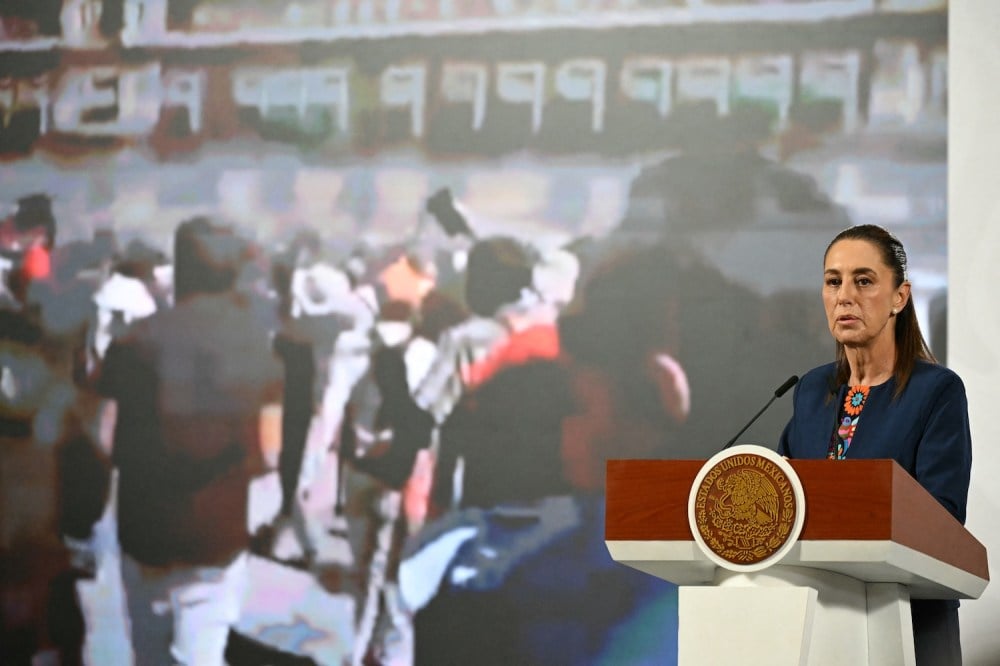
On Nov. 5, Mexican President Claudia Sheinbaum was sexually assaulted by a drunk man while she was greeting supporters outside the presidential palace in Mexico City. The man put his arm around her shoulder, touching her hip and chest while attempting to kiss her neck. The assault was recorded on smartphones and quickly went viral.
In her morning press conference on Nov. 6, the president said she would be pressing charges against the man, who was apprehended by police in Mexico City.
On Nov. 5, Mexican President Claudia Sheinbaum was sexually assaulted by a drunk man while she was greeting supporters outside the presidential palace in Mexico City. The man put his arm around her shoulder, touching her hip and chest while attempting to kiss her neck. The assault was recorded on smartphones and quickly went viral.
In her morning press conference on Nov. 6, the president said she would be pressing charges against the man, who was apprehended by police in Mexico City.
“My thinking is: If I don’t file a complaint, what becomes of other Mexican women?” said Sheinbaum. “If this happens to the president, what will happen to all the women in our country?”
The scope of gender-based violence in Mexico is staggering. In 2021, 70 percent of 50.5 million women and girls aged 15 and older experienced some kind of violence—up 4 percentage points from 2016—and it is estimated that 10 women and girls are murdered every day in Mexico.
Sheinbaum has subsequently announced her administration will pursue the criminalization of sexual assault across state jurisdictions, with the federal ministry for women drawing up a raft of measures to address gender-based violence in the country.
As a moment of embodied feminist leadership—a female head of state is publicly sexually assaulted and responds to it by using her power to make it stop for all women—Sheinbaum has been the subject of international feminist praise and support. As many have observed, the incident is a powerful demonstration of the entitlement men feel to the bodies of women everywhere, even the body of a woman president.
Yet it’s hard to see how Sheinbaum announcing that she is pursuing criminal charges and the further criminalization of assault in federal and state codes is actually going to help lower the rate of gender-based violence for ordinary Mexican women. In fact, some Mexican feminist groups—which have grown exponentially in recent years and which spurred the “green wave” that led to the country electing its first female president in 2024—argue the push for consequences from one sexual assault obscures the ongoing threat of state violence, including against women.
The first problem is how Sheinbaum’s pursuit of criminal code reform and stricter consequences for sexual assault in judicial sentences meaningfully materializes in practice. Around 92 percent of crimes in Mexico go unpunished, from which gender-based crimes are no exception.
As Mexican feminist civil society organization Intersecta has pointed out, recent reforms to the legal system—such as the introduction of a popularly elected judiciary and new restrictions on prosecuting injunctions—are unlikely to increase the strength of the country’s rule of law. The judicial reform effectively collapsed that branch of the state into the executive, meaning that, to practice, judges have to “curry favor with the powers that be,” as an Intersecta analysis noted.
Both the administrations of President Andrés Manuel López Obrador and Sheinbaum, his successor, have also pursued a policy of “preventive imprisonment,” which has been criticized by the United Nations and other human rights authorities. There are more than 40,000 people, many of whom are women, currently stuck in this form of detention without trial. As per an analysis by independent media daily Animal Político, new restrictions on injunctions will prevent people in preventive imprisonment from petitioning for their freedom.
In a legal system that involves judicial cronyism and detention without trial, the serious investigation and judgment of gender-based crime before the law is necessarily threatened. Plus, the moral authority of feminist claims against abuse, assault, and femicide in wider society is compromised. Simply creating new laws in a system that operates with these features is at best unlikely to make any difference to prevention and accountability for gender-based violence. At worst, it provides just another tool to wield against accountability for the most powerful.
To make matters worse, Sheinbaum has just announced a new chapter in the “war on drugs,” which has failed, and failed women, time and time again, and which only creates more violence.
In the week the president was assaulted, Mexico had once more been rocked by the brutal assassination of a political leader. On Nov. 1, Carlos Manzo, mayor of Uruapan in the southwestern state of Michoacán, was shot dead in a professional hit while attending a Day of the Dead celebration. Believed to be linked to the Jalisco cartel, the murder of Manzo was the seventh of a mayor since 2022 in Michoacán, where armed criminal groups have a heavy presence and have been fighting for control of territory. In response, Sheinbaum has announced the “Plan Michoacán” security strategy, which will see some 10,000 military personnel deployed to the region.
Deploying the military to fight cartels was the cornerstone of former President Felipe Calderón’s war on drugs, declared in 2006, and to which at least 450,000 murders and the disappearance of more than 100,000 can be linked. These are figures that have continued to climb under both López Obrador and Sheinbaum, despite their Movement for National Regeneration (known as Morena) party professing to have ended the neoliberal trade and social policies, government corruption, and state-criminal pacts that fostered the catastrophe of unchecked armed violence in Mexico. Indeed, mass militarization has been a policy of both López Obrador and Sheinbaum, with the ranks, power, and arsenal of the armed forces—of which the president is commander in chief—expanding at an unprecedented rate.
In Chiapas, Mexico’s southernmost and poorest state, for example, the introduction of a militarized elite police force, the “Pakales,” (Fuerza de Reacción Inmediata Pakal, or FRIP) in 2024 has brought widespread targeting of poor and Indigenous populations—with women, as always, bearing the brunt. In the words of Indigenous feminist scholar Delmy Tania Cruz Hernández, a “war mindset” means that being poor, unemployed, or Indigenous “is criminalized, and the real culprits get off scot-free.”
Where Sheinbaum could be assaulted on the street and announce a crackdown on gender-based violence in response, the drivers of security for women and gender-diverse people in Mexico lie elsewhere—in how state leaders respond to armed violence. As a continuation of the war on drugs, the acceleration of Plan Michoacán-style militarization throughout Mexico has only made life more dangerous for many.
While Sheinbaum and her state government counterparts continue to pursue such strategies as national security policy, their claim to be making life safer for women in Mexico is highly dubious.
