

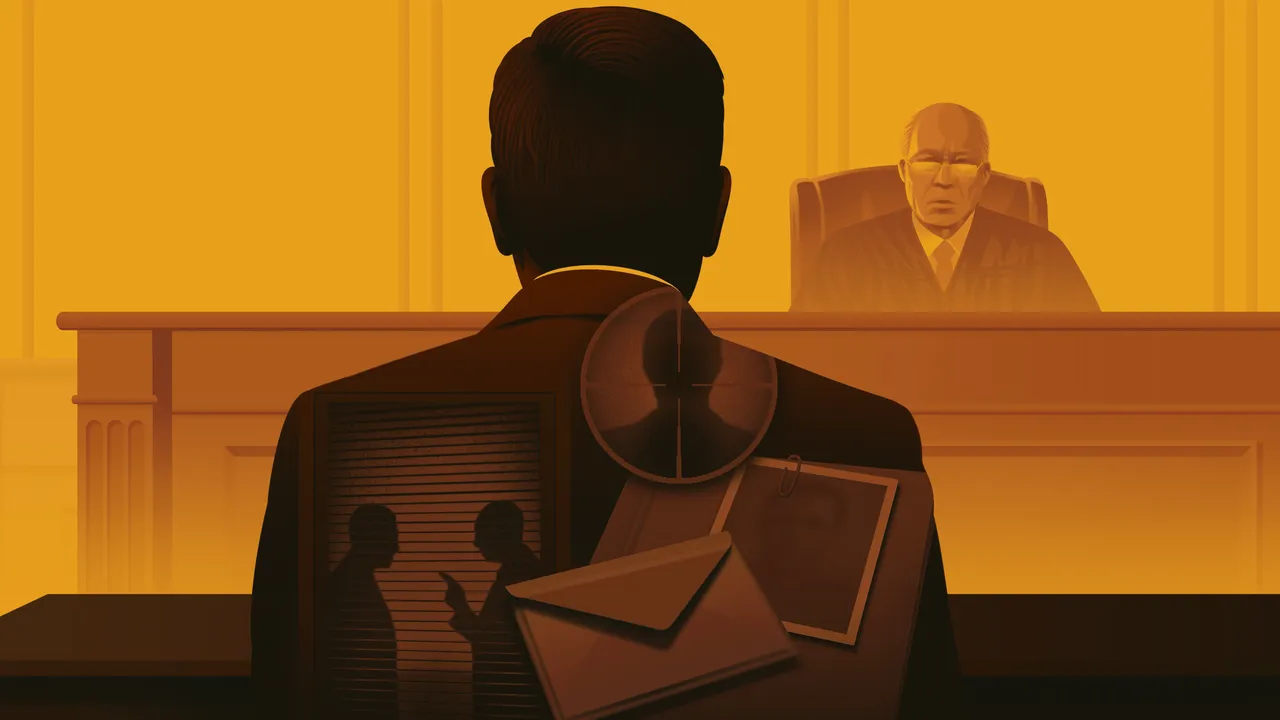
In October, 2024, after negotiations with the U.S., Modi’s government agreed to break ties with Yadav, who is currently at large and wanted by the F.B.I. India, which has never acknowledged culpability for the killing, has portrayed Yadav as an independent actor, but a source close to Indian intelligence told me that one RAW officer privately characterized these denials as “total bullshit.” Another called the plot “a botched operation.” Court filings for Gupta’s trial indicate U.S. prosecutors will argue that India was directly involved in the attempt to assassinate Pannun, and that he was just one of several targets in a scheme to murder political activists in Canada, California, and New York. These individuals, fearing for their lives in India, had immigrated to North America decades ago and continued advocating for an independent Sikh state.
A few minutes after Nijjar was shot, his son Balraj received a distress call from a family friend and raced to the gurdwara, sprinting through a crowd that had already grown to some two hundred people. “They were pulling at my clothes, my arms, as I ran,” he told me. In the center of the throng, already cordoned off with police tape, was Nijjar’s bloodstained pickup. “The second I saw it, I knew he had passed,” Balraj told me. “His last breath was for Khalistan, regardless of how many thousands of miles he was from home.”
The idea of a Sikh homeland arose nearly a century ago, as colonial Britain lost its grip on its South Asian territories. The region began to split along religious lines, and Sikh leaders, recognizing that their community was much smaller than those of Muslims and Hindus, advocated for their own sovereign state. The idea never came to fruition. In 1947, British India was partitioned into Muslim-majority Pakistan and Hindu-majority India. As a vast migration flowed from place to place, depraved and indiscriminate faith-based violence ensued, affecting Hindus, Muslims, and Sikhs alike. The province of Punjab, where most of the Sikhs in British India lived, was split in two.
Sikhs currently constitute less than two per cent of India’s population. Since Partition, however, advocacy for an independent state has grown, funded in part by wealthy members of the diaspora and fuelled by a pattern of discrimination by the Indian government. The most striking instance came in 1984, after Prime Minister Indira Gandhi was assassinated by two of her own bodyguards, who were Sikh; the ruling Indian National Congress helped to organize a retaliatory spasm of mob violence that killed thousands of Sikhs. In the aftermath, the state began to disappear members of the community. Such brutality has only encouraged resistance. Although Sikhism is built around tenets of oneness and divine love, a small group of militants have carried out a long campaign of violence. Before September 11, 2001, Sikh separatists held a bleak record for the deadliest act of aviation terrorism in history: in 1985, all three hundred and twenty-nine people on board Air India Flight 182, a passenger flight from Toronto to Delhi, were killed when a bomb in the cargo hold brought the plane down off the coast of Ireland.
The cycle of violence and discrimination has only heightened since Modi came to power, in 2014. As the leader of the far-right Bharatiya Janata Party, he has spearheaded a ruthless Hindu-nationalist campaign that villainizes and assaults religious minorities. For a party that believes Hindus have a preëminent right to rule India, the Sikh separatist cause is a profound affront—especially when the calls for independence are made from Canada and the U.S. According to the source close to Indian intelligence, senior RAW officials hold a “skewed world view” that “everything is a conspiracy, that the West is out to get India,” and this paranoia played a large part in the recent assassination plots.
The Indian government regards Pannun’s law offices as a hotbed of terror, a base from which he directs “Punjab based gangsters and youth” to undermine the “sovereignty, integrity, and security” of India. The offices are situated in a large corporate center, decorated with garish contemporary sculptures and softly flowing water features, in East Elmhurst, Queens. The interior suggests the detritus of a small business in stasis: Post-it notes stuck to walls, piles of paper stacked haphazardly, a mini-fridge filled with forgotten lunches.
On a recent visit, I was led in through a series of back hallways and patted down by two hulking guards. The main entrance stays locked, the lights in the waiting room off. Pannun, who met with me in a small conference room, was dressed soberly. “Since 2023, I’ve only worn black,” he said. “I’m only going to change that once we liberate Punjab.” He grew up in a village outside the city of Amritsar, the home of Sikhism’s holiest site, the Golden Temple. In 1984, Indian military forces invaded the gurdwara to capture Jarnail Singh Bhindranwale, a Sikh militant who was hiding inside. In the raid, known as Operation Blue Star, the army opened fire on Bhindranwale’s followers and civilians alike. Government documents put the death toll at a few hundred individuals, but independent reports suggest the figure exceeds four thousand. (It was this unilateral attack, sanctioned by Gandhi, that led to her assassination.) Pannun was seventeen at the time. “We could see the helicopters bombing, the shooting,” he said. “There was blood everywhere.” Fearing that the slaughter would touch off an insurrection, the government organized a campaign called Operation Woodrose, in which thousands of young Sikhs living in rural areas were detained and interrogated. “They were people I grew up with,” Pannun said. “I haven’t seen them since.” One young man he knew was tortured so viciously that his back was broken.
