

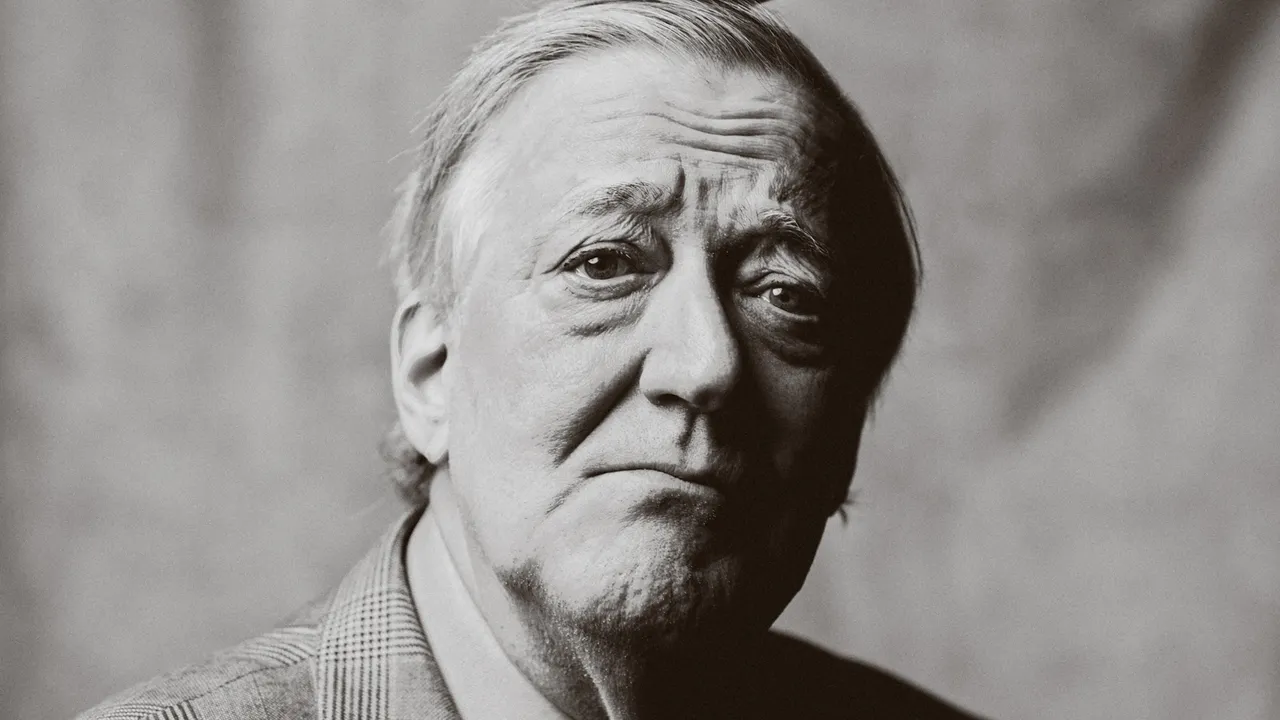
In “More Fool Me,” Fry speculates that, had he entered Cambridge fifty years earlier, he might have been tapped as a spy. During that era, he writes, “an old fashioned classical English education” was often “given to a certain kind of person equipped with charm, intelligence, duplicity, guile . . . who had an almost pathological need to prove himself, to belong.” He adds, however, that he thinks it unlikely that the intelligence services would have taken him, because of his Jewish heritage: his maternal grandparents were Hungarian Jews, and Fry has been outspoken about antisemitism in Britain.
In the late seventies, however, another Cambridge tradition called—comedy. “I’d always had this nagging feeling that I liked trotting about on a stage,” Fry said. Emma Thompson told me, “Stephen could basically extemporize Shakespeare.” Fry began appearing in numerous productions, and he even wrote a play, “Latin!,” which drew on his experiences at preparatory school. “I’m sure it would be pretty eye-watering now, because it’s a satirical comedy about pederastic schoolteachers,” he told me. He was recruited to join the Cambridge Footlights comedy group by its then president, Hugh Laurie, who had seen Fry in a production of “Volpone.” In an e-mail, Laurie told me, “I was looking to cast a revue for the Cambridge Footlights, and desperately wanted adult roosters in a field of squeaky, prancing cockerels. Stephen walked onstage, and it all fell into place. I remember nothing of the play except this mesmerising giant who stood at the centre.” Fry had, Laurie went on, “such gravity, such authority. Also an odd melancholy that just grabbed me from the first.”
By the mid-eighties, Fry and Laurie had become fixtures of light entertainment on British television. They appeared in their own sketch show and, later, in “Jeeves and Wooster,” an adaptation of P. G. Wodehouse novels, in which Fry plays an omnicompetent butler. “Over the years, from the first day to this, Stephen and I have laughed more with each other than anyone else I can think of,” Laurie said. “Unless he has other, secret laughing partners, which is possible. Because he keeps secrets, by God he does.”
In the early nineties, Fry’s financial situation received a boost when he helped revise the book of the 1937 British musical “Me and My Girl,” which went on to a three-year run on Broadway, with Fry reportedly earning three per cent of its box-office revenue. But, in an interview from this period, Fry explained that he was hopeless with money: “If I have a bone, I eat it; I don’t bury it in the garden. I can’t hoard anything, and that includes thoughts. I spend—thoughts, money, myself. I can’t save and conserve anything.”
Fry’s polymathic talents spilled forth. In 1991, he published the first of four novels, “The Liar,” a semi-autobiographical account of a brilliant and mendacious schoolboy. A best-seller, it includes long fictional extracts from a pornographic manuscript about child prostitution, supposedly written by Charles Dickens. “That you should stand exposed as an amuser of children, nought but a corrector of youth, a pedestal!” a malapropism-prone housekeeper cries. As Fry’s star rose, so did attempts to knock him off his own pedestal. Some were grotesquely literal. Anti-gay insults, and fists, were thrown at a school-reunion dinner at which Fry was the speaker, leading to the levying of fines against Fry’s detractors. In a degraded opinion piece, a Daily Mail columnist wrote, “Why is it that Stephen Fry is so eminently whackable, smackable, kickable, flickable? The answer is that he is simply the most irritating man in the country.” The paper even offered a “blow-up-and-biff” Stephen Fry doll to readers. Jokes about harming celebrities have aged about as well as jokes about pederasty, and perhaps it’s not surprising that such threats left Fry in a state of distress. Things reached a head in 1995, when he co-starred in a new play, “Cell Mates,” in the West End; three shows into the run, which had received mixed reviews, he disappeared to Belgium. He later faxed a note to his agent, explaining that he felt he’d failed as an actor. Fry was missing for several days, and friends feared that he’d taken his own life.
