

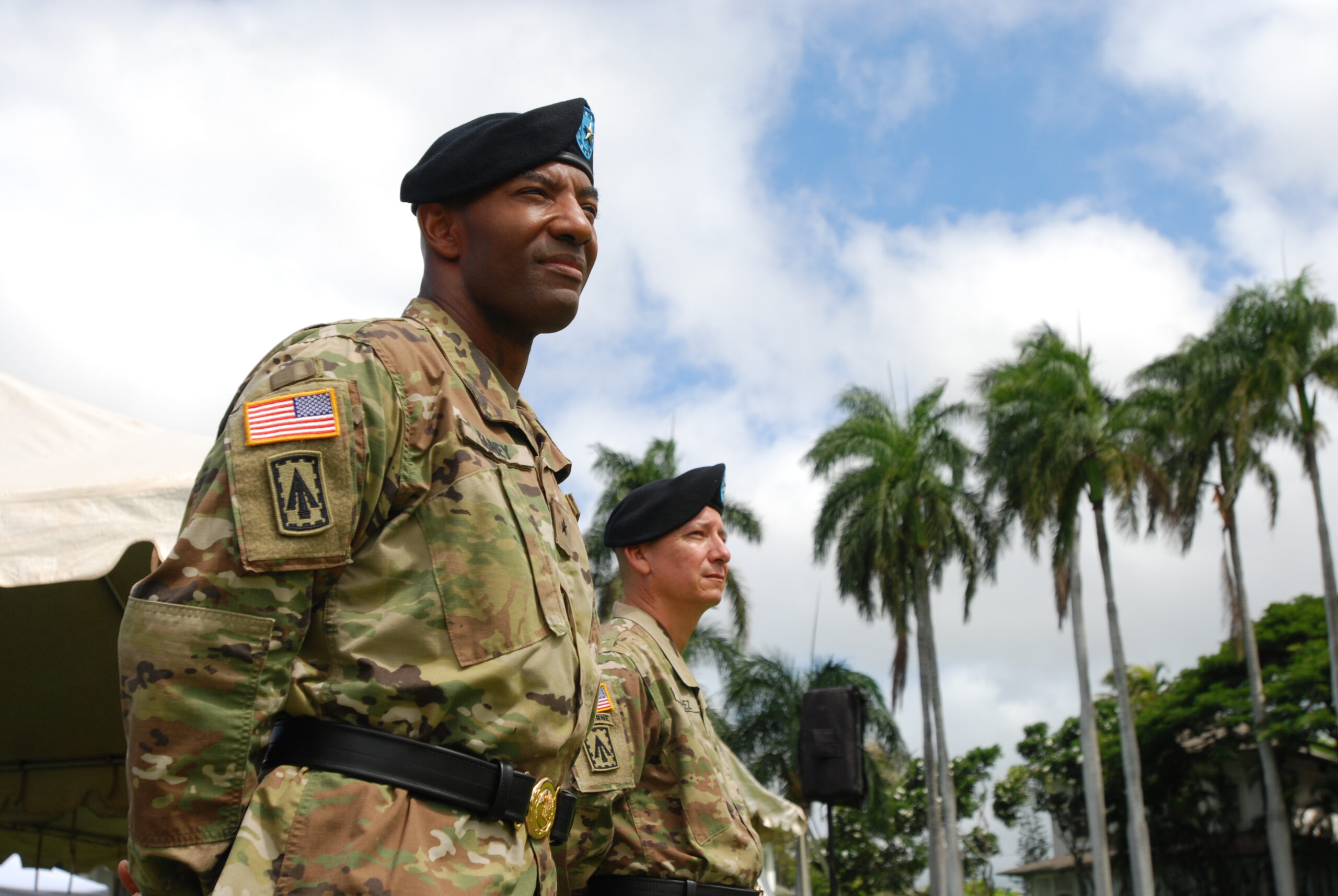
Terry Gerton How’s AUSA going for you?
Sean Gainey Fantastic, getting the opportunity to tell the Space and Missile Defense Command story, visit a lot with our industry partners and connect with a lot of old friends, so great few days so far.
]]>
Terry Gerton Speaking of the SMDC story, there’s been some changes for SMDC lately. You’ve picked up some new organizations. Tell us about the transfer of the Army Air and Missile Defense Commands (AAMDCs).
Sean Gainey Yeah, a lot of great opportunities inside of Space and Missile Defense Command with the Army’s Transformation Initiative. So as the Army transitioned to the Western Hemisphere Command, [that] presented an opportunity for 32nd Army Air and Missiles Defense Command that was previously under the Army Forces Command (FORSCOM) to move under Space and Missile Defense Command, and also it presented an opportunity for 263rd Air and Missile Defense Command, that was previously under [U.S. Army North (ARNORTH)] doing the homeland defense mission, set to move under SMDC. So now what you have is you have the Senior Army Air and Missile Defense Expertise Headquarters, now the higher headquarters for two of our homeland-based air and missile defense commands, one with a focus on the homeland and the other with a global force mission focus, particularly on the CENTCOM [area of responsibility], but with the opportunity to focus on the homeland. So therefore, putting the priority, the Secretary of War’s priority on the homeland with the alignment of these forces under Space and Defense Command.
Terry Gerton Is that a shift in focus and mission for those subordinate units now?
Sean Gainey The 263rd always had the homeland defense focus. They currently defend the National Capital Region mission set. So they will continue to focus on the homeland mission set. The 32nd Army Air and Missile Defense Command has had a focus in the CENTCOM AOR for the past several years based off of the mission sets in protecting our soldiers abroad. They’ve always maintained a global mission. Their service retained forces. So this gives Space and Missile Defense Command the opportunity to leverage 32nd in multiple capacities globally, also in the homeland.
Terry Gerton And you also mentioned this is really sort of a realignment for space and missile defense to a more homeland-based defense mission.
Sean Gainey Yeah, so it adds the warfighter component inside of our command. Our previous focus was, we’ve always had a focus on defending the homeland with our ground-based missile defense system, our [Ground-Based Interceptors] primarily in Alaska area. And so now this addition of the two AAMDCs and the redesignation of SMDC as the Army Service Component Command and for [Ground-Based Midcourse Defense] to now Army Service Component Command for all of AMD under the NORTHCOM commander right now.
Terry Gerton And what’s the timeline for this? Is it complete? Is it just underway in terms of transformation?
]]>
Sean Gainey First of October was the effective date, so we’ve moved out. We’ve been coordinating with these supporting elements for the past few months and we reached a point of 1 October is where we wanted to determine initial operating capability and we’ve done that and we’ll continue to progress on to full capability as we move forward in the future.
Terry Gerton It’s really an increase in span of control for you as the SMDC commander. Are you able to reinforce your staff to cover the additional responsibilities?
Sean Gainey It’s difficult because as we took on the additional elements, there are no additional resources provided, but we reorganized and we optimized inside of our command to meet this new mission set. For Space and Missile Defense Command in this organization, with the inherent expertise of space and missile defense that we have in the organization, we were properly suited and properly aligned to accept these two AAMDCs, and as the commander of SMDC, previously commanded a AAMDC and I have several senior leaders in my organization that have previously served in an Army Air and Missile Defense Command. My command sergeant major served as my command sergeant major in the Army Air and Missile Defense Command, so we understand the roles and responsibilities of an Army Air and Missile Defense Command so it was a smooth transition taking higher headquarters of those AAMDC.
Terry Gerton Tell us a little bit more about the shift to a primacy of focus on homeland defense. The Army’s always been fighting over there, right, to keep some distance between the enemy and the homeland. How is that changing how you’re organized, how you are focused, what the plans are?
Sean Gainey Yeah, so for Space Missile Defense Command, we’ve always had that homeland defense focus as I highlighted earlier. We defend the homeland with our GBI’s from an intercontinental ballistic missile and we’re the only ones that do that. And so having that previous focus and understanding with our role with NORTHCOM as Army Service Component Command for GMD at the time and now for [Air and Missile Defense (AMD)], working closely with 263rd who’s had the homeland defense mission inside of Space and Missile Defense Command, we assist in the role of that inside of protecting the [National Capital Region] with capability development. So we’ve always had a homeland focus, but we’ve also had a global mission. So our Army-Space forces have deployed globally in almost every [combatant command] over the past several years. And so recently, they’ve also started to do some of the homeland mission set. So for us, it’s a natural evolution as the administration shifts and as the Department of War shifts their focus. For us, it’s a easy shift. We see the homeland as priority number one and we will accommodate and adjust accordingly to put more emphasis on something we’ve previously been doing.
Terry Gerton So far we’ve talked mostly about missile defense, but space is the first word in your command. How is the Army engaging in a space mission?
Sean Gainey Yeah, so I’m often asked that question, and believe it or not, the Army is the largest consumer of space, and so to be able to protect our equities in space, to be able to enable our formations to fight in a current and future conflict where precision fires, being able to move and communicate are heavily reliant on space capabilities, it only makes sense to have those capabilities inside of the Army to enhance what we’re doing. And also as the Army moves into close fight, having space in the close fight and close support is critically important to enable our forces on the battlefield.
Terry Gerton Then it’s essentially a joint mission. So how do you integrate with Space Command and U.S. Space Force?
Sean Gainey Yeah, I’m very fortunate as the commander of SMDC, I am also the Army Service Component Command to SPACECOM. So we have the opportunity to work closely with the SPACECOM staff and with the other components from a joint perspective and really work through the equities of how do we provide that close space support and able to observe the Space Force as they do orbital warfare. So Space Command has the ability to, across all of the components and all the services, integrate, synchronize and properly use services capabilities to enhance the overall space mission set.
]]>
Terry Gerton And the Army’s creating a mission occupational specialty for space. Tell us how that’s going.
Sean Gainey We are: the 40D, and we’re very excited about that. So right now what the Army has been doing, you highlighted the Army having space. So we’ve been doing that on a borrowed manpower process. So we have been taking soldiers from the Air Defense branch, Signal Corps branch, Military Intelligence branch, bringing them into our space formations, teaching them how to do space operations and then put them in formations and we have three years to do this before they go back to their basic branch. So it’s a very difficult construct to be able to build, train and ready sustained forces and to build a non-professional, non-commissioned officer corps. So what we’ve done is we’ve taken the 40D and so now what we’ll do on October 26, we’re in the process of assessing soldiers into 40D, so now we have space experts that will do the space occupational moving forward and creating a professional Army space [Military Occupational Specialty (MOS)], to eventually create an Army space branch to move forward with, because of the future fight and the current fight, the reliance on space is so significant. Having the trained MOS and a space branch inside of the Army, now is the right time to do that.
Terry Gerton It’s a real shift in focus and a real challenge to build out a new MOS, but it seems to align with the Army’s air and missile defense strategy. So tell us about what that new strategy is for 2040.
Sean Gainey Yeah, we’re excited inside. So as you can see, there’s a lot going on in Space and Missile Defense Command.
Terry Gerton You’re not bored down there.
Sean Gainey No, we are not. And we are excited because the Army leadership has really invested in this command. And so when you look at things that the chief of staff of the Army, the secretary of the Army are constantly talking about continuous transformation, transformation in contact, that’s happening inside of Space and Missile Defense Command now. And strategy is an evolution of taking previous strategies and visions and look into the future. So we are in the probably the most significant missile fight that we’ve been in globally with what’s going on in Ukraine, what’s going on in Israel. We’re seeing the number of threat platforms, whether it’s ballistic missiles, cruise missiles or unmanned systems, drones, that we’ve ever seen in any conflict. And so looking at the lessons learned and looking at the complexities of how the threat is now employing, not in one salvo, but mixed salvos to create several complexities for the operator. We felt it was time to take the good work that’s been done in the past and move it forward with the integration of these lessons, learn how we’re going to fight in the future and what’s our path to fight in the future going to be, with the future systems and capabilities to get after this complex threat. So we’ve completed the strategy. We’re now working its way up to the chief of staff of the Army and secretary of the Army for their final approval. We believe that will happen in November time frame, but we’ve been working very closely with the force moving this forward and we’re excited to get that out to the larger force.
Copyright
© 2025 Federal News Network. All rights reserved. This website is not intended for users located within the European Economic Area.
