

On October 26, a horrific massacre rapidly unfolded in North Darfur as the Rapid Support Forces (RSF)—one of two main factions in Sudan’s brutal two-and-a-half-year civil war—captured its capital, El Fasher. The world has finally turned its eyes toward this genocidal war, thanks to videos taken and circulated by the killers themselves. The unedited, close-up footage is too sickening for television and newspapers to show. But pools of blood can be seen from satellites in space. At just one hospital, according to the World Health Organization, fighters murdered 450 patients and health-care workers as well as their family members. The official death toll from the city’s occupation has risen to over 1,500, and thousands more civilians are missing.
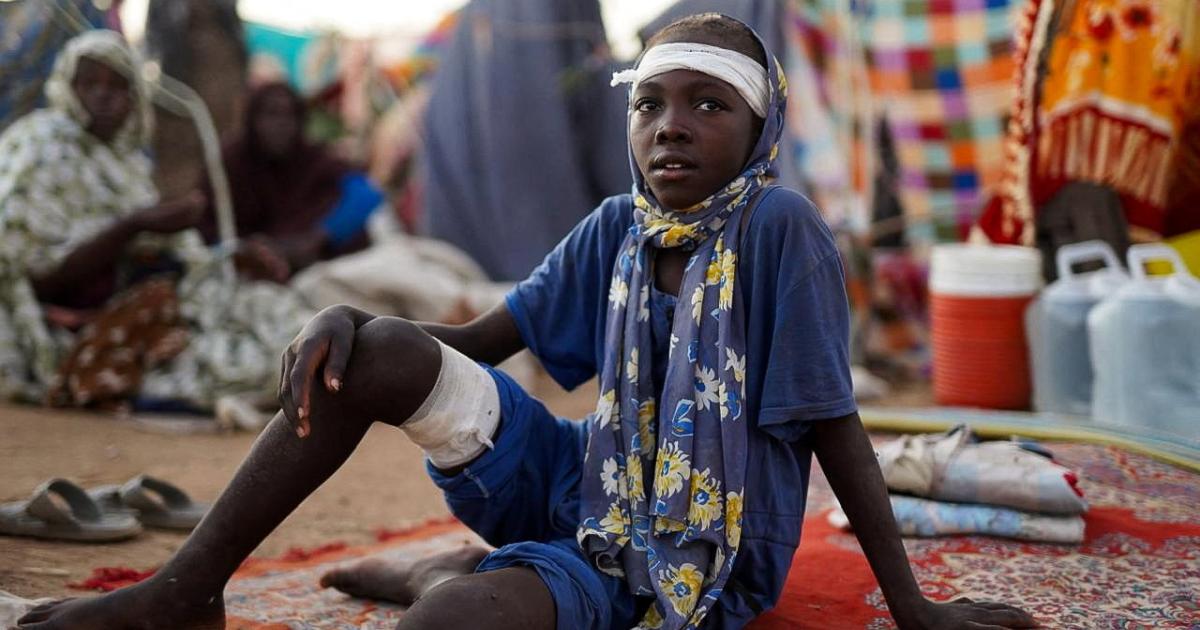
Survivors have made their way to Tawila, a once sleepy town 45 miles west of El Fasher, where aid agencies such as Doctors Without Borders and the International Rescue Committee provide small quantities of assistance, and some protection is afforded by a rebel group that has thus far managed to stay neutral. Every child reaching Tawila’s clinics is malnourished. This week, the Integrated Food Security Phase Classification’s Famine Review Committee (FRC)—the premier multinational body that assesses hunger worldwide—declared a famine in El Fasher and its environs.
The FRC had, in fact, already declared a famine in the area well over a year ago. And although the war’s atrocities have recently captured worldwide attention, the RSF has never tried to hide them—in fact, it has long openly advertised its intent to destroy entire groups, whether for punishment or to seize their land. The mass killing of civilians in El Fasher was foreseeable and foreseen; genocide has been underway in Sudan since well before October. Official recognitions that a genocide is happening or even International Criminal Court (ICC) charges and sanctions cannot stop it. Indeed, to some observers, the war has acquired a brutal sense of inevitability.
But escalation is not inevitable. U.S. Secretary of State Marco Rubio’s effort to secure a cease-fire in Sudan and the delivery of more humanitarian aid was tantalizingly close to success. In the aftermath of the shocking crimes in El Fasher, there is a chance that the Middle Eastern states that have backed Sudan’s warring parties may agree to fully adopt a peace template and force the factions they support into compliance. Such an outcome, however, would require a much bigger push from the White House. And that is a major ask of an administration often wary of becoming entangled in conflicts in which the United States has no clear, immediate interests. But the alternative is more civilians murdered, more children dying of hunger, and many more refugees fleeing a collapsing country.
PUSHING THE ENVELOPE
The principal practitioners of Sudan’s genocide, RSF fighters led by Mohamed Hamdan Dagalo (known as Hemedti), advertise their brutality on purpose. Since the RSF began fighting Sudan’s regular army, the Sudanese Armed Forces (SAF)—headed by Abdel Fattah al-Burhan—the conflict has destroyed much of Khartoum, Sudan’s capital; forced about a quarter of the country’s 45 million people from their homes; and created the world’s biggest humanitarian catastrophe. The RSF has intentionally sought to build a reputation for conspicuous atrocities, telegraphing its mercilessness through killing and raping and then circulating trophy videos among its network of social media influencers.
Over the course of 40 years of studying Sudan and working in the country, I have seen genocidal slaughter become a normalized strategy on the battlefield. In the 1980s, militia fighters and military intelligence officers dispatched to southern Sudan to put down rebellions massacred civilians and created widespread hunger. These fighters were told: do what you need to do and don’t report back. Slaughter and starvation unfolded in secret. Outside analysts had to rely on oral reports gathered by journalists and aid workers, most of them Sudanese.
As that civil war dragged on into the 1990s, organizations such as Human Rights Watch began to more systematically compile evidence of war crimes. Moved by harrowing stories of suffering in Sudan, including accounts of starvation and enslavement, a bipartisan coalition of American churches, charities, and human rights campaigners pressed the U.S. government to help end the war and punish the abusers.
President George W. Bush’s administration helped broker a peace deal in southern Sudan, but in 2003, a new rebellion erupted in the western province of Darfur; rebel leaders protested Khartoum’s neglect and opposed attacks by Arab militia units, including a clan led by Hemedti’s uncle. To beat back the rebels, President Omar al-Bashir licensed a local militia to wage a counterinsurgency on the cheap. Backed by regular army brigades and the air force, young men with rudimentary training—the Janjaweed—attacked villages suspected of harboring rebels. The criterion for their assaults was singular: if a community was the same ethnicity as a rebel leader, it was fair game. Because Janjaweed fighters often went without direct pay, they rewarded themselves with land, loot, and the bodies of women and girls. They murdered tens of thousands of civilians, and hundreds of thousands more perished of hunger and disease.
Foreign governments and multinational watchdogs used new technology to spotlight the abuses, mapping burned villages using satellite imagery. In 2004, U.S. State Department investigations prompted Secretary of State Colin Powell to declare that the Janjaweed had committed a genocide. A UN inquiry shortly afterward compiled irrefutable evidence of war crimes on a vast scale and pushed the Security Council to refer Darfur to the ICC. At the same time, a coalition of young American and European activists under the “Save Darfur” banner pressed for the protection of Sudanese civilians, the delivery of humanitarian aid, and justice for genocide victims. Bush stepped up humanitarian aid and backed the deployment of a joint UN-African Union peacekeeping force, the biggest in the world at that time. In 2008, then Senator Barack Obama made ending the genocide in Darfur a component of his presidential campaign.
GETTING AWAY WITH IT
But the trajectory of the Darfur conflict also taught Sudanese combatants that ultimately, even if their atrocities were aired worldwide, they wouldn’t be called to account. Just two months after the United States declared a genocide in Darfur and four months after the UN demanded that Bashir disarm the Janjaweed, African Union peacekeepers encountered Hemedti in a burned-out village. He made no secret of the fact that his forces had been responsible for the 126 bodies the peacekeepers found in the ashes, including 36 children.
Hemedti had no reason to worry about consequences. Khartoum had empowered the Janjaweed to do its dirty work and, by then, could not crack down on the thuggish group even if it wanted to. Bashir decided that his best bet was to formalize the Janjaweed into the RSF, immensely upgrading the militia’s status, in return—he hoped—for loyalty. Despite occasionally paying rhetorical lip service to accountability, the Sudanese authorities have never brought any Janjaweed commander to trial.
The ICC has done better—but only just. In October, the court found a Janjaweed commander, Ali Muhammad Ali Abd-al-Rahman (known as Kushayb), guilty of 27 counts of war crimes and crimes against humanity; the ICC will impose his sentence later this month. The trial was a model of due process, featuring a mountain of evidence painstakingly compiled and presented. But 20 years after the outbreak of genocide in Darfur, Kushayb is the only individual who has ever been brought to trial—and only because he surrendered to the ICC in 2020, worried that authorities in Khartoum might have something even worse in store for him.
History has taught many Sudanese fighters that they will not face consequences for genocide.
The ICC’s investigators are still at work in Darfur. They are particularly focused on a rampage committed by RSF fighters in mid-2023 against the Masalit, a non-Arab ethnic group that resides in western Sudan and Chad. The fighters killed between 10,000 and 15,000 people (including the governor of West Darfur state) and drove most survivors off their land. But so far, no charges have been brought against Hemedti, his lieutenants, or any of the commanders of the SAF, who themselves are responsible for many abuses in other theaters of war. One of the Biden administration’s last acts was to declare that the RSF was responsible for genocide, and in his early 2025 confirmation hearing, Rubio agreed with this determination. The United States has imposed financial and travel sanctions on Hemedti, but these have failed to have any discernible impact.
Over the course of decades, many Sudanese fighters have become so confident that they will face no real consequences for genocidal acts that they now advertise such practices to terrorize any who stand in their way. Impunity reigns. In videos recently circulated by RSF fighters, they have forced their victims—before they were killed—to crawl and make animal sounds while calling them dogs, donkeys, or slaves. As the RSF has pillaged residential neighborhoods in Khartoum and elsewhere, committing murder and sexual assault and vandalizing schools, hospitals, and government offices, its fighters have continued promoting their most gruesome deeds and telegraphing their intent. They have promised to avenge any attack by the government tenfold and to wipe out any communities that resist them. In its siege of El Fasher, the RSF blocked aid and trade and intercepted all who tried to flee, overrunning a nearby camp for displaced people in April and killing hundreds, including nine nurses.
WASHINGTON’S UNUSED WEAPON
It is little wonder, then, that Hemedti and his band of killers remain unbothered by calls for accountability from the United States, European governments, and the United Nations. In late October, Hemedti did arrest one commander who was notorious for flaunting his crimes. But terror is simply woven into Hemedti’s modus operandi. RSF forces have encircled the city of El Obeid, the SAF’s main garrison on the road to Khartoum, and overrun the nearby town of Bara, killing 50 civilians—including five Red Crescent humanitarian workers who were distributing aid. Because the SAF (and especially its Islamist brigades) is also responsible for grave abuses, many Sudanese worry that the SAF’s rage and fear will further escalate the catastrophe.
Determinations of genocide, investigative commissions, and sanctions are nowhere near enough to curb the killing—nor are most of the peacemaking efforts mustered thus far. Days after the war broke out in 2023, the United States and Saudi Arabia summoned the RSF and the SAF to Jeddah for cease-fire talks. The two sides dutifully signed a “Declaration of Commitment to Protect the Civilians of Sudan” but then ignored its promises entirely.
It soon became clear that both Burhan and Hemedti believed they could win, or at least gain a decisive battlefield advantage—and, moreover, that they could each marshal enough foreign sponsors to sustain their violent campaigns. The United Arab Emirates quickly became the war’s most significant foreign patron, putting its weight behind the RSF. Although Abu Dhabi consistently denies backing the RSF, the evidence is overwhelming that it has armed the militant group, including with sophisticated drones. A coalition of other Middle Eastern powers, meanwhile, led by Egypt and Qatar, Saudi Arabia, and Turkey, are arming the SAF—including its powerful Islamist brigades. The UAE and Saudi Arabia are rivals on the Arabian Peninsula, and UAE leaders were not going to accept Riyadh running peace talks without an equal say.
The UAE is unlikely to make serious concessions unless Trump wields direct pressure.
Although foreign backing has made it possible for Sudan’s generals to fight their war, that backing also creates leverage for ending it. The road to peace in Sudan runs through Abu Dhabi, Cairo, and Riyadh. The Biden administration knew this, but it failed to acknowledge that top-level leaders such as President Joe Biden himself or Secretary of State Antony Blinken would have to force these three capitals to set aside their differences long enough to impose a humanitarian truce. Instead, they placed responsibility for shepherding a peace process in the hands of the State Department’s Africa Bureau, which did not have the leverage to succeed.
Rubio grasped the formula that his predecessor had shunned by creating the “Quad”—a dialogue comprising the United States, Egypt, Saudi Arabia, and the UAE—and putting a special envoy close to President Donald Trump, Massad Boulos, in charge day to day. The Quad’s template is workable: it calls for a cease-fire, humanitarian access, and political talks towards the formation of a civilian government. But the Biden administration’s missed opportunities has made Rubio’s job tougher; the scale of the atrocities has hardened each faction’s determination to fight on. Earlier this year, the UAE was dragging its feet. But it was the SAF’s Islamist faction—which is backed by Qatar and Turkey—that sabotaged the Quad talks in Washington at the end of October. Burhan had agreed on the Quad’s template with his closest sponsor, Egypt. But unlike Hemedti, whose word is the RSF’s law, Burhan heads a fractious coalition, and the Islamists vetoed a deal at the last moment.
The day after the talks collapsed, the RSF launched a full-scale assault on El Fasher. If Abu Dhabi gave Hemedti the green light, however, it surely did not anticipate the wave of revulsion that would follow the RSF’s killings or the reputational damage that the UAE would suffer. Rubio’s formula remains the right one. The backers of the SAF’s Islamist faction, however—Qatar and Turkey—need to be brought into the room, as does Trump himself. It remains unlikely that the UAE will draw back its support for the RSF’s military campaign or that other foreign actors will make serious and necessary concessions unless Trump wields direct pressure. Rubio, Boulos, and their counterparts in Arab capitals and in Ankara can work out the details, but the theatrics of a true deal require the Oval Office as a stage.
Without quick action, the RSF and its drones will close in on Khartoum, and the SAF will almost certainly attempt a vengeful counterattack. However terrible the war and its consequent famine in Sudan is today, it can still get much worse.
Loading…
