

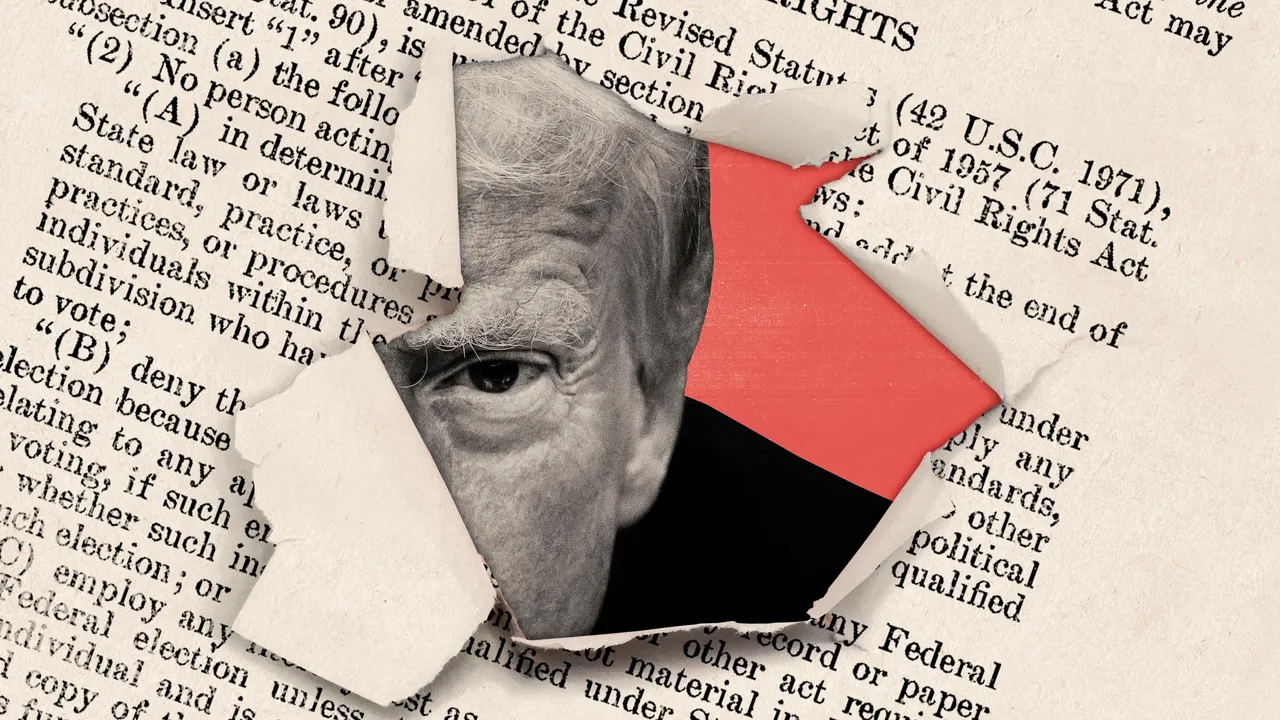
Sixty years ago, President Lyndon B. Johnson signed two pieces of legislation that are, to a remarkable degree, animating forces in the most volatile aspects of the current political moment. In August, 1965, Johnson signed the Voting Rights Act, a crowning achievement of the civil-rights movement which paved the way for the election of thousands of African Americans to political office in states where, previously, they were not even allowed to vote. Two months later, he signed the Immigration and Nationality Act of 1965, overturning the Immigration Act of 1924, which, by way of eugenics, had sought to curate an immigrant stock of white Europeans. Taken together, the laws democratized the idea of who could be an American, and also which Americans could freely exercise their rights at the ballot box. The Trump Administration and its Republican allies are now engaged in a concerted effort to return the United States to the landscape that preceded them.
The G.O.P. under Donald Trump, like many reactionary nationalist movements, is disproportionately concerned with demographics. Trump’s anti-immigrant crusade has reached a point where masked federal troops are snatching people from their homes—including an instantly infamous ice raid on Chicago’s South Side that involved a Black Hawk helicopter—their cars, their workplaces, courthouses, and public streets. Further demonstrating the nature of the President’s exclusionary vision, on Thursday the Administration announced that it will slash the number of refugees admitted to the U.S. next year to seventy-five hundred, with priority given to white Afrikaners. In addition, the Administration is insisting that universities accept fewer international students, recognizing that admission to such institutions is often the first step toward citizenship.
The President’s goals were made plain on the first day of his second term, when he issued an executive order defying the Fourteenth Amendment’s birthright-citizenship clause. The clause was written after the Civil War to affirm that emancipated native-born Black people were citizens, as was virtually anyone born in this country. But it has been targeted as a means of insuring that children born here without a parent who is either a citizen or a permanent resident are not automatically granted citizenship themselves. Courts blocked the executive order, so, in September, the Department of Justice asked the Supreme Court to take up the question of its legality. The attorneys general of twenty-four Republican-led states have urged the Court to act in Trump’s favor.
At the same time, the President’s desire to control which Americans’ votes will count has been manifested in the battle over congressional maps. The maps are typically revised every ten years, after the census. But three states—Texas, Missouri, and North Carolina—have redrawn their maps at Trump’s behest, creating potentially six more G.O.P.-held seats, and several others, including Louisiana, have taken steps to do the same. This is a transparent attempt to move the goalposts ahead of the 2026 midterms, when a three-seat shift would give Democrats control of the House of Representatives.
In response, at least five states with Democratic majorities are considering redrawing their maps. To counter Texas’s move, California put redistricting on its November ballot, which could give the Democrats five more seats, and voters appear set to approve the measure. In a perverse mirroring of a provision of the Voting Rights Act, the Justice Department is dispatching federal election monitors to some California districts.
But the potential impact of state efforts would likely pale in comparison with the one presented last month at the oral arguments in the Supreme Court case Louisiana v. Callais. In January, 2024, following court orders, Louisiana—which is allotted six seats in the House of Representatives, and where African Americans make up a third of the population—passed a map that created a second majority-Black district. In March, after a legal challenge, the state attorney general defended the map before the Supreme Court, asserting that it was consistent with Section 2 of the Voting Rights Act, which prohibits drawing districts in a way that minimizes minority voters’ ability to elect their candidates of choice. (Strategically drawn districts were key in preventing African Americans from gaining political power prior to the civil-rights movement.) But a group identifying itself as “non-African American voters” has claimed that the protections enshrined in Section 2 are themselves discriminatory, in that they offer Black voters an entitlement not offered to non-Black voters. And Louisiana has effectively switched sides, arguing that the map it defended just last year should now be struck down.
