

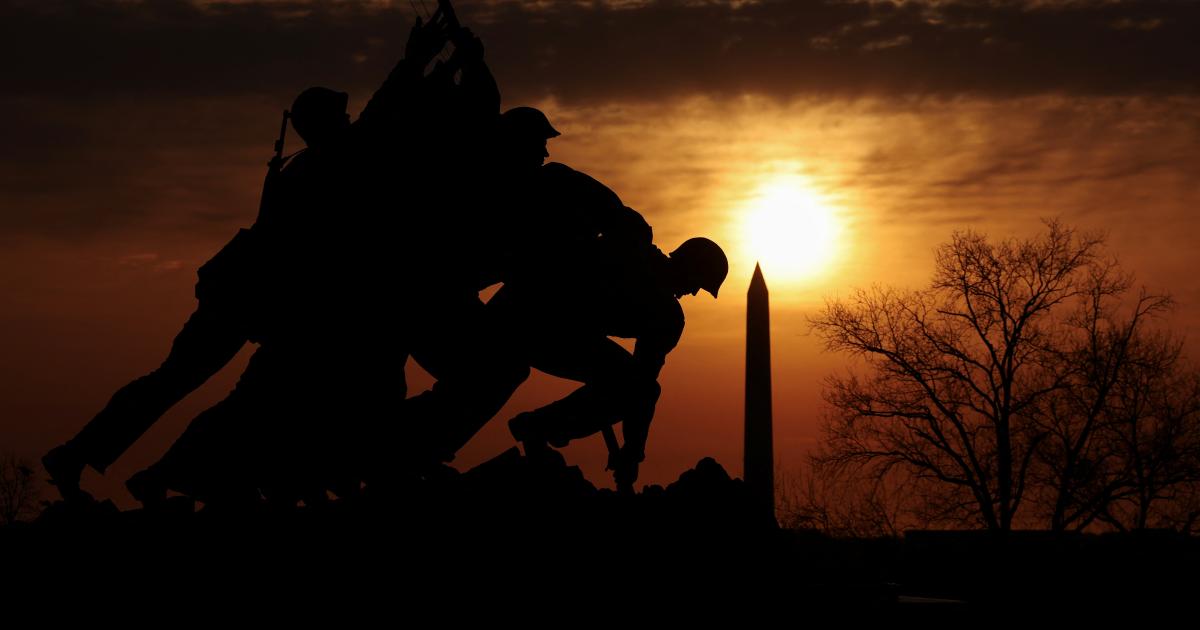
Since 1989, an estimated four million people have died as a result of armed conflicts around the globe—740,000 between 2021 and 2024 alone. A thorough understanding of these violent decades and of today’s persistent geopolitical volatility demands policy expertise, of course, but it also calls for a perspective beyond the realm of political science, which for all its rigor does not always account for certain human elements of war: desire for glory, thirst for vengeance, and other irrational passions that shape the belligerence of warriors and nations. In other words, the stuff of literature.
Nations weave myths out of victories and erase defeats with the promise of future triumphs. They tend to calibrate “bad” wars against “good” ones while memorializing the latter with a wistfulness that lures them into vainglorious and ultimately inglorious quests for new conflicts.
There are a few things to know about stories. First, humans have fed on them for millennia, from the Bible and the epic in ancient times to the nineteenth-century novel and the twenty-first-century Marvel franchise. Second, the hard-nosed realists and instrumentalists who are most contemptuous of the worth of stories, in particular of fictional ones, and wary of the enterprise of literary study are often the most gullible consumers of fables, swept away by the power of fictions yet ignorant of their limits, constraints, and capacity to delude. Third, the story has become many people’s primary way of understanding the world. As the literary theorist Peter Brooks argues in his 2022 book Seduced by Story, “Narrative seems to have become accepted as the only form of knowledge and speech that regulates human affairs.” In the process, Brooks observes, story has eclipsed rational argument as the dominant purveyor of social, political, and historical truths.
We operate in a world in which the teller of the best story triumphs over the one who reasons most clearly. The most successful stories attain the quality of myth, at which point, as Brooks writes, “their status as fictions . . . is forgotten and they are taken as real explanations of the world.” In the face of this “narrative takeover,” Brooks exhorts readers “to oppose critical and analytical intelligence to narratives that seduce us into the acceptance of dominant ideologies.” What listeners and readers need, he urges, is “to resist a passive narcosis of response.”
Given the ubiquity of stories and humanity’s vulnerability to them, citizens today would be wise to practice the skills of literary analysis, the very techniques routinely derided and devalued in a world committed to technology and tribalism. So many seem eager to be rid of the labors of thought and expression—the very labors that define them as free and autonomous human beings—by ceding them to generative artificial intelligence.
One way to think about the current state of the world is to imagine it occupying the intersection of story and war. The story has gained ascendancy as a vehicle for understanding the world while the ability to interpret narrative has atrophied. At the same time, the present era is an epoch in which wars go on seemingly forever—now simmering, now boiling—without end. In the absence of definitive ends and conclusive victories, we crave a good war story.
There is of course a strict sense in which fighting and storytelling are opposed: stories create, wars destroy. At crucial moments, however, one force surrenders to the other to produce an ambiguous collaboration. Writers have long boasted that the soldier is nothing without them: the poet and the novelist keep the soldier’s exploits alive for posterity. It is likewise axiomatic that the writer is nothing without the soldier: no war, no epic; no war, no war movie; no war, no War and Peace.
Anticipating and preparing for war leads quite naturally to accepting its inevitability.
Competing stories tempt people and nations into war. Once embroiled in conflict, participants and spectators layer on more stories to make sense of their relationship to its violent cauldron. The postwar period offers fertile ground for narratives about war’s origin, prosecution, and conclusion. Storytelling is an individual and a collective enterprise. Personal remembrance becomes interwoven with political fiction, historical fact, and mythological distortion in the flood of stories that customarily follows a war.
U.S. President Dwight Eisenhower introduced the concept of the “military-industrial complex” decades ago, in his 1961 farewell address. “In the councils of government, we must guard against the acquisition of unwarranted influence, whether sought or unsought, by the military-industrial complex,” he warned. “The potential for the disastrous rise of misplaced power exists and will persist.” One can debate whether the president was describing a new phenomenon or simply naming an old relationship between the public figures who authorize wars and the private actors who stand to profit from them. But he was also telling a story about how and why wars start: one that linked war-making with a pathological condition (a “complex”). This narrative was at odds with the supremely heroic story, which he helped to write, of World War II—the “good war” that made him famous.
More than six decades later, what has emerged is a military-narrational complex, in which war presents too good a story not to tell, over and over again. States, and now nonstate actors, have been engaging in wars of various kinds almost constantly since World War II. Each time, they seem to search for a story that yields the narrative satisfactions associated with that war: just causes, clear and powerful story lines of liberation and righteous vengeance, unambiguous heroes and villains, definitive ends. Yet not one of the sequels to World War II has measured up to the original tale.
PAGE TURNERS
Humans are always drafting and revising war stories, even when they aren’t actively fighting. Indeed, they routinely write themselves into and out of wars. Anticipating and preparing for war leads quite naturally to accepting its inevitability. The historian Odd Arne Westad offers an example of this dynamic in the British-German antagonism that precipitated World War I. “It wasn’t structural pressures, important as they were, that sparked World War I,” Westad argued in Foreign Affairs, in 2024. “War broke out thanks to the contingent decisions of individuals and a profound lack of imagination on both sides.” Westad also discerns a resemblance between this early-twentieth-century doom loop and the current attitudes toward U.S.-Chinese relations: “Any opening for cooperation, even on key issues, gets lost in mutual recriminations, petty irritations, and deepening strategic mistrust.”
This is the domain of grand tragedy. Potential adversaries interpret political action in zero-sum terms; see malice and evil design in mere blunders and coincidence; trumpet necessity rather than navigate choice; and, in extreme cases, invent pretext or promise profit to make more palatable a dubious cause. In The Mayor of Casterbridge, his 1886 novel about a man who attempts to outflank the great error of his past, the English writer Thomas Hardy offers an interpersonal version of the geopolitical misconstructions Westad articulates. Individuals tend to misunderstand each other’s motives, Hardy writes, because “we attribute to an enemy a power of consistent action which we never find in ourselves or in our friends.”
When it comes to violent conflict, the costs of this tendency are supremely high. With stunning celerity, possibility becomes probability and then certainty, as readers reject the quiet, circuitous, and unglamorous narratives of prudential compromise, ambiguous diplomacy, or incremental progress. The journalist and critic Carlos Lozada has called attention to the hawk’s “narrative advantage” over the dove. “It is unfair, but tales of war tend to be more exciting than stories of peace,” Lozada wrote in The New York Times in 2023. “Dire scenarios of risk and escalation are almost always more captivating than those dissenting voices that explain how to avoid a fight.” Hawks might whip up enthusiasm by waving a bloody shirt or recalling a stab in the back. Sometimes the case for war’s inevitability is couched in expressions of rue and reluctance. U.S. Air Force General Mike Minihan, now retired, followed that pattern when, as commander of Air Mobility Command, he began a 2023 memo on China: “I hope I am wrong” before revealing, “My gut tells me we will fight in 2025.”
War stories work because it is, quite simply, much easier to define oneself against an enemy than it is to look within. They win because can-do cultures, such as those within the military, require objectives and need to believe that victory is achievable. War stories have acquired even greater momentum since railroads and military staff colleges emerged in the late nineteenth century, when states committed themselves to the business of planning—a serious work that nevertheless entails playing war games and imagining scenarios. Preparing to meet a host of contingencies entails writing a series of scripts that predict the future.
It is much easier to define oneself against an enemy than it is to look within.
The British military historian John Keegan revealed the hazards of this kind of planning in his anatomy of the Schlieffen Plan, the German strategy for fighting a two-front continental war that was devised, in 1905, by the chief of the army’s general staff, Alfred von Schlieffen. Schlieffen grounded his plan in the “mathematical realities” of the late nineteenth and early twentieth centuries, but also, as Keegan notes, in “wishful thinking.” After all, Keegan continues, “plans do not determine outcomes.” Schlieffen’s fixation on the Carthaginian general Hannibal’s masterful envelopment of the Romans at Cannae, combined with a desire to reproduce the German victories of the Franco-Prussian War, distorted his math: “The dream was of a whirlwind,” Keegan observes; “the calculations warned of a dying thunderstorm.” The German army’s general staff largely ignored the frank acknowledgment, buried deep in the plan, that the Germans were “too weak” to bring it to fruition. In the end, Keegan writes, when Kaiser Wilhelm II “might have put brakes to the exorable progression of the Schlieffen Plan, he found he did not understand the machinery he was supposed to control, panicked and let a piece of paper determine events.” Once written, the script’s fantastic promise distracted its readers from the fatal holes in its plot.
As soon as a battle or a war has been fought, victors and losers alike begin to tell different stories. Official stories have a deliberate, not necessarily sinister, design. The rise of the PowerPoint “storyboard” in the U.S. military during the global “war on terror,” for example, helped ensure that every engagement would be recorded a particular way. One need only search the web for a “U.S. Army storyboard template” to see how institutionalized narratives can homogenize experience by molding episodes into a particular form or genre until all content starts to look and sound alike.
It is a truism that history is written by the winners, yet it is often the losers who tell the better story—an “if only” myth that has endless permutations: If only the bad weather had held off. If only the radio hadn’t malfunctioned. If only the colonel hadn’t been sick. If only the general hadn’t been quite so ambitious. If only our hands hadn’t been tied. If only we had the resources of our enemy, or the requisite political will. At war’s end, the narrative that develops valorizes physical courage, glorifies battlefield heroics, and vilifies hubris. It distorts the relationship between war and politics while also devaluing two decidedly unromantic virtues that can prevent war—prudence and restraint—and ignoring the role of chance and disorder. The Confederate “lost cause” narrative that developed in the wake of the American Civil War, which romanticized the antebellum Southern way of life and turned the conflict into chivalric tragedy, offers a case in point. So, too, does the obsession, during the Reagan and first Bush administrations, with winning a war (even a cold one) in order to “kick” the Vietnam syndrome that had seemingly eclipsed the victorious story of World War II.
ORIGIN STORY
Numerous works of literature illuminate the stakes of weaving and consuming war stories, but for many people, there is no more definitive beginning than the Trojan War—the founding war story of Western literature and, for some, the original conflict between East and West (in this case, Greece and Asia). The version of events found primarily in the Iliad and the Odyssey, the Homeric epics that narrate the war and its aftermath, respectively, serves as a template for how many people continue to imagine war, honor, heroism, and a whole set of related issues to this day. This story retains a hold on people to a degree that most are likely scarcely aware of. It is the ultimate hawk’s tale.
Those who have read Homer’s Iliad—even those who haven’t—think they know the story of the Trojan War. In a nutshell, the Trojan prince Paris sails to Sparta to capture Helen, the beautiful wife of the king of Sparta, Menelaus. Recruiting a coalition of Greeks to get Helen back from Troy, Menelaus and his brother lead a war that lasts ten years. The Iliad tells the story of the Greeks’ greatest warrior, Achilles, who sulks in his tent for most of the poem before rejoining the fight and turning the tide. The epic ends with the death of Troy’s champion, Hector, but the war carries on.
As various ancient sources recount, after Achilles is killed by Paris, the Greeks resort to deception. Odysseus, the Ithacan warrior who is as celebrated for craftiness as Achilles is for brute strength, devises a clever ruse in which the Greeks place a giant wooden horse outside Troy’s walls and pretend to sail away. After the duped Trojans wheel the horse inside their impregnable fortress, the warriors hiding within spearhead the attack. The Greeks raze the city, slaughter many of its inhabitants, and enslave those who survive. Helen returns with Menelaus to Sparta. In the Odyssey, Homer depicts Helen and Menelaus’s reunion as uneasy and sometimes tearful, after years of estrangement. While entertaining in their palace, Helen drugs the wine—the poet calls it “magic to make us all forget our pains”—so that for one evening at least, no one will cry for a world ruined by war.
Loving Achilles is an Achilles’ heel.
But there is also a radically different, comparatively dovish version of the story. According to the Greek historian Herodotus, who composed his glorious amalgamation of legend and fact in the fourth-century BC, Helen never even reached Troy because Paris’s ship was blown off course. Instead, the pair landed in Egypt, where a local king named Proteus reprimanded Paris for being such an ungrateful guest and sent him packing while holding both Helen and the stolen treasure in trust for Menelaus. Herodotus reasoned that had Helen in fact been within the walls of Troy instead of in Egypt, the Trojans would surely have surrendered her to the Greeks rather than allow their city to be destroyed. Herodotus recruits evidence from passages in the Iliad and the Odyssey to show that Homer himself knew at least fragments of this tale yet opted to tell another, better yarn.
The values Homer elevated, especially those of male honor and female duplicity, established parameters for the war story (and not only the war story) for centuries to come. But in the less-known version, the Greeks have no legitimate reason to fight at Troy, while the Trojans try to repel irrational aggressors who do not realize, do not care, or simply refuse to believe that Helen isn’t living with Paris behind Troy’s walls. In the words of one critic, Herodotus effectively calls into doubt “the whole concept of the causation of the war itself.”
Other Greek writers further embellished the tale. In the Athenian Euripides’s play Helen, for example, Menelaus discovers that he has retrieved a phantom rather than the real Helen only after sailing away from a sacked Troy. When he then encounters the genuine Helen in Egypt, the revelation that he has spent a violent decade hunting a shadow—a simulacrum of a cause—does nothing to alter his attitude toward his expedition to Troy, which remains heroic in his eyes. Indeed, the preservation of the honor and glory he won at Troy remains Menelaus’s favorite subject throughout the play. His victory loses none of its luster by being severed from its ostensible cause: prowess in battle proves a satisfying end unto itself.
Euripides’s play unsettles assumed truths of martial heroism and battlefield glory by contrasting “the hellish world of Troy,” as the classicist Charles Segal describes it, with a fantastic “Egyptian never-never land” from which Helen and Menelaus escape to return home to Sparta. The play’s deep ambivalence to war and conventional heroism certainly owes something to its historical moment. It was performed in 412 BC, in the wake of the Athenians’ catastrophic expedition in Sicily, an ill-conceived and poorly executed invasion that showed Athens the true cost of arrogant martial ambition and from which the city did not recover.
THE ROAD NOT TAKEN
All this would have little bearing on war today were it not the case that real-life warriors have, for millennia, found inspiration in the hawkish Homeric version of events, and not the dovish alternative. Soldiers, whether they believe it to be fact or legend, have held up Homer’s world as an ideal against which to measure their own behavior. The figure of Achilles, a warrior who singlehandedly choked a river with dead enemies before taking on the river god himself, provided a model for Alexander the Great and persists in contemporary popular entertainment, political speech, and military culture in celebrations of shock and awe. The ideal of the Achillean warrior lives on as a touchstone for anyone attempting to understand or reinvent military culture. The better story won a long time ago and froze into a myth with present-day repercussions. Loving Achilles is an Achilles’ heel.
The alternative story of Helen’s Egyptian detour invites a more critical examination of the relationship between war and story by highlighting the degree to which humans have been conditioned by a narrative that presents war as the ultimate stage for personal and national glory. That old story survived the reevaluation of war that took place during the Enlightenment; the transformation of the modern battlefield by mass mobilization and factory-scale killing in the twentieth century; and now, the separation between killer and target facilitated by technology.
What then does this mean for the practitioner, the policymaker, and the prognosticator, and for all those who produce, participate in, or hungrily consume war stories? Peter Brooks proposes that novelists “have recognized that life needs to be shaped and understood through narrative. But they have also understood the limits to the order that fiction can impose on life.” Novelists—those modern counterparts to the epic poets—have something to teach all those constituencies. Narrative has a seemingly relentless, ungovernable momentum, but humans retain a control over war stories that does not extend to war itself. War is a realm of chance, accident, and volatility over which its participants can only ever hope to work a small measure of influence, as Leo Tolstoy’s War and Peace reminds us. The prudent way forward ought then to be to read today’s many swirling war stories with greater acuity—or even to learn how to write an altogether different story. The Council on Foreign Relations currently tracks almost 30 conflict zones around the world, including both internecine and international struggles. Meanwhile, someone is surely already working on the story of the next war. Savvy readers might recognize that the story of that brewing war is just that, a story—and not yet an inevitability.
Loading…
